Now What?

Surprise History Quiz

Okay, books away, grab a pen (actually, keyboard) and answer this question, What is the worst Holocaust in recorded history? Answer at the end of this column, but you’ll see it, or should, long before that. Okay, go.

The Latest Trumpian Idiocy: Trump administration erases Native American, slavery history from U.S. national parks

https://english.news.cn/northamerica/20260201/477bfd64d4094e3480863616cd371ed2/c.html

To the victor goes the spoils and the opportunity to write the history. This administration is on a mission to whitewash any inkling of historical facts that place the United States in a bad light.

Slavery was uncompensated skills training and religious reorientation from heathenism with room and board.

The Trail of Tears was an all-expenses-paid government relocation program offering free land and the opportunity to live in other parts of the United States. And, when the discovery of oil, uranium, and other minerals spoiled the landscape, they were moved without cost again, and again, and again.

The European conquest of the Americas was a free offering of advanced technology to backwards people.

Somehow, Mr. Trump believes that removing references to historical facts will change reality. The saddest part of this is that he may not have to. Much of the history of slavery and the treatment of Indigenous peoples by Europeans, and by Americans after the establishment of the country, is glossed over in most classrooms.

This is how people fail to learn from history.

The Answer to the Quiz

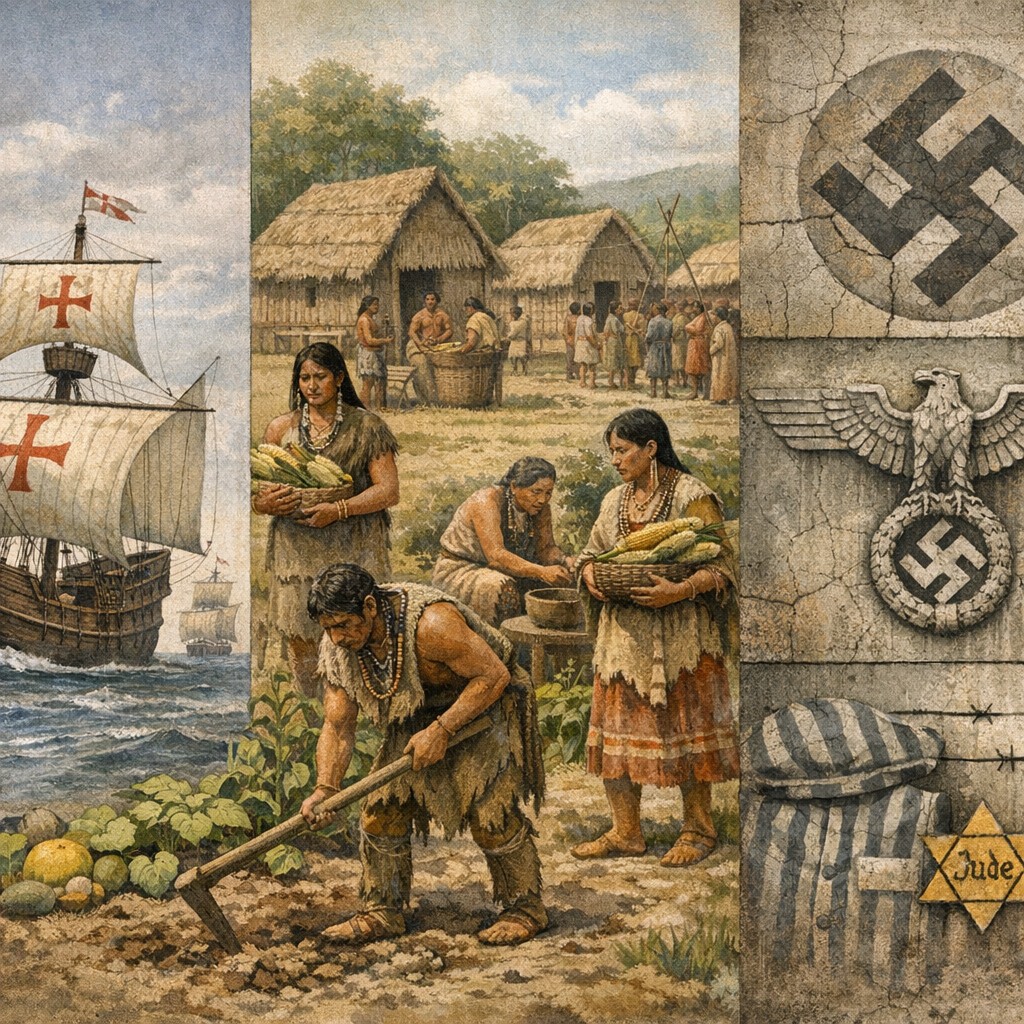
The decimation of indigenous people as a result of the arrival of Europeans to the Americas after 1492 dwarfs the deaths of the Holocaust of Nazi Germany.

While there are differences—timeframe, historical context, methodology—they all stem from the same ignorance-based prejudice against one group by another.

The genocide of Indigenous peoples in North, Central, and South America and the Holocaust of Nazi Germany were both driven by dehumanizing racial ideologies and caused immense loss of life. Still, they differed markedly in form and context. Indigenous populations in the Americas were devastated over centuries through a combination of introduced diseases, forced labor, land dispossession, cultural destruction, and recurring episodes of mass violence linked to European colonization, with responsibility spread across multiple empires and states. The Holocaust occurred over a short, defined period (1933–1945). It was a centrally planned, state-run genocide, using industrialized methods such as ghettos, deportations, and extermination camps to systematically murder Jews and other targeted groups. While both cases reflect the lethal consequences of racism and exclusion, they differ in duration, organization, methods, and contemporary documentation and postwar accountability.

It is vitally important to understand both the outcomes of these historical events and how they occurred.

Perhaps the sheer numbers may make it harder to ignore.

Nazi Holocaust

The accepted number for people killed by the Holocaust and Hitler’s final solution is 11 million. 6 million Jews, and 5 million Roma (Gypsies), disabled individuals, Polish and Soviet civilians, prisoners of war, homosexuals, and political opponents.

Slavery

When combining deaths before transport, during the Middle Passage, and under enslavement, historians often cite a total death toll of roughly 10–15 million people attributable to slavery in the Americas, with some broader estimates reaching higher when including wider African demographic losses tied to the system.

Post-Columbian Deaths of Indigenous Peoples

Most scholars today estimate that between 50 and 60 million Indigenous people lived in the Americas in 1492, and that by 1600–1650, roughly 85–90% had died as a result of European arrival. This implies about 45–55 million deaths across North, Central, and South America.

These deaths resulted primarily from introduced Old World diseases (such as smallpox, measles (wait, measles kill people?), and influenza), compounded by warfare, enslavement, forced labor, famine, displacement, and social collapse under colonial rule. While earlier estimates varied widely—from as low as 10 million to over 100 million—modern syntheses of archaeological, ecological, and documentary evidence have converged on the ~50–60 million precontact population and ~45–55 million deaths as the most defensible range.

The most dangerous killer of humans is prejudice.

Removing a few signs may eliminate obvious reminders of this tragedy, but it will not erase the reality. The United States learns from its mistakes. There are exceptions —the last Presidential election being the most glaring—but generally, we benefit from an open and frank analysis of our decisions and actions. It is what differentiates us from many other nations.

This folly of revising history isn’t new—The Civil War is known in the South as The War of Northern Aggression—but it is dangerous.

We have a friend from Germany, and we often talked about how a country as advanced, progressive, and educated as Germany descended into the horrors of Nazism. While there is no one answer, fear is a significant factor. And fear is almost exclusively a result of a lack of understanding and empathy.

I hope that, as we approach the mid-term elections and, more critically, the next Presidential election, we return to a nation that embraces empathy and intelligence over fear and ignorance.

And perhaps Columbus Day isn’t such a good idea after all.

Excerpt from A Miracle at Dachau by Laurin Haupt

“What hurts the victim most is not the cruelty of the oppressor, but the silence of the bystanders”

Elie wiesel, holocaust Survivor, author of “night”

An little known aspect of Nazi German was the efforts of ordinary German citizens who became extraordinary heroes fighting against Hitler’s Third Reich. This is one of their stories.

Introduction

Simon Johann Haupt spent almost a year as a political prisoner in Dachau Concentration Camp in Bavaria, Germany.
One of the first of many Germans to rise up against the Nazis, he would suffer grave consequences for his opposition. Sentenced to indefinite detention in Dachau—denied the hope of a release date—he faced certain death in the brutal world of the camp.
Although he considered himself French by birth, Simon was a German citizen. The change in his adopted country under the Nazis shocked his conscience. This same conscience would compel him to acts of enormous bravery and great personal risk. One selfless act by Simon Johann Haupt set in motion a series of events that would lead to his freedom
The world knows of the atrocities inflicted on the Jews, Gypsies, handicapped, and homosexuals by the Nazis. What many never knew was the suffering and torment of thousands of ordinary German people. Germans who resisted the Nazis at considerable personal risk through open acts of defiance or secretly aiding those doomed by the “Final Solution.”
This is a story about one of those ordinary people.
Simon Johann Haupt was a remarkable man who loved his family, his friends, and his homeland. A man who fought for the liberty of his country and countrymen, enduring great suffering, moral tribulation, and degradation to survive an era of tyranny and hopelessness. He suffered great hardships fighting against the relentless and brutal forces of the Nazi regime.
He bore arms against evil in its most insidious form, never losing faith or hope or yielding to despair. While souls were being lost to Nazi tyranny, while surrounded by the wanton destruction of human life and spirit, he persevered. Simon Johann Haupt would be the champion of the helpless and stand fearless in his convictions and moral creed.
He never surrendered to the darkness; becoming a hero who continued in his pursuit of righteousness for the sake of humanity.
Through an unbreakable bond of brotherhood, he survived by a real miracle. The undying love of friendship, forged by a selfless act, offered him a way out. When the only thing a man had left was his faith, Simon Johann Haupt held tight to his conscience and lived to tell the world the truth of the years of Nazi terror.

September 1972: Laurin’s Story

By the time I arrived in Bavaria, Germany, after my high school graduation, two years had passed since I’d seen my grandparents, Oma and Opa.
I am filled with both happiness and excitement as I get into the taxi that will take me to their house. The drive brought back fond memories. Every kilometer, every turn in the road, every landmark took me back to my carefree childhood.
A passing train toots its whistle as it moves down the track parallel to the road. I remember the train rides to the city with my Opa when I was a young girl. I daydream of eating ice cream while listening to him tell his favorite stories as the train chugged along.
The day trips to the city with my Opa were memorable in their own way.
As the taxi pulls in front of the old rock house, I can see the half-opened window calmly blowing the sheer lace curtain. In the kitchen, I see my Opa and Oma peering out.
Opa hurries outside to greet me with a hollow, toothless smile. His excitement is contagious. Hugging me to him, holding me tight in his arms, then releasing me, he takes my suitcase inside.
Oma is standing in the open doorway with warm, wet eyes and a joyous smile. It feels as though I had never left them. The reunion is tearful, yet happy, and the joy melts away the years we’ve been apart.
Oma set the kitchen table with a coffeepot and her white gold-rimmed saucers on a bright red tablecloth. Centered are fresh homemade Danish made from the berries from their garden.
We talk about my mother and how much they miss her. I tell them of my plans for college, filling in the gaps of the two years since I’ve seen them. Surrounded by the familiar sights and sounds of the fourteen years I lived here before moving to the US, I feel at home.
My Opa and I would take our train ride to Augsburg in the morning, and I can’t wait. Childlike, all I can think about is our favorite place to get ice cream.
This train ride to Augsburg would be like no other, and the story I will hear would forever imprint on my heart and spirit. It would be an incredible emotional experience.
I will never forget.
My Opa, Simon Johann Haupt, was an ordinary man with an extraordinary true-life story. His was a story about war, the Holocaust, and courage more intriguing than any I have ever heard or could imagine.
My Opa would reveal his own human story, one I never suspected. Here was a man I have loved and admired my entire life yet had no inkling of his past. Little did I know he was a man of great courage, worthy of admiration and respect.

His is a story worth the telling…and one we should Never Forget

Pre-order in Kindle here https://www.amazon.com/Miracle-at-Dachau-Laurin-Haupt-ebook/dp/B08C4LQ4DJ. Print book available August 26, 2020 on Amazon, Barnes & Noble, or wherever books are sold.

For more information about the book or the author contact JEBWizard Publishing at info@jebwizardpublishing.com.

______________________________________________________________________________

JEBWizard Publishing (www.jebwizardpublishing.com) is a hybrid publishing company focusing on new and emerging authors. We offer a full range of customized publishing services.

Everyone has a story to tell, let us help you share it with the world. We turn publishing dreams into a reality. For more information and manuscript submission guidelines contact us at info@jebwizardpublishing.com or 401-533-3988.

Signup here for our mailing list for information on all upcoming releases, book signings, and media appearances.

Echoing History: The Trump Way

“…Whoever disturbs this mission is the enemy of the people, whether he pursues his aim as a Bolshevist democrat, a revolutionary terrorist, or a reactionary dreamer. In such a time of necessity those who act in the name of God are not those who, citing Bible quotations, wander idly about the country and spend the day partly doing nothing and partly criticizing the work of others; but those whose prayers take the highest form of uniting man with his God, that is, the form of work…”

“The value of every wage and salary corresponds to the volume of goods produced as a result of the work performed. This is a very unpopular doctrine in a time resounding with cries such as “higher wages and less work…”

It would seem Donald Trump has the facts of history on his side. These words reflect his philosophy and policies he embraces. The tenor is similar, the ideas consistent, the intent clear. Trump, like the original speaker of these words, promises to make his country great again.

The only question remaining is, like Germany when Adolf Hitler spoke these words, will we blindly plunge this country down the same path in pursuit of a false dream.