Geek Joke: A photon checks into a hotel. The clerk says, “Do you have any luggage?” The photon answers, “ No, I am traveling light.”

Supermassive Black hole in M87 (Andromeda Galaxy)
While I have always been fascinated by the objects in the universe, I have only recently had the time and technology to delve into astrophotography. This naturally leads me to think about the unimaginably massive size of the known universe.
Two trillion GALAXIES, each with BILLIONS of stars. This image was taken by the Hubble telescope, covering a tiny fraction of the night sky. Almost every object in this image is a galaxy!

Our universe is enormous and expanding.
I won’t bore you with theories of multiverses, string theory, and assorted other cosmological concepts, one either likes to read about that or you don’t, but I do want to offer things for your consideration.
The image at the beginning of this piece is the first black hole we’ve been able to photograph. I didn’t take this, but if somebody wants to give me several billion dollars to buy such a telescope I would accept it.
This particular image isn’t the actual first, but it is the first to show the power of a black hole. This black hole sits in the center of M87, the Andromeda Galaxy, some 55 million light years away from us.
The spiral effect is the first evidence of the black hole devouring anything captured by its gravity. Even light cannot escape the event horizon. Nothing that enters a black hole ever leaves. We have our own supermassive black hole in the center of our MIlky Way called Sagittarius A * (pronounced Sagittarius A Star.) The latest theory is almost every spiral galaxy has a supermassive black hole residing in the center.
Another interesting thought. What you are looking at is likely to be the very thing that destroys our own galaxy.
We are looking at our killer.
The Milky Way and Andromeda have collided in the past and will again in the future. Not next year or next century, more on the order of several billion years from now, but it will collide. The good news is by that time Earth will have already ceased to exist, engulfed by the expanding red giant star our own star will morph into as its nuclear fuel is depleted.
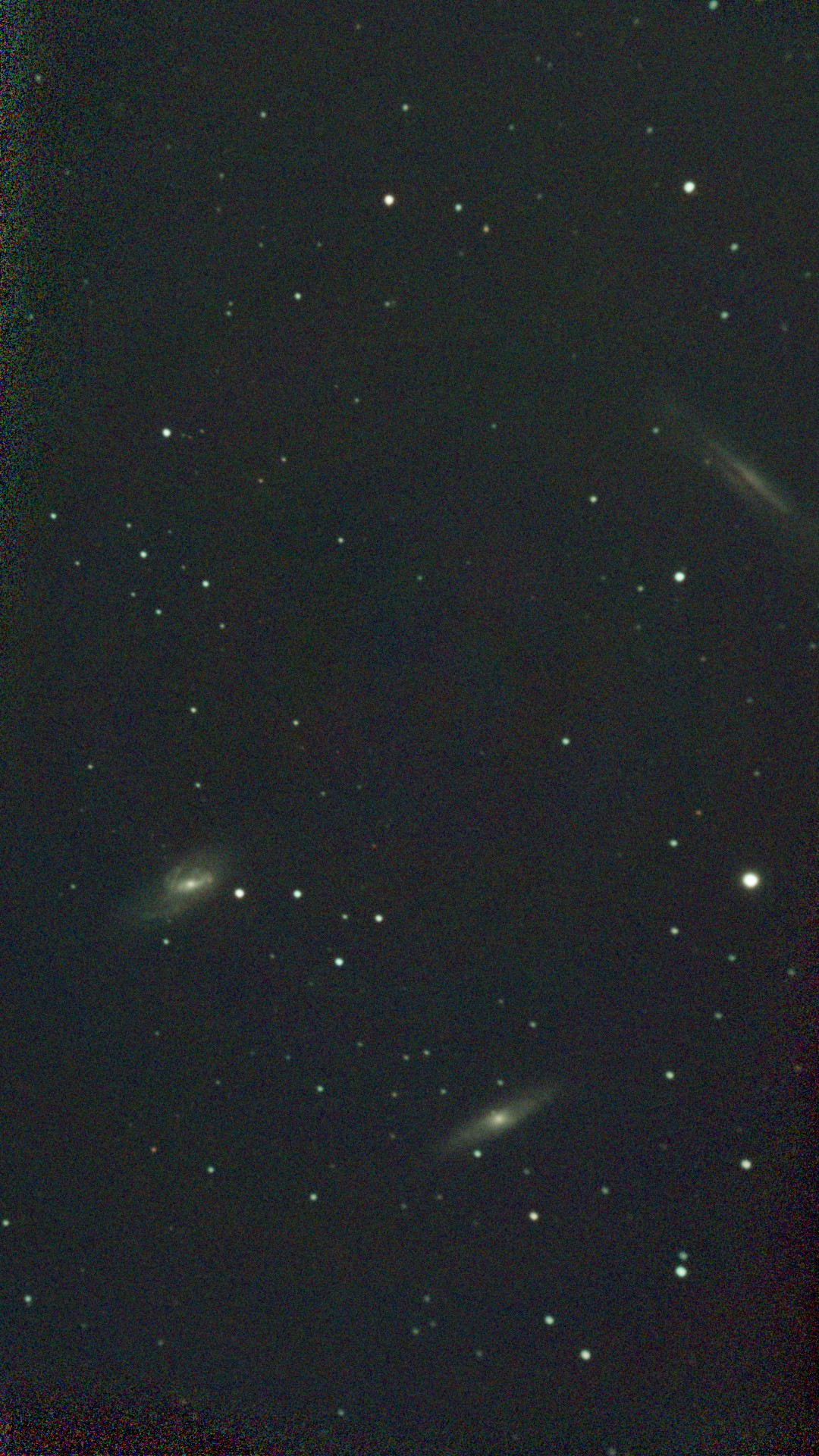
This image is of the Leo Triplets, which I took with my humble equipment. It is also known as the M66 Group. It consists of three small galaxies, M66, M65, and NGC 3628, about 35 million light years away.
These wonders are right over our heads every moment of every day and are a joy to behold. I heartily recommend it.
One last mind-bending thought. The common concept is that one is looking into the past when looking at the stars. And that some of the stars you are seeing may no longer exist, but the light when they did exist is just reaching us. This is sort of true only because of how we are observing it.
But to the photon that left the star, from our perspective millions of years ago, they just left it and arrived here at the exact same moment. At the speed of light, time stops relative to other observers.
Mind boggling.
As one approaches the speed of light, time slows. If one could travel at 99.99% of the speed of light to Alpha Centauri, our closest star neighbor at 4.2 light years away, it would take the spaceship a little over 4 years, but on Earth, 939 years would pass. Try it yourself. Here’s a link to a Time Dilation calculator. (https://www.emc2-explained.info/Dilation-Calc/)
Don’t believe time is different for different observers or different objects? If you have a cell phone or a car equipped with GPS, you have evidence right before you. The GPS satellites in medium-earth orbit have internal clocks. Time on these satellites passes differently than time on Earth. Adjustments are made to account for these differences in order for the GPS system to work.
Time is relative.
The reality is that it is unlikely we will ever exceed the speed of light. We may approach it, perhaps, but never exceed it, which locks “Ahead Warp 8, Mr. Sulu” forever in the realm of fiction. And given the effect of time dilation, what would a space traveler return to if, during their eight-year round trip to Alpha Centauri, almost two thousand years passed by on Earth?
But to look up at the stars and wonder is about as close to experiencing magic as we can here on earth. Could some advanced civilization have found a way to exceed the speed of light? Of course. Given what we know of the absolute universality of the laws of physics, is it likely? Probably not.

Is it likely aliens have visited us, dissected some cows, experimented on humans, and created crop circles? No. Any civilization capable of such technology would hardly resort to such activities. We may never greet an extraterrestrial being. Never say “live long and prosper” to a Vulcan, or contact another star-travelling vessel on a hailing frequency, but so what?
That shouldn’t stop you from finding a place away from the light of your daily life and taking a moment to gaze at the magisterial beauty of the cosmos.
 The Writing of Joe Broadmeadow
Joe, love the awe and wonder in your galacticc posts. Have you read ‘The Universe is a Green Dragon’ ? Written by Brian Swimme. Came out 35 years ago but still stands up. He’s a scientist in th Cal University system and not too woo woo….I think you’d find it of interest. Joe, be well and prosper.
LikeLike