How Many Dead Americans?

“War does not determine who is right, only who is left.” – Bertrand Russell

Since we seem to be stumbling toward regime change in Iran, something Mr. Trump was very clear about opposing as a presidential candidate (and likely, at least partially motivated by taking Epstein off the headlines), it might do well to remind people of the potential US casualties we will endure.

Sometimes war may be inevitable, but it is never necessary.
“In war, there are no unwounded soldiers.” – José Narosky” and the horrors of war are not confined to the battlefield.

So how many dead Americans are we likely to see?

There is no single, authoritative public number for “realistic American casualties” in an all‑out U.S.–Iran war. Most credible assessments treat casualties as highly scenario‑dependent—driven by how long the war lasts, whether it stays mostly air/naval or becomes a ground fight, how effectively Iran’s missiles and proxies hit U.S. forces, and how well U.S. bases/ships are defended and dispersed.

What we can say realistically, based on what’s publicly documented about prior Iranian strikes and Iran’s strike capacity, is:

  • Limited, short, mostly standoff fight (days–weeks) could plausibly mean dozens to low hundreds of U.S. casualties if escalation stays managed and defenses hold.
  • Regional, sustained fight (weeks–months) in which Iran and its partners repeatedly strike U.S. bases/ships could plausibly mean hundreds to several thousand U.S. casualties.
  • A major ground war/occupation (least likely, but “all‑out” could imply it) is the kind of scenario that can push casualties into the many thousands to tens of thousands over time.

Those ranges are order‑of‑magnitude illustrations, not “the” forecast—because the publicly available sources rarely publish a single consolidated U.S.-casualty estimate.


What public evidence does tell us about likely casualty dynamics

1) Iran has shown it can strike U.S. bases—but outcomes vary sharply with warning/defense

Two modern data points show how widely casualties can swing depending on warning, dispersal, and base defenses:

  • In January 2020, senior U.S. military leadership emphasized that defensive measures and preparedness prevented loss of life during Iran’s ballistic missile attack on bases in Iraq, describing sirens, bunkers/barriers, and defensive procedures as critical in avoiding deaths at the time. [war.gov]
  • In June 2025, a UK parliamentary research briefing notes that Iran launched missiles at a U.S. base in Qatar in retaliation for U.S. strikes, and “there were no reported American casualties.” Contemporary reporting similarly described no reported deaths or injuries following the missile attack on Al Udeid Air Base. [commonslib…liament.uk] [cnbc.com], [military.com]

Why this matters: these episodes demonstrate a key point for any “realistic casualties” estimate: even sizable missile attacks can produce low immediate casualties if telegraphed and well-defended—but that does not guarantee low casualties in an “all‑out” war where surprise, volume, and multi‑axis attacks could be greater.

2) Iran’s missile inventory and ability to fire salvos is the biggest direct driver of U.S. casualties

A major “all‑out” scenario is less about U.S. troops meeting Iran’s army head‑on, and more about Iran attempting to inflict costs via missiles/drones on fixed sites and regional infrastructure.

A current reference on Iran’s missile forces notes that Iran’s arsenal has been described as very large, citing a past CENTCOM statement that Iran possessed “over 3,000” ballistic missiles (as of that cited timeframe) and describing ongoing efforts to rebuild stocks after exchanges. [iranwatch.org]

Implication for casualties: more missiles + more launches + lower intercept success = higher U.S. casualties, especially at concentrated bases. Conversely, dispersal, hardened shelters, and layered missile defense strongly reduce casualties.

3) “All‑out” likely means proxies and terrorism risk as well—not just missiles

RAND commentary after U.S. strikes on Iranian nuclear sites underscores that Iran has multiple response options, including mobilizing proxies and potentially attempting terrorist actions (and that how Iran responds remains uncertain). [rand.org]

Implication for casualties: proxies expand the battlefield (Iraq/Syria, Gulf, Red Sea, etc.), adding risk of:

  • rocket/drone attacks on smaller U.S. outposts,
  • attacks on logistics nodes and regional partners,
  • maritime incidents (mines/anti-ship missiles),
  • and potentially attacks outside the immediate theater.

A practical way to think about “realistic casualties”: 3 scenario bands

Below are scenario bands that analysts commonly use when thinking about U.S. exposure. I’m labeling these clearly as scenario logic, not a sourced “official estimate.”

Scenario A — “Short, mostly standoff” (days to a few weeks)

What it looks like: U.S. air/naval strikes; Iran retaliates, but in a constrained way; heavy base hardening, dispersal, and missile defense limit hits.
Casualties: plausibly dozens to low hundreds (killed + wounded).
Why: the 2020 and 2025 episodes show that when attacks are anticipated and defenses work, casualties can be limited. [war.gov], [commonslib…liament.uk], [military.com]

Scenario B — “Regional campaign” (weeks to months)

What it looks like: repeated Iranian missile/drone salvos + proxy attacks across multiple countries and maritime routes; U.S. responds over an extended period; some attacks get through.
Casualties: plausibly hundreds to several thousand.
Why: duration + repeated exposure creates more “rolls of the dice,” and even high interception rates still allow occasional damaging hits—especially if Iran prioritizes saturation, mixed missiles/drones, and timing against defenses (this is general operational logic; public sources typically don’t publish a single number).

Scenario C — “Truly all‑out, including major ground operations” (months to years)

What it looks like: large U.S. ground presence, extended combat operations, occupation/security missions, insurgency conditions, plus ongoing missile/proxy threats.
Casualties: can rise into many thousands to tens of thousands over time.
Why: historically, the wars with the highest U.S. casualty totals are the long, manpower‑intensive ones; CRS maintains comprehensive U.S. war casualty statistics across major conflicts, illustrating how sustained ground wars accumulate far more casualties than short standoff operations. [congress.gov]


Below is a direct, apples‑to‑apples comparison between your 30‑day Iran‑war estimates and what actually happened in the first ~30 days of the 2003 Iraq invasion (Operation Iraqi Freedom), using official U.S. casualty data where available.


1. What happened in Iraq, March–April 2003 (first ~30 days)

Scope

  • Major combat operations: 20 March – ~18 April 2003 (≈30 days)
  • Nature of war: Large‑scale ground invasion, armored thrusts, urban combat, air dominance
  • U.S. force size: ~150,000–170,000 troops in theater

U.S. casualties (first ~30 days)

Using DoD / Defense Casualty Analysis System monthly tallies:

  • Killed
    • March 2003: 65
    • April 2003: 73
    • Total deaths (≈30 days): ~138
  • Wounded in action
    • March 2003: 202
    • April 2003: 340
    • Total wounded (≈30 days): ~542
  • Total U.S. casualties (killed + wounded): ~680

These figures are consistent with DoD‑compiled monthly casualty summaries for Operation Iraqi Freedom. [globalsecurity.org], [dcas.dmdc.osd.mil]

Bottom line for Iraq 2003 (first 30 days):
~140 killed, ~540 wounded, ~680 total casualties


2. Side‑by‑side comparison

Table: First‑30‑Day Casualties

Conflict (first 30 days)KilledWoundedTotal Casualties
Iraq 2003 (actual)~140~540~680
Iran war – low estimate~50~300~350
Iran war – mid estimate~150~900~1,050
Iran war – high estimate~300+~1,500+~1,800+

3. Why Iraq 2003 was comparatively low in casualties

Despite being a full‑scale ground invasion, Iraq 2003 had unusually low U.S. casualties because:

  1. Overwhelming conventional superiority
    • Iraqi air force and air defenses collapsed quickly
  2. Poor Iraqi command cohesion
    • Limited coordinated resistance after initial engagements
  3. Minimal standoff strike exposure
    • Iraq lacked long‑range precision weapons to hit U.S. rear bases
  4. Short duration of major combat
    • Baghdad fell within weeks

These factors kept U.S. casualties in the opening month well under 1,000 despite heavy maneuver warfare.


4. Why a 30‑day Iran war could match or exceed Iraq 2003

Even without an invasion, Iran differs from Iraq 2003 in ways that directly affect casualties:

Key differences

FactorIraq 2003Iran (today)
Long‑range missilesMinimalExtensive arsenal
Ability to strike U.S. basesLimitedProven capability
Proxy forcesWeakRegional network
Maritime threatLowHigh (mines, ASMs)
Urban ground fightingHighLikely avoided early

Iran can impose casualties without losing territory, which means:

  • Casualties accumulate via missiles, drones, and proxies
  • No need to defeat U.S. forces tactically to cause losses

This is why a non‑invasion Iran war can still rival or exceed Iraq 2003 casualties in 30 days.


5. Key takeaway (the comparison in plain English)

Iraq 2003 shows that even a ground invasion can produce relatively low first‑month casualties if the enemy collapses fast.
Iran is the opposite problem: it doesn’t need to collapse, and it can hurt U.S. forces at range.

  • If an Iran war stays limited and well‑defended, casualties could be below Iraq 2003 levels
  • If Iran sustains pressure for 30 days, casualties could match or exceed Iraq 2003 despite no invasion

I’ve yet to see any solid case for launching an attack on Iran. Over the past few decades, surgical strikes by the Israelis and the US has consistently kept nuclear weapons from being developed or deployed.

So why now? And why at all?

The American people are owed a reasonable and defensible reason for sacrificing young Americans in the service of toppling the Iranian government. And to consider restoring the Shah to the throne is substituting a Theocratic dictatorship for an equally evil secular one.

Do the people of Iran deserve freedom? Of course. So do North Korea, China, Russia, Syria, and a host of other countries, some of whom do have nuclear weapons. Do we just make a list and start identifying targets?

Ask yourself, after you stop pounding your chest and raving about killing commies and bad guys, what number of Americans are you willing to sacrifice for a President who cannot even articulate one valid reason for their deaths?

And include your son or daughter, grandson or granddaughter, brother, sister, aunt, mother, or father who may be in the service, or called into service, when you decide how many you are willing to sacrifice.

Blind Expectations

I am at a loss to explain the Cult of Trump.

He is neither articulate nor inspiring.

He casts no aura of competence or concern.

He is not admired or respected but inexplicably feared.

He has never written anything memorable or notable.

His personal and professional lives are filled with betrayal and failure.

And yet millions of Americans are mesmerized by him, placed into a catatonic state of blind devotion.

Helen Arendt, a brilliant writer and researcher who crafted a fundamental and articulate explanation for the rise of Nazism in an intellectually advanced and otherwise rational Germany, explains it this way.

If a society feels disconnected, and the perception of decline of white, primarily male, dominance fulfills this role in the US, they seek someone who will do two things. Identify the enemy (in this case Immigrants, DEI, and progressiveness) and offer them a solution.

Mr. Trump does this while ignoring the courts, sending armies of occupation into America cities, and emasculating Congress, all to rousing cheers of the faithful. Perhaps not as drastic as the Final Solution but nevertheless horrifying in its usurping of civil rights, discourse, and conduct.

I’ve come to realize the most ardent Trump supporters are like a flock of chickens. Everyday the man arrives and feeds them what they want to hear.

How their problems are not their fault but a conspiracy by those different than them trying take away their rights.

How only he, with absolute power, can fix this and save them.

How everything he does, he does for them and not for his own personal enrichment.

They look forward to his arrival, feasting on the largesse of his benevolence, until the day he wrings the neck of one of them to satisfy some perceived offense.

And by the next day, they’ve forgotten all about the event.

They wait excitedly the next day and the next and the next, some fed, some killed, until everything has been taken away from them.

Too late the flock realizes they are now dependent on him to survive yet powerless to prevent his callous and unremittent control over their very lives.

That is the quintessential example of Trump Derangement Syndrome; willful ignorance in the face of reality.

Walking Past History

We have the pleasure of hosting our grandsons at, as they call it, “Grandmother and Grandfather’s hotel,” a couple of days a week here in Warren in the old American Tourister Mill. Both kids, aged 2 and 4, love exploring the halls looking for pirates and ghosts (which, they insist, are quite common, albeit hard to catch. But they have seen them!)

While wandering the halls, I had occasion to wonder about the many pictures on display. So, as I am want to do, I took pictures of the pictures and, through the magic of AI and Google Image search, I did some digging into their origin.

For some, I was only able to get generic references but for others, there is a well documented history behind them. Several of the images were taken by a man named Lewis Hines in the late 19th and early 20th century.

Here is the Wikipedia listing for him.

Lewis Wickes Hine (September 26, 1874 – November 3, 1940) was an American sociologist and muckraker photographer. His photographs taken during times such as the Progressive Era and the Great Depression captured young children working in harsh conditions, playing a role in bringing about the passage of the first child labor laws in the United States.

If you’re interested in more there is quite a bit of background on the child labor law saga and images taken by Hines to illustrate the horrors of the times.

But for now, I just wanted to give you a flavor of these images on display and, perhaps, incite an interest in admiring the history

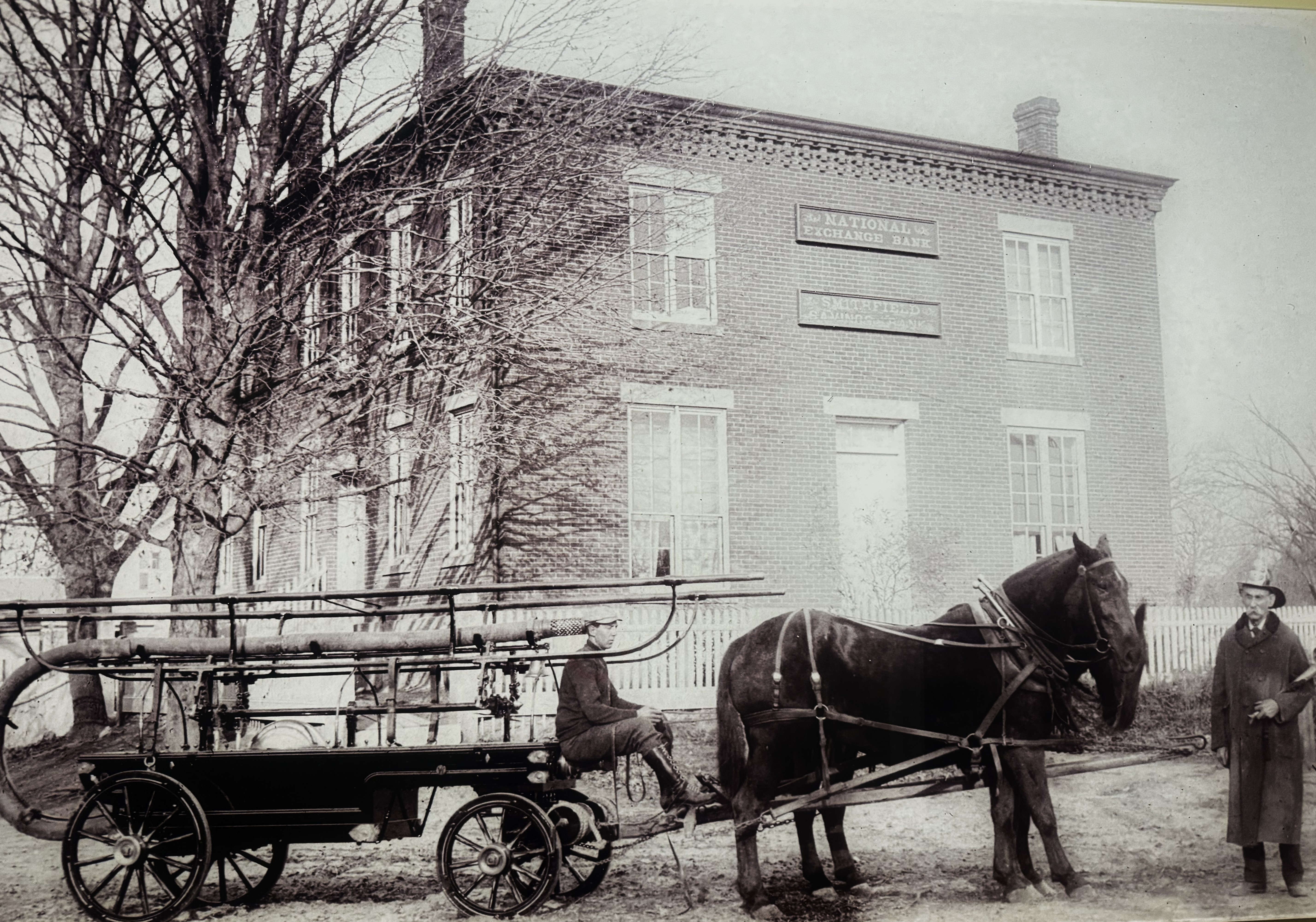
Between 1876 and 1924, Greenville’s best defense against fire was this antique hand-pumper affectionately named the “Water Witch”. It took quite a few men, and a lot of stamina to operate it. (Photo courtesy of Priscilla W. Holt.)

Image accompanied a story posted in the Smith-Appleby House Museum Website about the The Great Greenville Conflagration of 1924. It was an intense blaze that broke out on a cold winter’s night in the very heart of Greenville, at an hour when most citizens were snug in their beds. When it was over, two prominent landmarks had been destroyed, six businesses and the post office were gone, and three families were left homeless. Had it not been for the brave efforts of volunteer firefighters, it could have been much worse.

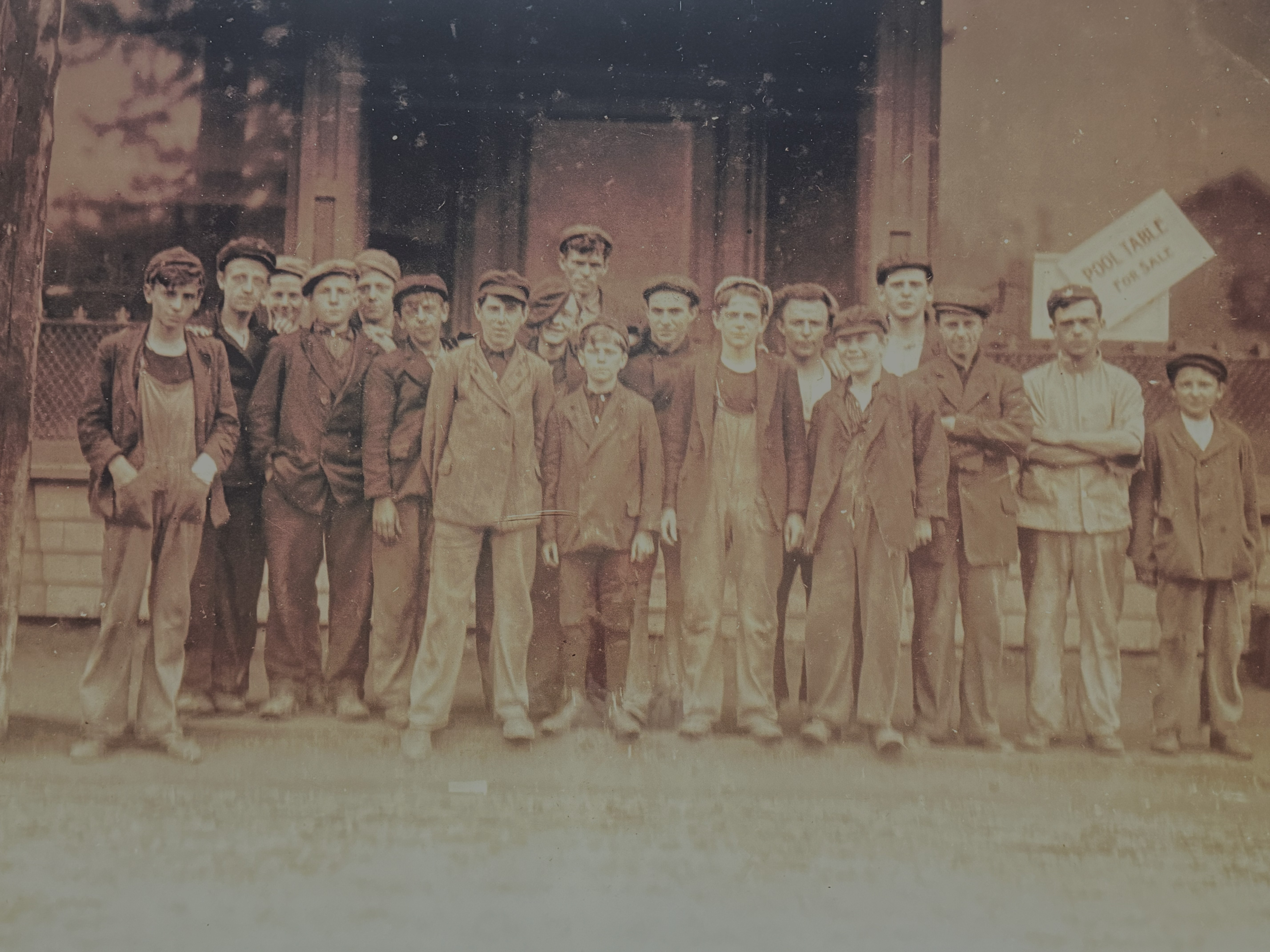
This vintage photograph captures a group of young workers, likely child laborers, posing in front of a building in the early 20th century. 

  • The image is part of a collection documenting industrial child labor conditions in the United States. 
  • Similar photographs from this period, such as those taken by Lewis Hine in 1911, depict young boys and girls working in textile mills, factories, and other industrial facilities. 
  • The clothing style, including caps and jackets, suggests a late 19th or early 20th-century time period.
  • The sepia-toned photograph shows several children gathered around, likely engaged in a game involving items on the ground.

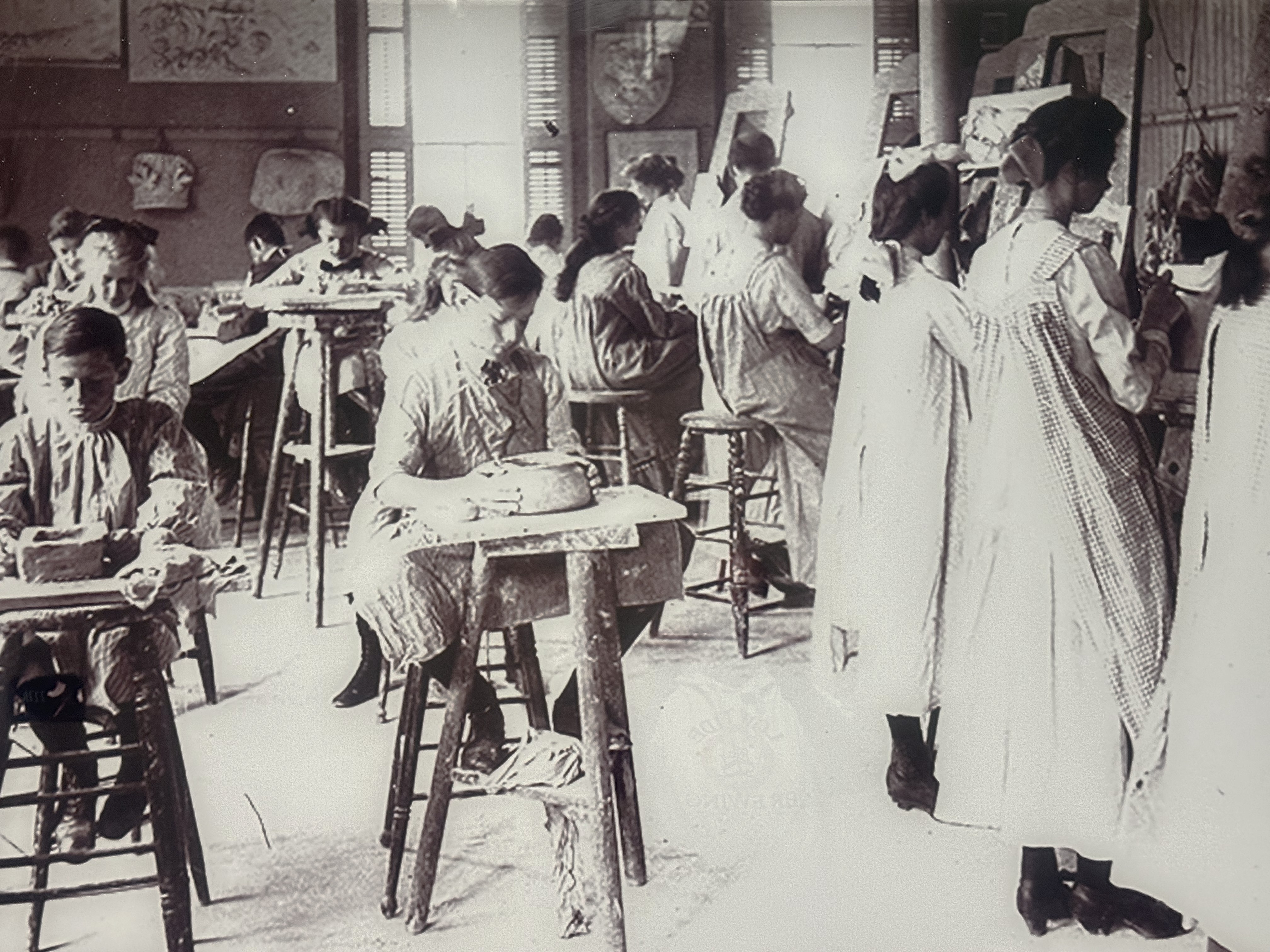
This image depicts an early classroom at the Rhode Island School of Design (RISD)

Historical Context

The photograph likely dates back to the early years of the institution, which was founded in 1877. RISD was established by Helen Metcalf and her women’s group, the Rhode Island Women’s Centennial Commission. 

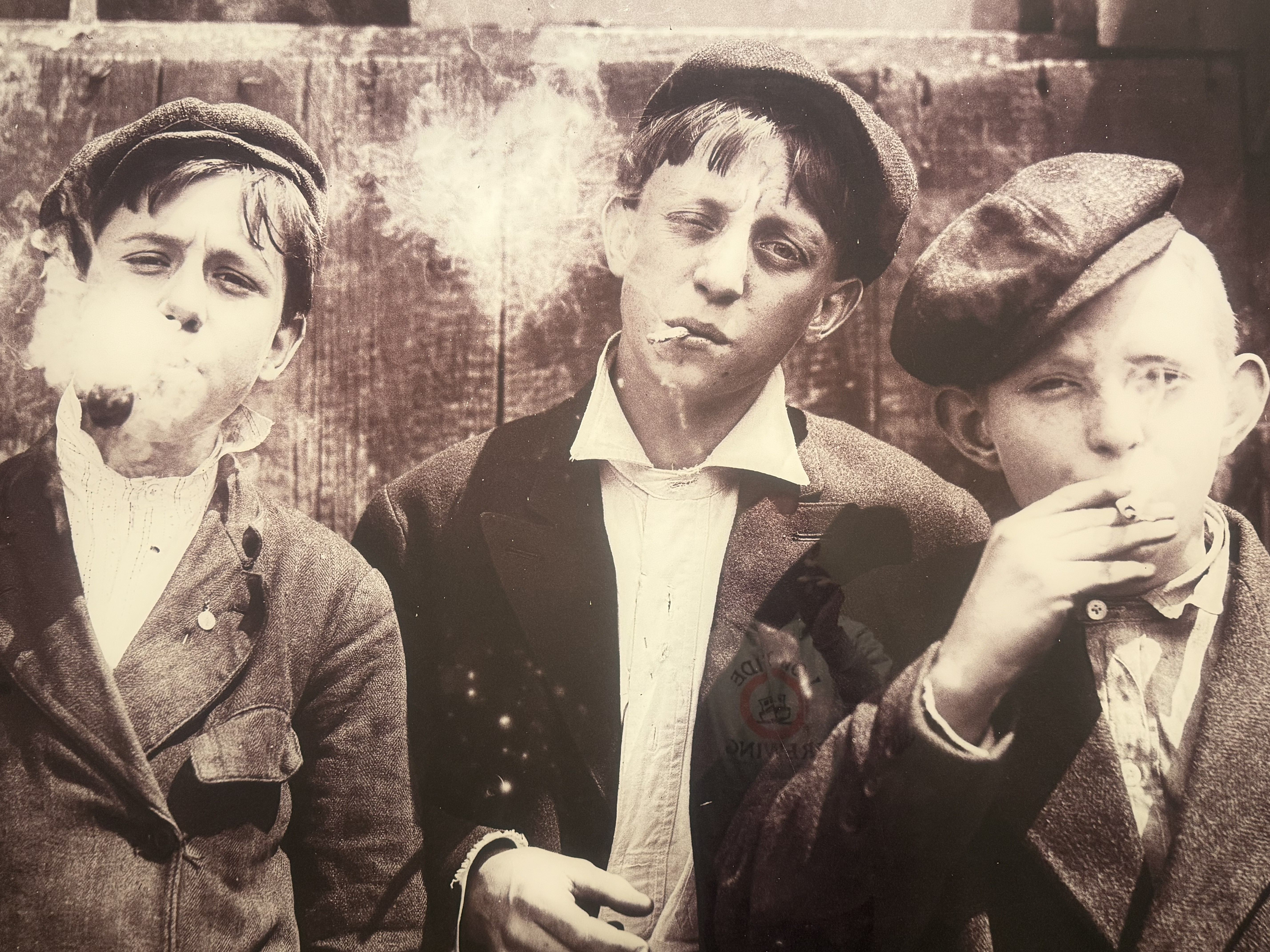
  • Photograph Title: Newsboys Smoking, 1910
  • Photographer: Taken by Lewis Hine on May 9, 1910, while working for the National Child Labor Committee (NCLC). 
  • Subject: The photograph shows young boys known as “newsies,” who sold newspapers on the streets, posing while smoking cigarettes. 
  • Location: The scene was shot at Skeeter’s Branch in St. Louis, Missouri. 

Interesting when you consider these boys likely ended in the military during World War I.

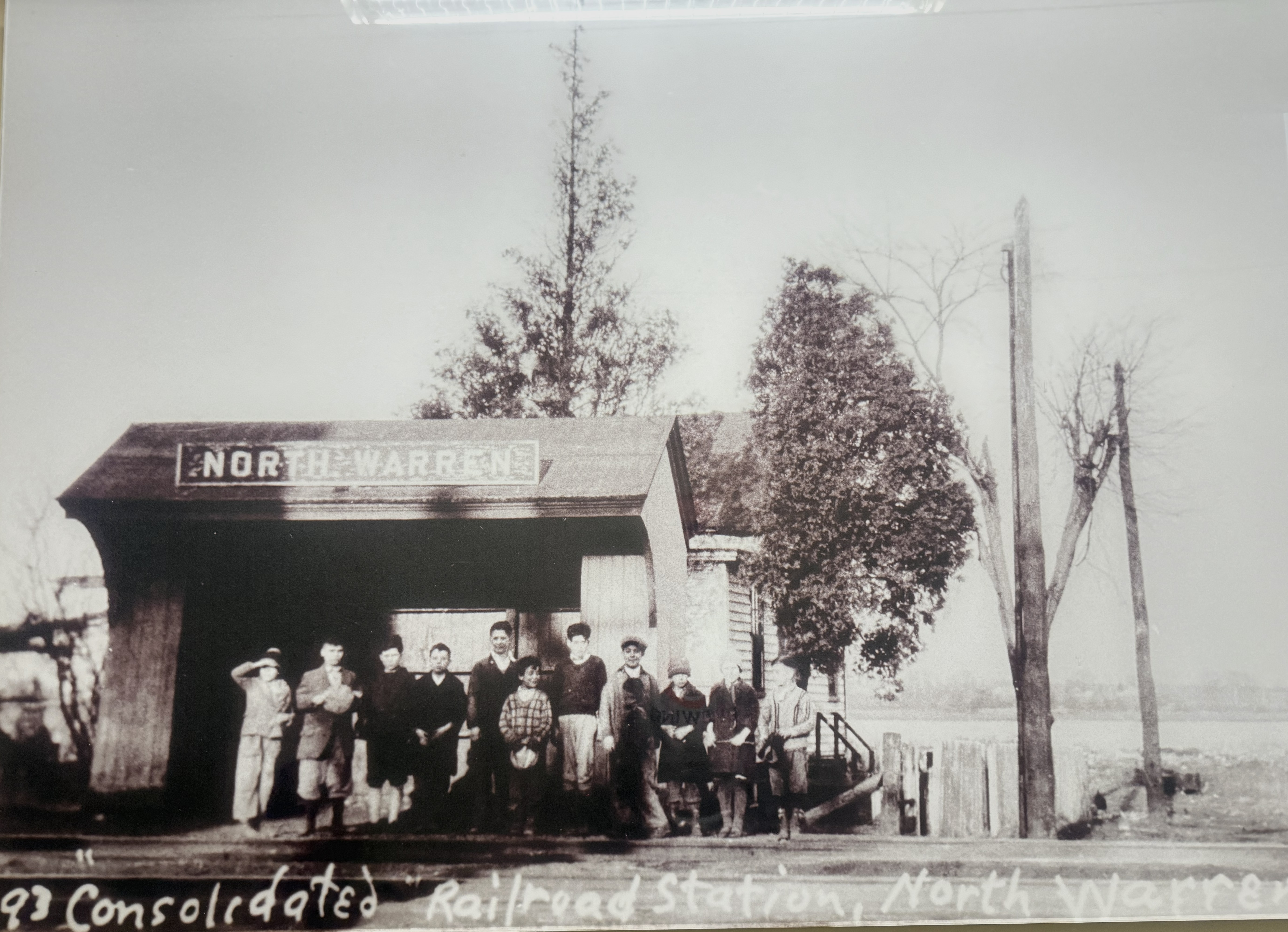
This image captures a historical moment featuring the North Warren Consolidated Railroad Station.

  • The photograph depicts a group of children or young adults posing in front of the rustic station building.
  • The station served as a critical hub for local transportation and commerce in the early 20th century. 
  • Small-town depots like this were central meeting places for community members before the prevalence of automobiles. 

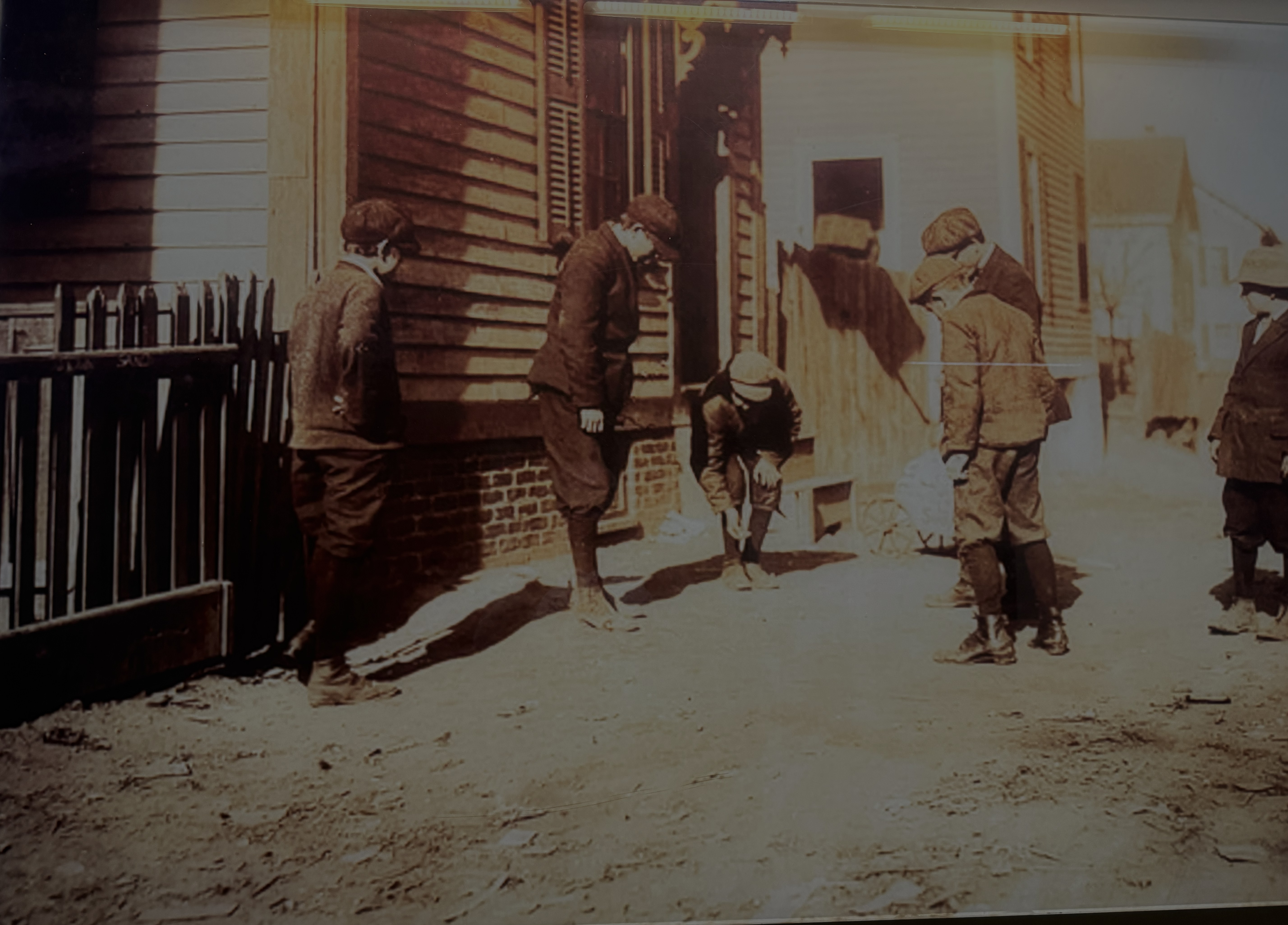
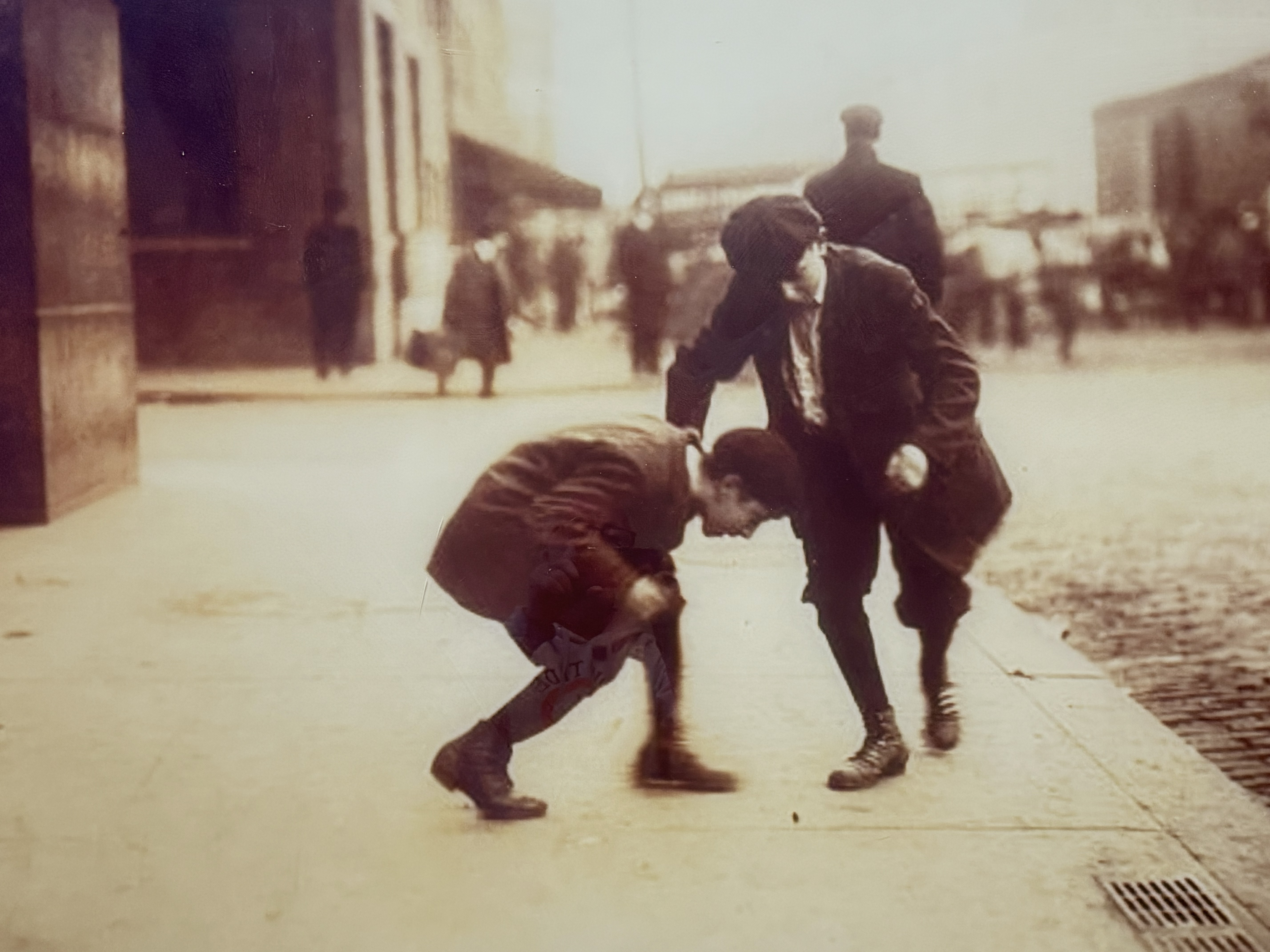
This image captures a moment in time featuring children playing a game known as “pitching pennies” on a city sidewalk. 

  • Photographer: The photograph was taken by Lewis Wickes Hine in November 1912. 
  • Location: The scene was recorded in Providence, Rhode Island. 
  • Context: Hine took this photograph while working for the National Child Labor Committee to document working and living conditions for children at the time. 
  • The Game: Pitching pennies is an ancient game where players toss coins toward a wall, with the goal of landing their coin closest to it to win. 

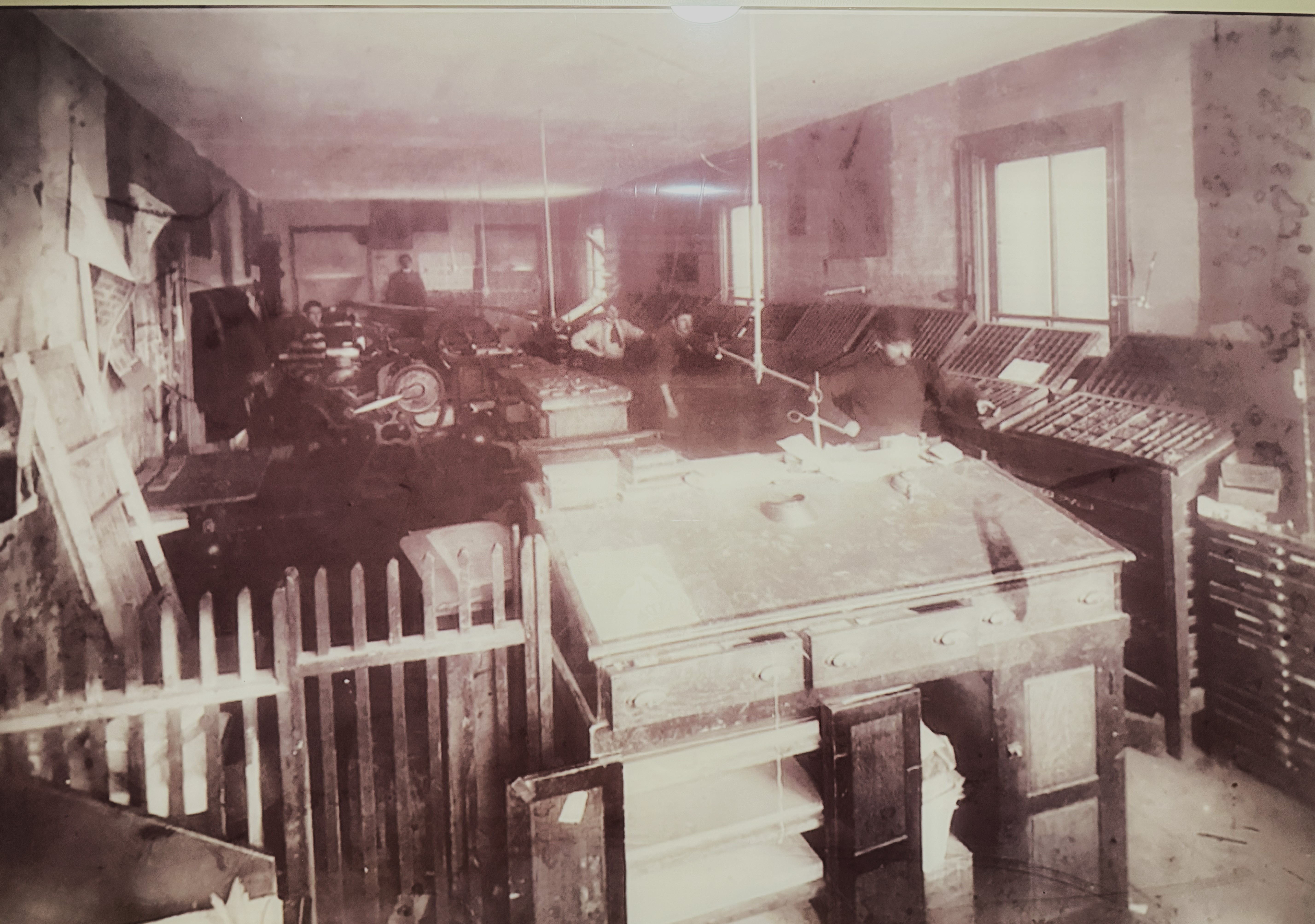
This image depicts an early 20th-century newspaper printing office, likely dating from the 1900s to the 1920s, showcasing the traditional letterpress printing process.

  • Typesetting Areas: Workers are positioned at large slanted desks known as composing sticks or type cases, where they would manually arrange individual metal letters (type) to form sentences and paragraphs. 
  • Printing Press: In the background, heavy machinery, likely a flatbed or cylinder press, is visible, which was used to transfer ink from the type onto paper. 
  • Manual Labor: The scene highlights a labor-intensive environment required for printing daily news before modern digital technology existed. 
  • Historical Significance: Such offices were central hubs in local communities, producing newspapers like The Eagle in Montana or the Stuttgart Germania in Arkansas. 

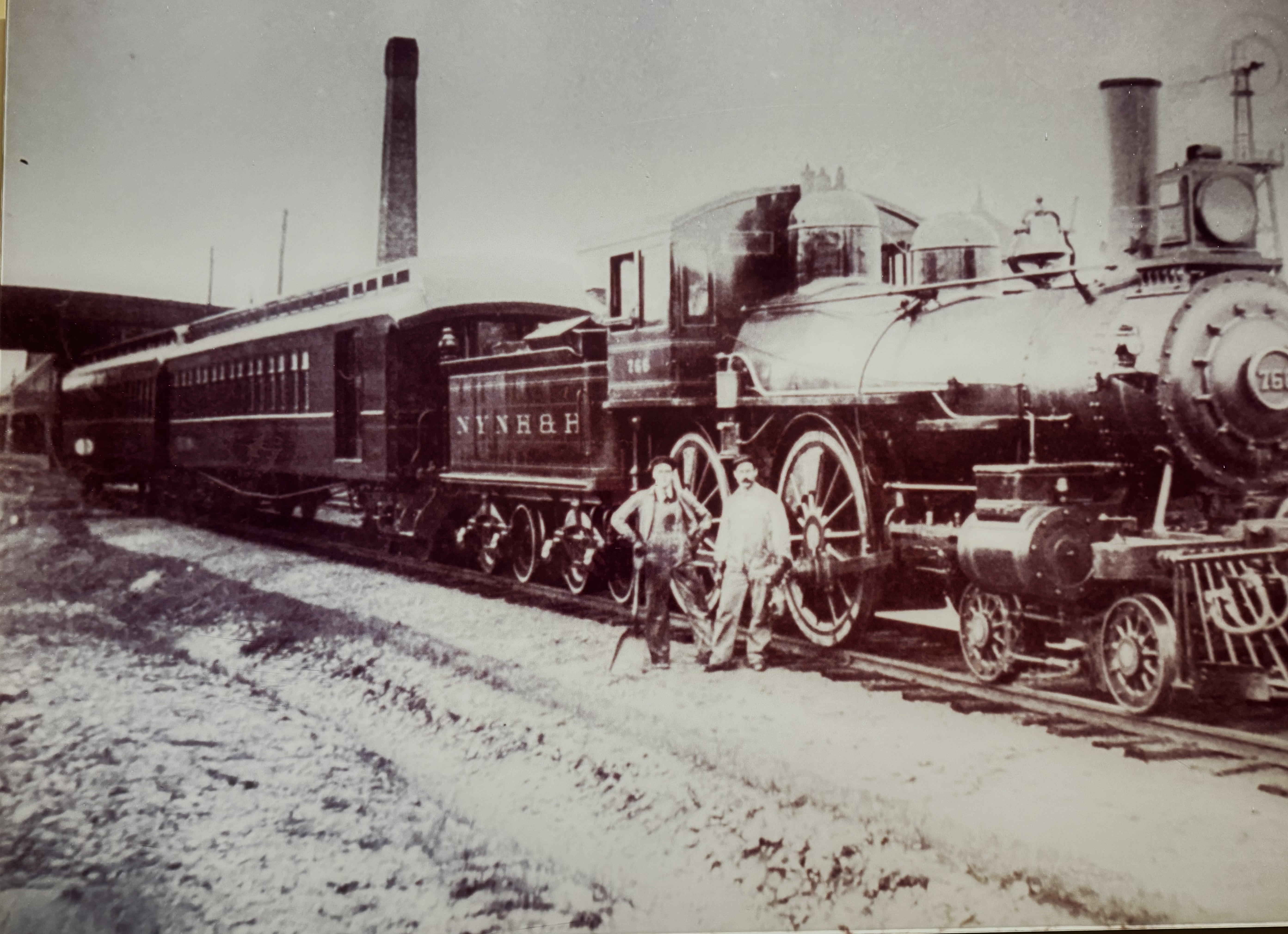
This vintage photograph captures a historic train scene featuring a New York, New Haven & Hartford Railroad locomotive, specifically numbered 76. 

  • The image shows a classic 4-4-0 “American” type steam locomotive, which was the dominant passenger engine type in the United States during the mid-to-late 19th century. 
  • Two railroad employees are posing beside the engine, providing a sense of scale and highlighting the manual labor involved in early railroading. 
  • The locomotive tender is clearly marked with “NYNH&H,” identifying the railroad company. 
  • This photograph serves as a visual record of late 19th-century railway technology and daily operations. 

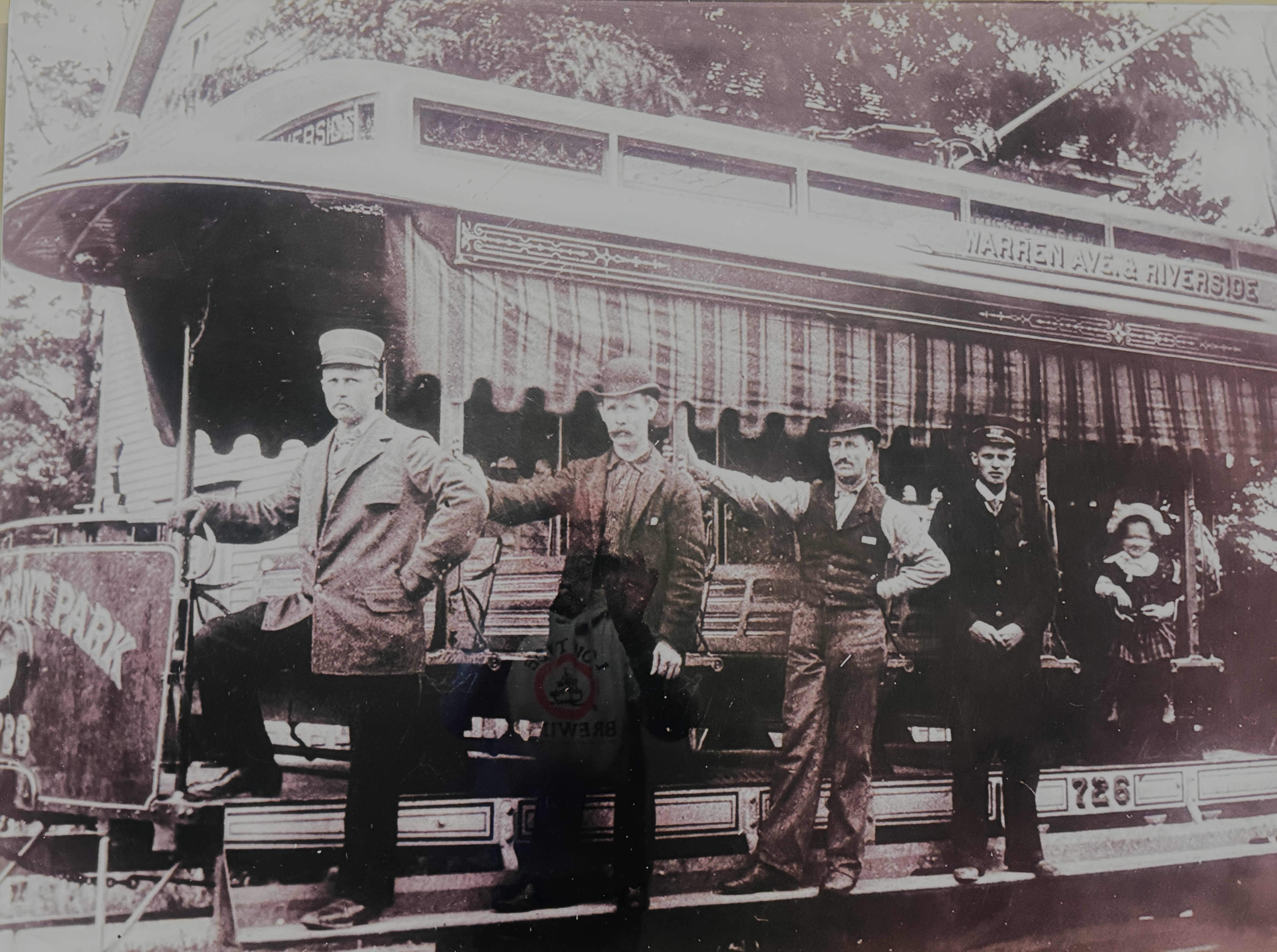
This photograph depicts an early trolley car operating in Rhode Island, likely near the turn of the 20th century, which served as a primary form of public transportation in the state. 

  • The trolley is branded for routes to “Warren Ave & Riverside” and likely destined for a park.
  • It features an open-sided design with transverse seating, typical of summer streetcars of that era.
  • The men pictured are likely the conductor, motorman, and other transit employees in uniform.
  • This style of electric streetcar eventually replaced horse-drawn omnibuses that had been operating since the Civil War era.

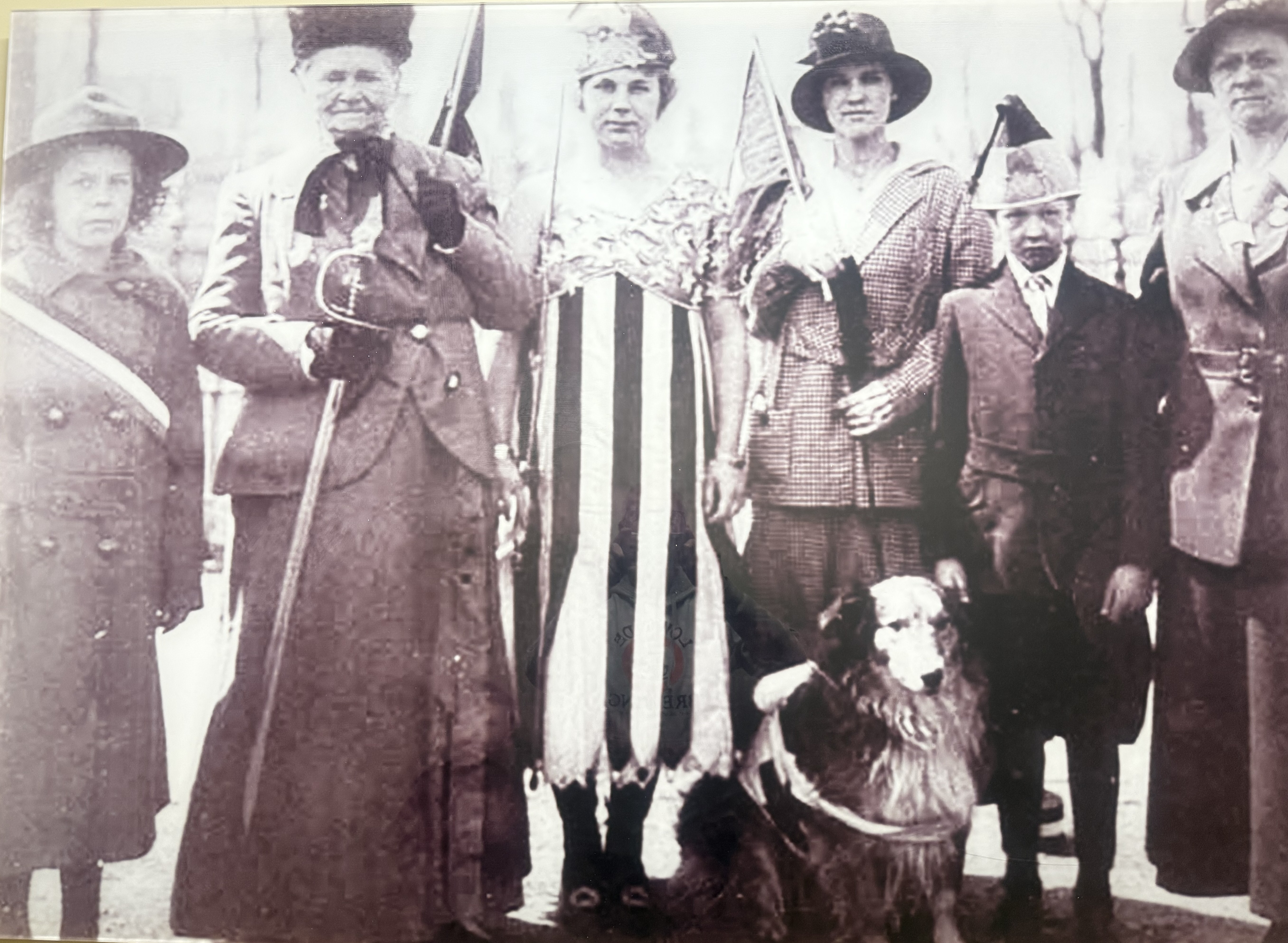
This vintage photograph, likely from the early 20th century, captures a group of people including women in distinctive period attire and a boy with a dog. Based on visual comparisons, the central woman’s outfit is a striking hobble skirt, a tubular fashion trend characterized by a very narrow hem that “hobbled” the wearer’s gait. 

Historical Context and Attire

  • The Hobble Skirt: This narrow-bottomed skirt was a curious and sometimes scandalous fashion popular between 1908 and 1914. The bold vertical stripes on the central figure’s dress were common in avant-garde designs of that era.
  • Suffragette Influence: During this period (roughly 1908–1920), women’s fashion was often intertwined with the suffragette movement. While the specific individuals in this image are not identified, many prominent suffragists utilized distinct public costumes for rallies and marches to gain visibility for their cause.
  • Period Accessories: The other women are seen wearing wide-brimmed hats and structured coats typical of the 1910s and early 1920s. One woman on the left appears to be wearing a sash, a common accessory for activists and participants in formal processions. 

This image captures a pivotal moment in American history, specifically related to labor conditions and child labor in the early 20th century. 

  • Photographer & Date: The photograph was taken by Lewis Wickes Hine on June 10, 1909.
  • Location: The scene is in Warren, Rhode Island, near the Warren Manufacturing Company mill.
  • Context: The image shows young boys arriving for work at 6:00 AM.
  • Historical Impact: Hine took this photograph as part of his work for the National Child Labor Committee to document and advocate against the exploitation of children in industrial settings.

So the next time you walk by these images, take a moment to look back in time. You are walking right past history.

This Special K isn’t Good for Most

The US is in a K-shaped economy. It is characterized by extreme growth in the high-end sector at the expense and detriment of the lower and medium wage sector. While many sing the praises of this administration’s economic policy (if one could even describe what that policy is) the reality for most Americans is not a positive economic outlook.

A K‑shaped economy describes a recovery or growth pattern where different parts of the population experience sharply different outcomes simultaneously. One group’s economic prospects rise (the upward arm of the “K”), while another group’s prospects fall or stagnate (the downward arm). This term became common during and after the COVID‑19 pandemic to explain uneven economic recovery.

Effects on lower‑income Americans

Lower‑income Americans are typically on the downward side of the “K” and face several challenges:

  • Job insecurity: Many lower‑wage jobs are concentrated in service, retail, hospitality, and gig work, which are more vulnerable to layoffs, reduced hours, and automation.
  • Slower wage growth: Even when employment recovers, wages for low‑income workers often lag behind inflation, reducing real purchasing power.
  • Limited asset ownership: Lower‑income households are less likely to own stocks, real estate, or other assets that usually grow during economic recoveries, so they miss out on wealth gains.
  • Rising cost pressures: Increases in housing, food, healthcare, and transportation costs hit lower‑income families harder because these expenses make up a larger share of their income.
  • Reduced economic mobility: Gaps in savings, education access, and job training can make it harder to move into higher‑paying roles as the economy changes.

Bottom line: In a K‑shaped economy, overall growth can mask widening inequality, with lower‑income Americans experiencing prolonged financial hardship.

What the K‑Shaped Economy Means for Workers

Workers on the downward side of the K face intersecting challenges that unions confront daily:

  • Unequal recovery: Office‑based and managerial jobs rebounded quickly, while service, manufacturing, logistics, healthcare support, and food service jobs remain volatile despite being essential to the economy.
  • Falling real wages: Even where nominal wages went up, inflation—especially in housing, food, and healthcare—has eaten away at paychecks, leaving many workers worse off.
  • Precarious employment: More workers are employed part‑time, on temporary contracts, or misclassified as independent contractors, limiting access to benefits and job security.
  • Unsafe and demanding conditions: Productivity demands have gone up without corresponding improvements in safety, staffing, or compensation.
  • Weakened worker voice: Decades of declining union density and weak labor law enforcement have reduced workers’ ability to bargain collectively for fair wages and conditions.

A K‑shaped economy is a direct consequence of declining worker power. When workers cannot collectively negotiate, economic gains flow upward instead of being shared. Union jobs consistently deliver higher wages, safer workplaces, better benefits, and greater economic stability—making unions a key solution to K‑shaped inequality.

Since the Trump administration often blames Biden for everything, here is the reality of the many causes of the high rate of inflation resulting from Global, not exclusively domestic, conditions. Biden faced unprecedented global economic pressures requiring innovative and challenging responses. Yet his policies managed to slow and then reduce inflation from it peak of 9% to a generally accepted 3% level.

Here is a single‑row table summarizing the primary cause of inflation under Biden, as described by mainstream economic research (Fed, NBER, FactCheck): These conclusions are easily verifiable.

Inflation under Biden (2021–2022)Primary cause
Rapid inflation surge to ~9%Post‑COVID demand rebounded faster than supply, while supply chains were still constrained; fiscal stimulus boosted demand, and energy/food shocks from the Ukraine war pushed prices to their peak

In one sentence: Inflation was mainly caused by too much demand chasing too little supply after COVID, with stimulus and global energy shocks making it worse.

Primary cause (the core driver)

Demand rebounded faster than supply after COVID

  • As the economy reopened in 2021, consumer spending surged while production, labor supply, and logistics were still constrained.
  • Pandemic supply‑chain disruptions (ports, chips, autos, shipping) limited how fast goods and services could be produced, pushing prices higher when demand jumped.
    [factually.co], [nber.org]

This demand‑supply mismatch is widely identified as the central mechanism behind the inflation takeoff.


Major amplifiers (what made it worse)

1. Large fiscal stimulus

  • Pandemic‑era stimulus (including the $1.9T American Rescue Plan) added significant purchasing power while the economy’s supply capacity was still impaired.
  • Research and fact‑checks conclude stimulus contributed meaningfully, though estimates vary on how much.
    [nber.org], [politifact.com]

Most mainstream analyses say stimulus was a contributor, not the sole cause. And, with inflation now closer to the standard model, the termination of the program will eliminate necessary and long-term benefits from the program targeting infrastructure improvements, environmental progress, and adapting to a changing energy focus from fossil fuels to renewables.


2. Global energy and food shocks

  • Russia’s invasion of Ukraine in early 2022 caused sharp increases in oil, gas, and food prices, pushing inflation to its peak.
  • Energy prices spill into transportation, manufacturing, and groceries, affecting nearly everything.
    [factually.co], [nber.org]

3. Tight labor markets

  • Job openings far exceeded available workers in 2021–2022.
  • Rising wages added cost pressure in services, contributing to “sticky” inflation later on.
    [nber.org]

What it was not

  • Inflation was not unique to the U.S.; it surged across advanced economies after COVID.
  • That global pattern supports the conclusion that pandemic and energy shocks mattered greatly, not just U.S. policy.
    [chicagofed.org]

One‑sentence summary

Inflation under Biden was primarily caused by a rapid post‑COVID demand rebound colliding with constrained supply, then intensified by fiscal stimulus and global energy shocks—especially the Ukraine war.

Then there’s this, from a posting by Ken Block on social media.

“Have the tariffs negatively impacted the US economy?

Yup.

A $12 billion “Farmer Bridge Assistance” program, also known as a bailout, will provide up to $155,000 to each “row crop” farm (soybean farms are the most affected).

The bailout mitigates financial losses from trade disputes and the impact of reciprocating tariffs.

Farmers are calling this aid a “drop in the bucket” and a short-term band-aid rather than a solution to their economic crisis. Farmers estimate this aid covers only about 25% of the economic harm they have endured since Trump lit up his tariff war.

Worse, China has stopped buying US soybeans altogether and has replaced our soybean exports with soybeans from other countries. There is a real risk that our soybean farmers have lost the Chinese market for good. Other countries have also replaced US exports with goods from non-US sources. Economic isolation, as well as isolation stemming from the US’s unfriendly posture toward many of the countries we trade with, means a loss of crucial markets that we may never fully regain.”  Ken Block, Author of Disproven (https://kenblock.com/DISPROVEN.html)

And do yourself a favor and read Ken Block’s book, Disproven. In light of recent statements by President Trump and his administration continuing the spread of the lie that the 2020 election was stolen and rife with fraud, the threat to the free and open elections outside the control of government is an existential one.

“The Inhuman Power of the Lie”*

*From Dr. Zhivago by Boris Pasternak

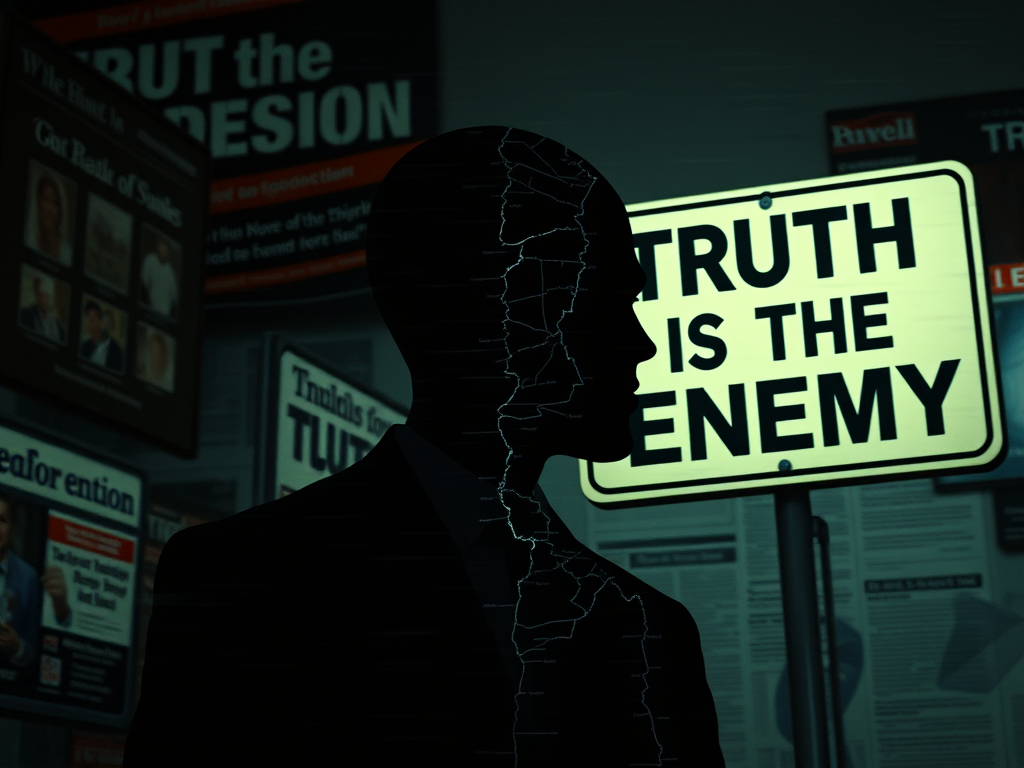
If it is not clear to everyone now that this administration, and Mr. Trump, rival the Soviet Union when it comes to prevarication and suppression of the truth as policy it never will.

What they have done is seize the “inhuman power of the lie” as so aptly put by Boris Pasternak in Dr. Zhivago (and you thought it was just a movie) and implemented it as standard practice.

Can’t answer a question by the media, attack the media.

Can’t explain a revelation or report of incompetence or wrongdoing, attack the source.

Can’t answer critics, indict them or sue them.

The list is long and I won’t bother to recite it all here. Those of you who recognize this disaster of an administration already know it and those of you who deny this reality will skip over it as per your master’s protocol (if you need to know something, he will tell you what it is.)

This political usefulness (in a Machiavellian sort of way) of lies and denial, well documented in On Lying and Politics by Hannah Arendt, while a characteristic of many political entities, has been taken to a different level with the Trump Cabal of Con Artists and Pretenders to the Throne.

Every single member of that administration suffers from nocturnal emissions dreaming about a time when they will occupy that position and bask in the same exercise of undemocratic power.

And it’s not like they concocted some secret plan to do this. Oh no, they hid it in plain sight in the pages of Project 2025. That wasn’t a policy document, it was an operational plan and it is well on its way to full implementation. I’ll post the link (again) and hope you take the time to read it. (Project 2025)

These lies are always accompanied by complaints of assaults by imaginary enemies with the parallel lie of imaginary triumphs. “Enemies are everywhere and they are jealous of our success. They hate America and want us to fail. The Constitution is not always right, we know better.”

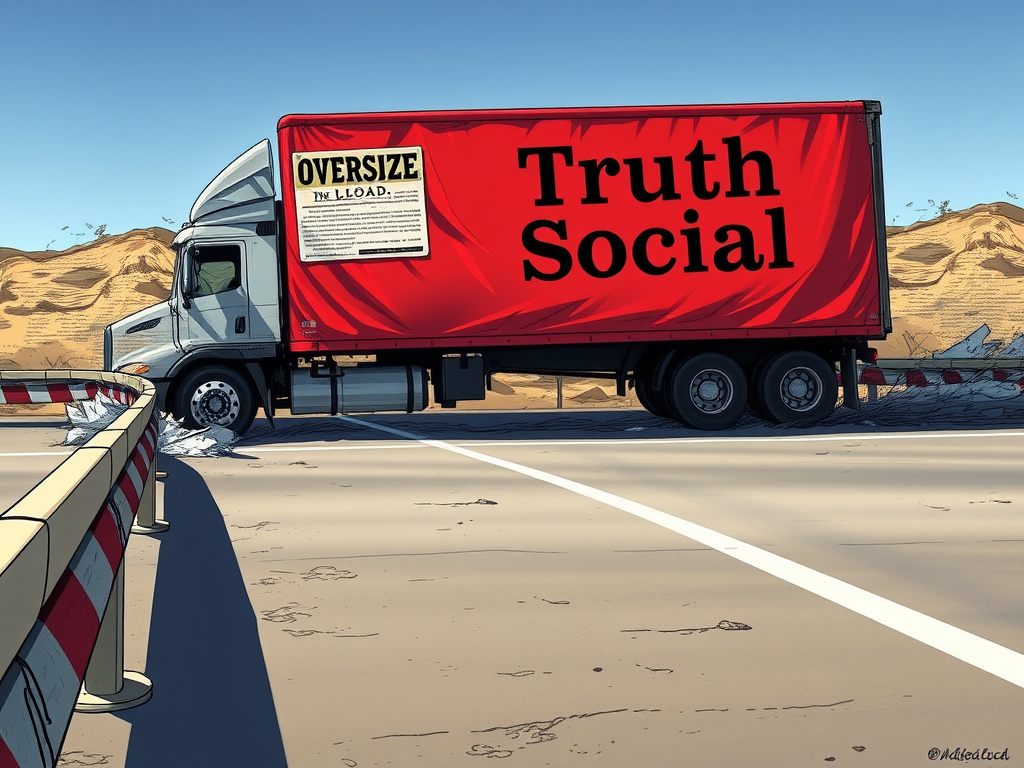
Since the first moment he pronounced the 2020 election a fraud, a blatant lie well documented in the book Disproven by Ken Block (a must read), to the latest denial that he “didn’t read the whole post,” when he put a racist and sickening video on his Truth Social platform, which could be named Pravda but the irony might be too deep, I believe he is incapable of telling the truth. And before you scream Block is a liar and agent of the Democrats, he was hired BY THE TRUMP CAMPAIGN and last time I checked they do not hire Democratic operatives. Why would they? They don’t actually embrace democracy in either the Democrat or the once admirable GOP style.

And the frightening part, is the number of otherwise intelligent and supposedly rational individuals around him who have become card carrying members of the Hear no Evil, See no Evil, Speak no Evil club required for membership in the Trump Cult. They would’ve burned a card with a saint in their hands, but they couldn’t find any.

Let’s hope the guardrails of government can withstand this out-of-control monstrosity of an oversize load vehicle veering side to side and smashing against them.

Now What?

Surprise History Quiz

Okay, books away, grab a pen (actually, keyboard) and answer this question, What is the worst Holocaust in recorded history? Answer at the end of this column, but you’ll see it, or should, long before that. Okay, go.

The Latest Trumpian Idiocy: Trump administration erases Native American, slavery history from U.S. national parks

https://english.news.cn/northamerica/20260201/477bfd64d4094e3480863616cd371ed2/c.html

To the victor goes the spoils and the opportunity to write the history. This administration is on a mission to whitewash any inkling of historical facts that place the United States in a bad light.

Slavery was uncompensated skills training and religious reorientation from heathenism with room and board.

The Trail of Tears was an all-expenses-paid government relocation program offering free land and the opportunity to live in other parts of the United States. And, when the discovery of oil, uranium, and other minerals spoiled the landscape, they were moved without cost again, and again, and again.

The European conquest of the Americas was a free offering of advanced technology to backwards people.

Somehow, Mr. Trump believes that removing references to historical facts will change reality. The saddest part of this is that he may not have to. Much of the history of slavery and the treatment of Indigenous peoples by Europeans, and by Americans after the establishment of the country, is glossed over in most classrooms.

This is how people fail to learn from history.

The Answer to the Quiz

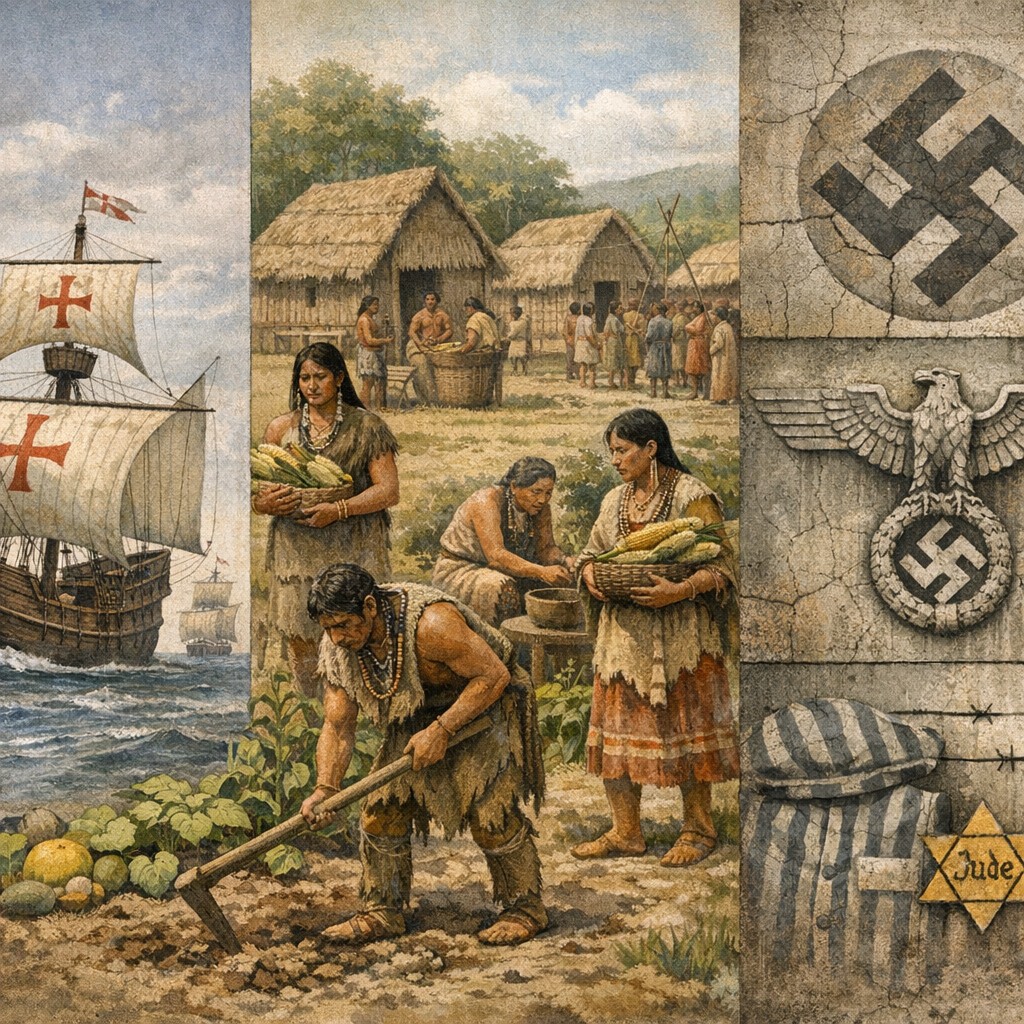
The decimation of indigenous people as a result of the arrival of Europeans to the Americas after 1492 dwarfs the deaths of the Holocaust of Nazi Germany.

While there are differences—timeframe, historical context, methodology—they all stem from the same ignorance-based prejudice against one group by another.

The genocide of Indigenous peoples in North, Central, and South America and the Holocaust of Nazi Germany were both driven by dehumanizing racial ideologies and caused immense loss of life. Still, they differed markedly in form and context. Indigenous populations in the Americas were devastated over centuries through a combination of introduced diseases, forced labor, land dispossession, cultural destruction, and recurring episodes of mass violence linked to European colonization, with responsibility spread across multiple empires and states. The Holocaust occurred over a short, defined period (1933–1945). It was a centrally planned, state-run genocide, using industrialized methods such as ghettos, deportations, and extermination camps to systematically murder Jews and other targeted groups. While both cases reflect the lethal consequences of racism and exclusion, they differ in duration, organization, methods, and contemporary documentation and postwar accountability.

It is vitally important to understand both the outcomes of these historical events and how they occurred.

Perhaps the sheer numbers may make it harder to ignore.

Nazi Holocaust

The accepted number for people killed by the Holocaust and Hitler’s final solution is 11 million. 6 million Jews, and 5 million Roma (Gypsies), disabled individuals, Polish and Soviet civilians, prisoners of war, homosexuals, and political opponents.

Slavery

When combining deaths before transport, during the Middle Passage, and under enslavement, historians often cite a total death toll of roughly 10–15 million people attributable to slavery in the Americas, with some broader estimates reaching higher when including wider African demographic losses tied to the system.

Post-Columbian Deaths of Indigenous Peoples

Most scholars today estimate that between 50 and 60 million Indigenous people lived in the Americas in 1492, and that by 1600–1650, roughly 85–90% had died as a result of European arrival. This implies about 45–55 million deaths across North, Central, and South America.

These deaths resulted primarily from introduced Old World diseases (such as smallpox, measles (wait, measles kill people?), and influenza), compounded by warfare, enslavement, forced labor, famine, displacement, and social collapse under colonial rule. While earlier estimates varied widely—from as low as 10 million to over 100 million—modern syntheses of archaeological, ecological, and documentary evidence have converged on the ~50–60 million precontact population and ~45–55 million deaths as the most defensible range.

The most dangerous killer of humans is prejudice.

Removing a few signs may eliminate obvious reminders of this tragedy, but it will not erase the reality. The United States learns from its mistakes. There are exceptions —the last Presidential election being the most glaring—but generally, we benefit from an open and frank analysis of our decisions and actions. It is what differentiates us from many other nations.

This folly of revising history isn’t new—The Civil War is known in the South as The War of Northern Aggression—but it is dangerous.

We have a friend from Germany, and we often talked about how a country as advanced, progressive, and educated as Germany descended into the horrors of Nazism. While there is no one answer, fear is a significant factor. And fear is almost exclusively a result of a lack of understanding and empathy.

I hope that, as we approach the mid-term elections and, more critically, the next Presidential election, we return to a nation that embraces empathy and intelligence over fear and ignorance.

And perhaps Columbus Day isn’t such a good idea after all.

Questions I’ve Been Asked

After a post on Social media, I received a number of negative responses (always entertaining) including one that wanted me to answer a few questions. Here is the series of topics and my response.

1. Border Policy

Not sure what the question is here. Of course I support secure borders and prevention of unlawful entry but I also support reasonable opportunity to enter the country lawfully, robust and intelligent amnesty programs for those facing deprivation of rights in their native countries, and recognition that lawful immigration is a net benefit to this country.

Closing the borders isn’t a policy. Controlling the borders and those who can enter the country is.

2. FED Policy

The FED has always enjoyed an independent status from political interference. It is the whole purpose that monetary policy be free of politics. While the members are selected by political authorities (hopefully based on background and qualifications, not loyalty), they are free to make their decisions based on sound economic indicators and conditions not political pressure or threats of removal without cause.

Why this is a mystery or perceived as a problem by this administration is troubling yet consistent with their abandonment of standards and precedent.

3. Ukraine War

Russia invaded the Ukraine after agreeing (decades ago) never to do that in exchange for the Ukrainians surrendering nuclear weapons formerly belonging to the Soviet Union after the collapse. While I do not think we should put ground troops there, I do believe it is in our best interest to provide sophisticated weaponry to the Ukrainians as a bulwark against further Russian aggression which would directly impact NATO allies, primarily Poland and Germany.

Not that tit-for-tat is wise foreign policy, but helping Ukraine inflict more casualties on Russia might expedite a settlement. Keep in mind it was Russian and Chinese weaponry that killed most Americans in Vietnam. Of course, it was American weapons that killed many Russians during their exploits in Afghanistan and Russian weapons killing Americans in our time there, demonstrating the folly of such policies. But this is just a speculative discussion, not setting foreign policy.

Mr. Trump seems to believe his force of personality is enough to restrain Putin, it is not. The constant reversal of policy and flipflop between Russia and Ukraine merely delays any long-term resolution. We either live up to our claim of defending all friends, opposing all foes or we drop the facade and just pursue our own agenda.

4. Iran protest

I once read an article (that I am trying to find) that argued, during our invasion of Iraq, we picked the wrong country in terms of the support of the local population. Iraq is a series of historically antagonistic tribal associations with little loyalty to the country. Iran, on the other hand, was a mostly unified population (excepting the Kurds) that would be more supportive of outside assistance to rid them of the horrors of theocracy (something we should take notice of and avoid).

Iraqis would fight for their own part of the country and against any other, the Iranians would be more unified in toppling the Mulahs and crafting a more representative government for the whole country.

I do not think we should directly aid the Iranian people unless we have a fully articulated plan in place for the end game. A war here would be much different than Iraq. And discussion of restoring the Shah to the throne is tantamount to trading one dictatorship for another.

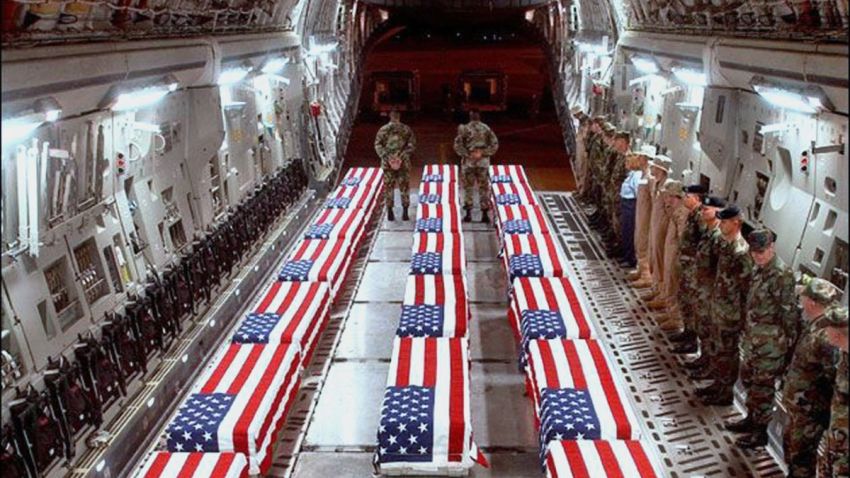
I have no doubt we would succeed militarily. Nor do I believe, despite the threats of other nations (North Korea, Russia, Syria) to come to the aid of Iran, that any of that would come to pass. But I do not believe the US has made the case sufficiently well to justify such an action or to prepare the American people to accept the reality of flag-draped coffins returning to the US in numbers that might exceed Vietnam, Korea, or Normandy. There is also insufficient demand from Iranian opposition parties indicating a openness to such open engagement.

Such an action would require the most deft diplomatic and military skills by the administration and that is sorely lacking.

5. ICE ability to enforce the law without interference.

Clearly legitimate law enforcement operations should be free from interference and those who impeded such operations arrested and charged. But here we have a unique situation. While unlawful entry into this country is a crime, it is a misdemeanor. A minor offense.

The overwhelming majority of those arrested by ICE have committed no other crime other than this misdemeanor

History is replete with examples of people breaking the law to bring attention to injustices and foster change.

No one objects to ICE seeking out and apprehending those here illegally who have committed crimes. Those who have lived here without committing other crimes and contributed to the nation deserve some consideration of their conduct in the country.

At a minimum this would include due process.

But from my perspective, those who committed crimes, whether that crime is operating a motor vehicle without a license or murder makes no difference, they deserve to be deported. You came here to escape some situation then to further compound that act by breaking other laws eliminates my empathy for your struggles. Although, with that said, if someone here illegally were charged with shoplifting for stealing food to feed themselves or their family it may mitigate the circumstances, but that’s just the bleeding heart liberal (although quite Christian attitude despite my atheism) in me.

However, sending masked and heavily armed tactical officers after men, women, and children (particularly children who are completely innocent of any unlawful act) who have done nothing more than commit a misdemeanor is abhorrent. This is what led to the widespread protests against this policy.

One of the key aspects of dealing with arresting individuals for any crime, something every experienced officer knows, is the goal is to make the arrest with the minimum amount of force. Any competent officer seeks to reduce the tension in these circumstance, not exacerbate them.

Sending what resembles, for all intents and purposes, a military unit to arrest people for minor offenses sets a dangerous tone. Now while every arrest has potential to become violent, no matter the charge, it is incumbent on the law enforcement agency to stage the arrest to avoid, as best they can, inciting violent resistance.

One of the arguments for this invasion of Minnesota (Minnesota?) is the lack of cooperation by state and local authorities. Cooperation is a two way process not a demand for surrender. From what I’ve seen, local and state authorities have only sought the assurances that the law of immigration enforcement, due process, be followed. When they see the reality is midnight flights in direct violation of federal court orders I would expect them to withhold cooperation. It is their duty to operate under the law and refuse to aid any agency which acts counter to that.

One of the biggest roadblocks to expediting deportation is the lack of sufficient numbers of immigration judges. This falls squarely on the shoulders of the administration and their focus on arrest while ignoring the due process aspect. The average time from arrest to hearing can often be months or even years. Reducing this would go a long way to removing one incentive to come here.

The very argument the government made for overturning court decisions on abortion-that it should be a state decision-is inconvenient in this case. And if your argument that immigration enforcement is a Federal issue exclusively you are defeating your own argument. Reducing or eliminating access nationwide to lawful abortions was a cornerstone of the Republican platform. The states rights argument was a smokescreen.

And the fallacious argument of widespread voting fraud, particularly voting by illegal immigrants, is verifiably false.

I firmly believe in the premise of innocent until proven guilty. The tragic shootings of American citizens remain open cases and the officers involved deserve to be treated as innocent. Until all the evidence comes out, and it should be all the evidence for the courts and the public to see, the legality of these matters remains undetermined, but the innocence of the officers under the law need be respected.

Keeping an in-progress investigation confidential is often necessary and prudent, but it cannot remain that way indefinitely. The Justice Department would go a long way to reassuring the public by including local and state investigators in the process.

But, as I mentioned before, placing these officers in these circumstances amid widespread public resistance to these policies is a recipe for disaster. To falsely characterize these demonstrations as a violent insurrection because it fits a political narrative is tantamount to taking a match to a fuse.

While the government has a clear responsibility to keep the peace and enforce the law, it also bears a bigger responsibility to do so in a manner that does not incite violence. Under these circumstances, they have failed.

If ICE held a perp walk of every illegal immigrant convicted of a violent crime being loaded on a plane out of the country, they would do it to almost universal approval. Instead, they face almost universal disdain for their tactics.

6.Transgender surgery and hormone treatment for minors

This issue, like all the others, is complex. There is also an underlying false narrative, often reinforced by the President and his supporters, that children are being surgically altered or given hormone treatments without their parents knowledge on a regular basis. “They send Johnny to school and Jane comes home.”

Nothing could be further from the truth. But this, like many other issues, should be one undertaken with medical advice not political grandstanding. The biggest issue, as always, is a refusal by many who protest the loudest against such treatments to refuse to even consider the complex physical and psychological trauma of these conditions. They let their false “moral” outrage framed by religious nonsense blind them to reality.

God does not determines sex, genetics does.

Gender dysphoria refers to the clinically significant distress or impairment that can occur when a person’s experienced or expressed gender does not align with the sex assigned to them at birth. The distress may affect emotional well‑being, social functioning, or daily life, and it is not defined by gender identity itself, but by the presence of distress associated with that incongruence.

Gender dysphoria is recognized as a medical condition in major diagnostic systems. In the Diagnostic and Statistical Manual of Mental Disorders (DSM‑5‑TR), published by the American Psychiatric Association, it is classified as a diagnosable condition to ensure access to appropriate clinical care. In the International Classification of Diseases (ICD‑11), published by the World Health Organization, it is described as gender incongruence and placed under sexual health conditions rather than mental disorders, reflecting evolving medical understanding while still supporting access to healthcare.

Recognized Legal Exceptions to Parental Control Over Medical Care for Minors

While parents or legal guardians generally have the authority to make medical decisions for minors, U.S. law recognizes several well‑established exceptions where a minor may consent independently, or where the state or courts may override parental choice to protect the minor’s health, safety, or rights.

1. Emergency Medical Care

In situations involving a medical emergency where delaying treatment would pose a serious risk to a minor’s life or health, healthcare providers may provide necessary treatment without parental consent if a parent or guardian is unavailable or refusal would cause harm.

2. Abuse, Neglect, or Medical Neglect

When parental decisions constitute abuse or neglect, including refusal of medically necessary treatment, the state may intervene through child protective services or the courts. Courts may authorize treatment when parental refusal places the child at substantial risk of serious harm.

3. Mature Minor Doctrine (Recognized in Some States)

Under the mature minor doctrine, some states allow minors—typically adolescents—to consent to certain medical treatments if they demonstrate sufficient maturity and understanding of the risks and benefits. Application varies by state and is often limited to specific circumstances.

4. Statutory Minor Consent Laws

All U.S. states recognize statutory exceptions allowing minors to consent to certain categories of care without parental involvement, commonly including:

  • Sexual and reproductive healthcare (e.g., contraception, pregnancy‑related care)
  • Testing and treatment for sexually transmitted infections (STIs)
  • Substance use and addiction treatment
  • Mental health services (with varying age thresholds and limitations)

5. Emancipated Minors

Minors who are legally emancipated—through marriage, military service, court order, or financial independence—generally have the same authority as adults to make their own medical decisions.

6. Court Orders and Judicial Review

Courts may override parental medical decisions when necessary to protect a child’s welfare, including ordering treatment over parental objection or resolving disputes between parents or between parents and providers.

7. State Parens Patriae Authority

Under the legal doctrine of parens patriae, the state has an obligation to act in the best interests of children and may intervene when a minor’s health or safety is at serious risk due to parental decisions.

Again not a simple issue. Absent profound medical necessity for surgery or hormone treatments, the state should defer to parental choice. But if the circumstances warrant intervention, it should be taken.

7. Transgender men competing in women’s sports.

Given the complex nature of genetics, where there can be a range of chromosomal differences between male and female, this is a challenging topic. My personal feeling is it should not be allowed. But a more in-depth review of individual cases may be appropriate.

However, in the big scheme of things, this involves a very small percentage of the population.

Diagnostic and Statistical Manual of Mental Disorders, Fifth Edition, gender dysphoria prevalence accounts for 0.005–0.014% of the population for biological males and 0.002–0.003% for biological females. Using an average between male and female we are talking about 1.6 million individuals out of a US population of 326.7 million and they are not all athletes. I think this is much ado about nothing.

Reminds me of the old jokes about the East German women’s Olympic teams.

8. Protesters storming church services.

Like my earlier point on interfering with law enforcement engaged in lawful activities, no one has the right to interfere with someone practicing the faith of their choice. But there is another issue here. When a Church pastor is also engaged in secular matters for which lawful protest in opposition is perfectly legal, the fact that the protesters went to the church is immaterial.

While Freedom of Religion means we have to respect the right to embrace any faith and practice it, it does not mean we have to respect the tenets of the faith itself. Churches are not immune from protest simply because they are religious institutions. Quite often people of faith engage in activities in opposition to government actions. The cloak of faith does not make one immune from criticism, opposition, or open protest as long as it is done lawfully.

The fact that the protest took place at a church is not a significant issue. If someone broke the law, charge them. If they protest lawfully outside the church, it is the First Amendment in action.

In a related matter, the arrest of journalist Don Lemon is frightening, idiotic, and destined to be laughed out of court. What many may not know is the curious background to the arrest. The Justice Department went to a Federal Magistrate with the facts of the case requesting a warrant to arrest Lemon.

It was denied.

They then appealed the Magistrate’s decision and asked a Federal Judge to order the Magistrate to issue the warrant.

The court denied the request.

They then went to a Federal Grand Jury and obtained an indictment to charge Lemon. Now one doesn’t have to be a lawyer to understand this is a most unusual process to arrest someone and to predict, with a high degree of certainty, that the case against any of the journalists charged is going to collapse in court.

I hope this answers the questions. I cannot wait for the response.

Photo by Kindel Media on Pexels.com

…Where Credit is Due

If one seeks to be fair in criticizing others, one must acknowledge when you agree with someone as quickly as you are to disagree. To act otherwise is contrary to the spirit of open debate.

While I see little redeeming value in this President’s policies, performance, or persona, sometimes he says something that borders on correctness.

It was during a rambling and wide-ranging interview with the New York Times. Trump waxed on in his customary manner about his rejection of Diversity, Equity, and Inclusion (DEI) and managed to say something quite profound, albeit unintentionally, about the Civil Rights movement.

“Well, I think that a lot of people were very badly treated. White people were very badly treated, where they did extremely well, and they were not invited to go into a university or college.”

He then added,

“I think it was unfair in certain cases. It accomplished some very wonderful things, but it also hurt a lot of people. People that deserve to go to a college or deserve to get a job were unable to get a job. So it was; it was a reverse discrimination…”

Now if you muddle through the poor sentence construction and convoluted logic, there is an element of truth here. And before you take angrily to the keyboard and claim I have joined the opposition, let’s think about what he said.

“White people were very badly treated.”  This is a true statement.

They were very badly treated when they marched alongside their black brothers.

They were very badly treated when they fought for the right of blacks to vote.

They were very badly treated when they were killed for supporting actions such as boycotts, voter registration programs, and sit-downs to bring attention to rampant discrimination against minority Americans.

But their treatment doesn’t even approach the level of horrendous treatment afforded minority Americans (and women!) throughout this country’s history. Not even close!

Some argue this level of racism lies in the past, and that is true to some extent. But hidden, less overt, racism is alive and well and we now see evidence of a reemergence of the more overt version.

But this President wants to “whitewash” it.

The best we get from this President is a statement made in support of his disastrous, ill-conceived, and counter-productive attack on DEI that, when examined, shows signs of a truth, by way of his ignorance, not in the way he intended it to be. Many white people were treated badly when they supported civil rights legislation and those who fought against it now seek to repeal the progress.

That a sitting President can ignore the history of slavery, Jim Crow laws, segregation, racial violence, denial of basic human right, and reinvigoration of white supremacy movements and claim “whites were very badly treated,” is abhorrent.

The 1964 Civil Rights Act and the Voting Rights Act of 1965 were some of the most effective laws ever enacted to right the wrongs of the past. These equal opportunity laws balanced the inherent unfairness in hiring, housing, voting rights, and educational opportunities seems to have been lost on this man.

Have we made progress? Of course. Have we eliminated the ignorance, inhumanity, and inequity of racism? Clearly not. We may never become color blind, but we can become more aware of our own innate prejudices and work to overcome them.

This President sees a black man placed in a position that once would have been denied that black man and given to a white man because of the color of their skin as unfair. That such discrimination against blacks was acceptable in this country draws no criticism or rational analysis. And his “it did some wonderful things” hardly qualifies as acknowledging both the need and value of the legislation.

His lack of basic historical context and understanding is embarrassing. The fact that any American either supports this or sits idly by and ignores it is tragic. I fear for the very survival of this country.

All you have to do is nothing.

Balancing Equality and Fairness in American Law

Civil rights legislation in the United States has played a pivotal role in promoting equality and protecting individuals from discrimination based on race, color, religion, sex, or national origin. These laws, most notably the Civil Rights Act of 1964, were enacted to address systemic injustices and ensure all citizens have equal access to opportunities. However, as these laws have evolved, so too debates whether certain policies, particularly affirmative action, lead to what some call “reverse discrimination.”

The Civil Rights Act of 1964 is the cornerstone of modern civil rights protections, prohibiting discrimination in employment, education, public accommodations, and more. Subsequent legislation, including the Voting Rights Act of 1965 and the Fair Housing Act of 1968, further advanced the cause of equality by aiming to eliminate barriers to full participation in American society for historically marginalized groups.

To address persistent inequalities, affirmative action programs were developed to proactively seek the inclusion of minorities and women in education and employment. Supporters argue these measures are necessary to correct historical disadvantages and foster diversity. Critics, however, claim that such policies can result in “reverse discrimination,” where individuals from majority groups feel they are unfairly treated or denied opportunities because of their race or gender.

The term “reverse discrimination” refers to the perception or reality that affirmative action or similar policies discriminate against members of a dominant or majority group. Legal challenges have reached the Supreme Court, with notable cases such as Regents of the University of California v. Bakke (1978), where the Court ruled that while affirmative action was constitutional, strict racial quotas were not. The debate continues, reflecting differing views on justice, fairness, and the best way to achieve an equitable society.

Civil rights legislation remains essential for protecting individual freedoms and promoting equal opportunity. The ongoing discussion about reverse discrimination highlights the complexities involved in creating laws that are both effective and fair. As society continues to evolve, so too will the legal and ethical considerations that surround these important issues.

One inevitably sees this attack on DEI and Civil Rights laws as a ploy to return to the good old days when whites weren’t “very badly treated.” All that was missing from his diatribe was “the South will rise again.”

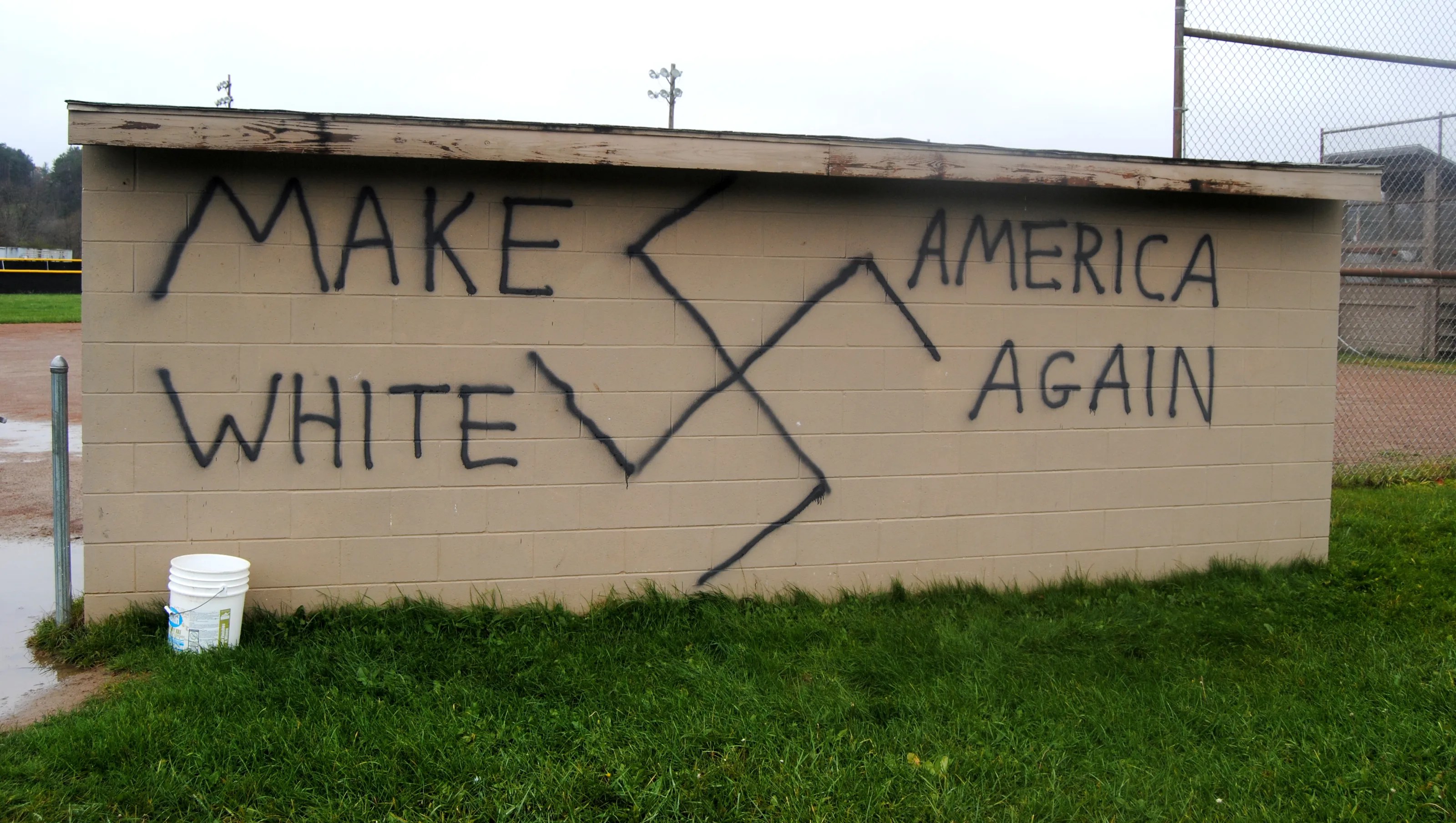
If you’ve ever wondered what happened in Germany that gave rise to Nazism, you are a but a step away from experiencing it. He’s given you an enemy. He’s made you fear them. He’s put the blame for all the country’s problems on them. And he will paint all who oppose his actions to “save” the country as anarchists.

American Hegemony

The Donroe Doctrine

The United States of America is on course to reincarnate the worst of the powerful era of Athens, the devastation of choosing military intervention over diplomacy, and embracing a dangerous foreign policy based on might rather than reason.

We have gone from the shining light on the hill to the bully in the school yard.

People who support this change, or more likely don’t even realize it’s happened, will make arguments like, “getting rid of Maduro is a good thing.” That remains to be seen from the perspective of the Venezuelan people, but if one wants to measure the legitimacy of military interference by the evil nature of a country’s government, a host of candidates match or exceed Maduro.

By that measure we should invade North Korea, Russia, China, and Saudi Arabia. The list of countries engaging in systematic abuse of human rights is long. We will need many weapons.

And there is a bit of introspection we might want to do at home starting in Minneapolis.

But let’s leave that for another time.

It would seem we prefer to go after low hanging fruit rather than a genuine commitment to righting all the world’s wrongs. So, in that vein, we set our sights on Greenland. What many of you may not realize is we have a military base in Thule, Greenland. Pituffik Space Force Base. Currently there are only about 150 military personnel stationed there, but at one time there were several thousand troops there specifically monitoring Russian and Chinese military operations.

he 1951 Greenland Defense Agreement allowed the United States to operate the base under a NATO framework, as long as both Denmark and the United States remain NATO members. Under the agreement, the Danish national flag must be flown at the base to recognize that the base is on Danish territory, but the United States is allowed to fly its own flag alongside the Danish flag on the facilities it operates.

Let that marinate in your brain for a bit. Since 1951 the government of the United States has recognized both the strategic military value of Greenland to our defense and, more importantly that Greenland is Danish Territory. So we are either a country that keeps its promises or we are not. What’s it gonna be?

If we have an agreement allowing us to accomplish the purpose of defending the United States against Russian or Chinese missiles, why do we need to incorporate Greenland into the United States. Why the belligerence between two nations long allied by NATO?

An excellent question.

By this point, you might be wondering why the comparison to Athens and what does that have to do with Greenland and Venezuela.

Let me explain.

At the height of the Athenian empire, around 416 B.C., it was one of the richest and most powerful nation states in the world.

They were at war with Sparta and her allies during the Peloponnesian War. Athens controlled almost all the islands of the Aegean except Melos. Athens sent an army of 2000 men and demanded the people of Melos submit to Athens rule and pay a tribute of silver.

Melos, although historically allied with Sparta, was neutral in the war. Melians argued from a position of morality that Athens was wrong to assert control simply because it was more powerful.

The argument fell on deaf ears, the Athenians laid siege to the island, killed all the men and boys, and enslaved the women and girls. As a side note, this bears a remarkable resemblance to much of the God directed smiting and decimation in the Old Testament, right down to the enslavement of women and killing of all males. But I digress.

From this incident, arose a process known as the Melian Dialog.

The “Melian Dialogue,” found in Thucydides’ History of the Peloponnesian War, presents a stark and philosophically significant exchange between representatives of Athens and the people of Melos during the Peloponnesian War. In this dialogue, the Athenians demand Melos’s surrender and argue for the dominance of power and self-interest over notions of justice and morality, asserting that the strong do what they can and the weak suffer what they must. The Melians plead for justice, neutrality, and hope for divine intervention or Spartan assistance. Ultimately, the dialogue exposes the harsh realities of international relations and the limits of idealism in the face of overwhelming force, culminating in the tragic fate of the Melians after their refusal to yield.

Now we find ourselves with a government embracing a foreign policy and, one might argue, a domestic one, “asserting that the strong do what they can and the weak suffer what they must.”

Since the end of World War II, the world has generally been free of one sovereign nation invading another sovereign nation. While there have been plenty of civil wars and revolutions, the world has not endured a large-scale invasion until recently with Russia’s unprovoked attack on the Ukraine. Of course, in the interest of full disclosure, we could also mention our invasion of Panama.

Invasion was recognized, in light of the devastation of World War II and the dawning of the nuclear age, as a dangerous policy fraught with risks far beyond any reasoning justifying an invasion. Particularly one based on “the strong do what they can and the weak suffer what they must.”

The most troubling thing is a significant number of Americans either agree with the idea of might makes right or are too fooled by this government’s propaganda to recognize the reality, and insanity, of the situation.

After decades of NATO being the most successful joint protection agreement in history, we face the perspective of NATO troops coming to the aid of a NATO member nation not to stop an action by a non-aligned nation but actions by the United States of America.

All because we have put in the office of the President the least qualified person in the world and watched him surround himself with sycophants and those who lack even a fundamental understanding of history, diplomacy, or foreign relations.

The history of the world is full of times when a most powerful nation existed and let their own arrogance and might destroy them. In a nuclear armed world, every nation, no matter how powerful, is vulnerable to the weakest enemy willing to resort to such weapons. Now is not the time for arrogance, now is the time for calm rationality of which the US, should it choose so, can lead the world.

As the keeper of the most adept military in the world, we face a choice. We can follow the course of history and be the architect of our own destruction or show to the world that this American experiment is different.

To paraphrase General Colin Powell, all America has ever asked for when aiding other countries facing invasion is land to bury our dead. Let us not forget that.

You need only to open your eyes to see the problem.

Bearing Witness to the Unjust Slander: Defending Renee Good and the ICE Officer

Why Dishonestly Besmirching Character Hurts Us All

In an age where reputations can be destroyed with a few keystrokes, the vicious phenomenon of besmirching the character of individuals we may disagree with has become a troubling norm, and few cases illustrate this more painfully than the recent attacks against Renee Good and the ICE Officer. The culture of public shaming, rumor-mongering, and baseless accusation not only harms the individual but also erodes the foundation of our collective trust and civility. The relentless character assassination of these two individuals offers a case study in why we must resist such destructive tendencies and reclaim the values of fairness and respect.

The Dark Power of Slander in the Digital Age

The digital revolution was supposed to democratize information and increase transparency. Instead, it has often provided fertile ground for half-truths, personal vendettas, and outright lies to flourish. In this environment, where anyone with keyboard courage can post anything anonymously, there is no justifiable reason or benefit—a campaign not rooted in facts or legitimate criticism, but rather in innuendo and unsubstantiated claims. Online platforms, amplified by the echo chambers of social media, allow damaging narratives to spread far beyond the reach of reasoned rebuttal. Once a reputation is sullied, it’s almost impossible to fully restore, regardless of the truth.

The Personal Toll: A Life Turned Upside Down

For those who have observed or experienced it, the defamation of an individual is not an abstract concern; it is a lived nightmare. The impact is not limited to professional setbacks or fleeting embarrassment. Slander can lead to loss of livelihood, social isolation, and even mental health crises. In Renee’s case, what is lost in the noise that she is a victim here. In the officer’s case, his presumption of innocence is tossed away for political purposes. The pain inflicted by such attacks is long-lasting and deeply personal, affecting not just the target but also their family and friends.

Slander as a Social Disease

We must ask ourselves: what kind of society do we become when we allow character assassination to go unchecked? This  is not just an attack on one person; it is a symptom of a broader social malaise. When the public rushes to judgment, prioritizing outrage over investigation, we undermine the principles of due process and empathy. This culture of suspicion and cynicism weakens our social fabric, making it less likely that people of principle will step forward to serve or lead. The chilling effect on civic engagement is considerable, as few are willing to risk being the next target of mob justice.

Standing Up Against Unfounded Accusations

It is not enough to shake our heads in dismay about the treatment of Renee Good and the ICE Officer. As a community, we have a responsibility to counteract the forces of rumor and slander. This means refusing to share or engage with unverified allegations, demanding evidence and fairness in all matters of public concern, and holding ourselves to the same standard of respect we would wish for ourselves. Defending the maligned is not just an act of kindness, but a defense of our shared humanity.

Reclaiming the Value of Character

Ultimately, the way we treat individuals is a reflection of who we are as a society. We must remember that character is built over years, but can be destroyed in minutes if we are not vigilant. Let us reject the easy path of gossip and condemnation and instead choose the harder, nobler road of discernment, forgiveness, and support. In doing so, we restore not only the reputation of those unfairly maligned, but also the values that make our communities strong.

The campaign against these two is a tragedy, not just for them but for all of us who aspire to decency and fairness. Let this story serve as a call to action—a reminder that our words matter, and that we are all responsible for the world we create with them.