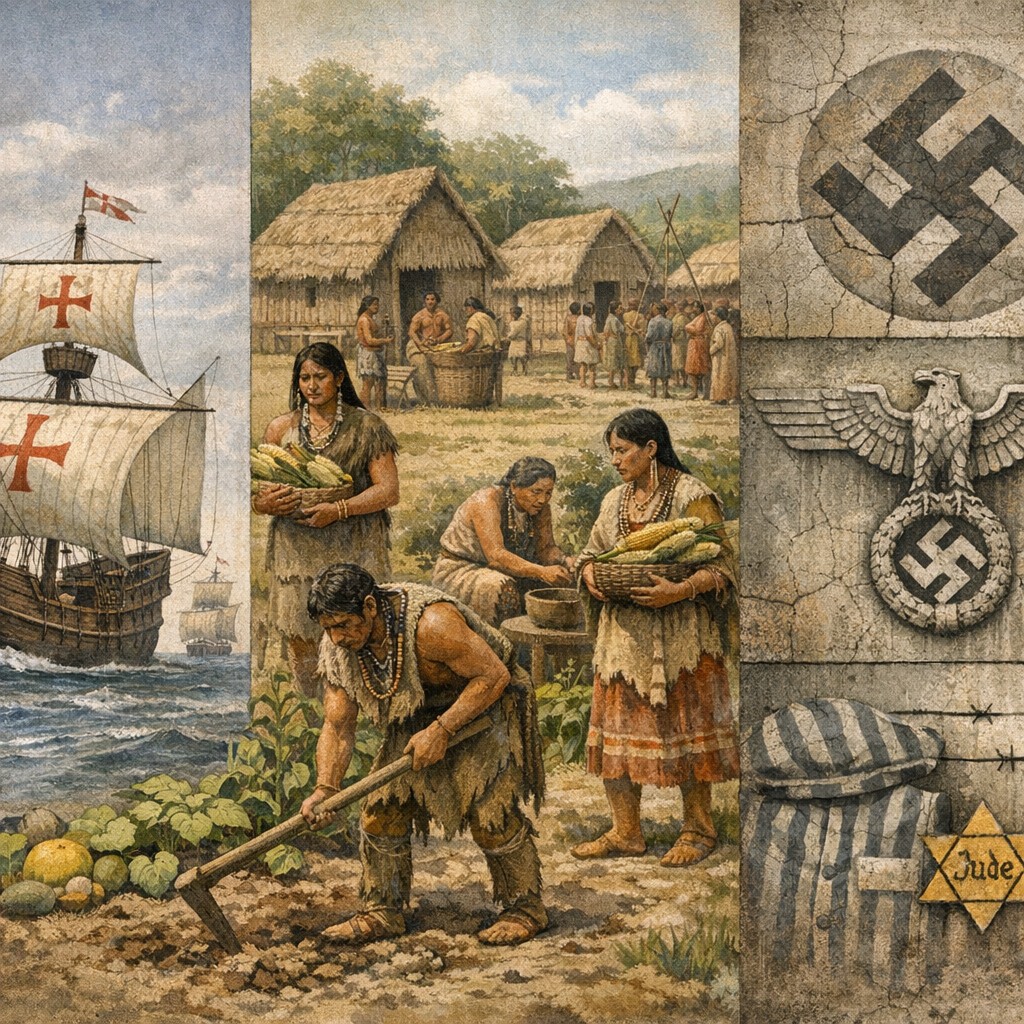
Surprise History Quiz
Okay, books away, grab a pen (actually, keyboard) and answer this question, What is the worst Holocaust in recorded history? Answer at the end of this column, but you’ll see it, or should, long before that. Okay, go.
The Latest Trumpian Idiocy: Trump administration erases Native American, slavery history from U.S. national parks
https://english.news.cn/northamerica/20260201/477bfd64d4094e3480863616cd371ed2/c.html
To the victor goes the spoils and the opportunity to write the history. This administration is on a mission to whitewash any inkling of historical facts that place the United States in a bad light.
Slavery was uncompensated skills training and religious reorientation from heathenism with room and board.
The Trail of Tears was an all-expenses-paid government relocation program offering free land and the opportunity to live in other parts of the United States. And, when the discovery of oil, uranium, and other minerals spoiled the landscape, they were moved without cost again, and again, and again.
The European conquest of the Americas was a free offering of advanced technology to backwards people.
Somehow, Mr. Trump believes that removing references to historical facts will change reality. The saddest part of this is that he may not have to. Much of the history of slavery and the treatment of Indigenous peoples by Europeans, and by Americans after the establishment of the country, is glossed over in most classrooms.
This is how people fail to learn from history.
The Answer to the Quiz
The decimation of indigenous people as a result of the arrival of Europeans to the Americas after 1492 dwarfs the deaths of the Holocaust of Nazi Germany.
While there are differences—timeframe, historical context, methodology—they all stem from the same ignorance-based prejudice against one group by another.
The genocide of Indigenous peoples in North, Central, and South America and the Holocaust of Nazi Germany were both driven by dehumanizing racial ideologies and caused immense loss of life. Still, they differed markedly in form and context. Indigenous populations in the Americas were devastated over centuries through a combination of introduced diseases, forced labor, land dispossession, cultural destruction, and recurring episodes of mass violence linked to European colonization, with responsibility spread across multiple empires and states. The Holocaust occurred over a short, defined period (1933–1945). It was a centrally planned, state-run genocide, using industrialized methods such as ghettos, deportations, and extermination camps to systematically murder Jews and other targeted groups. While both cases reflect the lethal consequences of racism and exclusion, they differ in duration, organization, methods, and contemporary documentation and postwar accountability.
It is vitally important to understand both the outcomes of these historical events and how they occurred.
Perhaps the sheer numbers may make it harder to ignore.
Nazi Holocaust
The accepted number for people killed by the Holocaust and Hitler’s final solution is 11 million. 6 million Jews, and 5 million Roma (Gypsies), disabled individuals, Polish and Soviet civilians, prisoners of war, homosexuals, and political opponents.
Slavery
When combining deaths before transport, during the Middle Passage, and under enslavement, historians often cite a total death toll of roughly 10–15 million people attributable to slavery in the Americas, with some broader estimates reaching higher when including wider African demographic losses tied to the system.
Post-Columbian Deaths of Indigenous Peoples
Most scholars today estimate that between 50 and 60 million Indigenous people lived in the Americas in 1492, and that by 1600–1650, roughly 85–90% had died as a result of European arrival. This implies about 45–55 million deaths across North, Central, and South America.
These deaths resulted primarily from introduced Old World diseases (such as smallpox, measles (wait, measles kill people?), and influenza), compounded by warfare, enslavement, forced labor, famine, displacement, and social collapse under colonial rule. While earlier estimates varied widely—from as low as 10 million to over 100 million—modern syntheses of archaeological, ecological, and documentary evidence have converged on the ~50–60 million precontact population and ~45–55 million deaths as the most defensible range.
The most dangerous killer of humans is prejudice.
Removing a few signs may eliminate obvious reminders of this tragedy, but it will not erase the reality. The United States learns from its mistakes. There are exceptions —the last Presidential election being the most glaring—but generally, we benefit from an open and frank analysis of our decisions and actions. It is what differentiates us from many other nations.
This folly of revising history isn’t new—The Civil War is known in the South as The War of Northern Aggression—but it is dangerous.
We have a friend from Germany, and we often talked about how a country as advanced, progressive, and educated as Germany descended into the horrors of Nazism. While there is no one answer, fear is a significant factor. And fear is almost exclusively a result of a lack of understanding and empathy.
I hope that, as we approach the mid-term elections and, more critically, the next Presidential election, we return to a nation that embraces empathy and intelligence over fear and ignorance.
And perhaps Columbus Day isn’t such a good idea after all.
 The Writing of Joe Broadmeadow