He is not admired or respected but inexplicably feared.
He has never written anything memorable or notable.
His personal and professional lives are filled with betrayal and failure.
And yet millions of Americans are mesmerized by him, placed into a catatonic state of blind devotion.
Helen Arendt, a brilliant writer and researcher who crafted a fundamental and articulate explanation for the rise of Nazism in an intellectually advanced and otherwise rational Germany, explains it this way.
If a society feels disconnected, and the perception of decline of white, primarily male, dominance fulfills this role in the US, they seek someone who will do two things. Identify the enemy (in this case Immigrants, DEI, and progressiveness) and offer them a solution.
Mr. Trump does this while ignoring the courts, sending armies of occupation into America cities, and emasculating Congress, all to rousing cheers of the faithful. Perhaps not as drastic as the Final Solution but nevertheless horrifying in its usurping of civil rights, discourse, and conduct.
I’ve come to realize the most ardent Trump supporters are like a flock of chickens. Everyday the man arrives and feeds them what they want to hear.
How their problems are not their fault but a conspiracy by those different than them trying take away their rights.
How only he, with absolute power, can fix this and save them.
How everything he does, he does for them and not for his own personal enrichment.
They look forward to his arrival, feasting on the largesse of his benevolence, until the day he wrings the neck of one of them to satisfy some perceived offense.
And by the next day, they’ve forgotten all about the event.
They wait excitedly the next day and the next and the next, some fed, some killed, until everything has been taken away from them.
Too late the flock realizes they are now dependent on him to survive yet powerless to prevent his callous and unremittent control over their very lives.
That is the quintessential example of Trump Derangement Syndrome; willful ignorance in the face of reality.
We face a multi-pronged existential crisis in this country.
A perfect storm of anti-science dumbing down of critical thinking, a growing intolerance for those who may be different than the majority, and an increasingly dangerous march toward an imbalance of power in government.
These phenomena are further inflamed by co-opting normally benign religious faith by Christian Nationalists which is merely a mask worn by those seeking to oppress any other belief system to further their own agenda and is most unchristian in practice.
It is nationalist in the worst sense of seeking domination over all others, is intolerant of any dissension, and is Christian for convenience not doctrinal integrity.
Whatever your faith may be, no true religion seeks to turn their god into a bullet and shoot it into another human’s heart. Claiming that any God has chosen one people over all others is a manmade fallacy whose only purpose is to justify dominance over and oppression of others.
The fact that in the 21st century, the most powerful nation in the world would seek to justify their policies based on primitive beliefs from an age dominated by illiteracy is frightening. That it even enters into the discussion is inexplicable.
The danger of such a course for government policy should be self-evident.
A significant number of Americans firmly believe that God can suspend the immutable laws of physics to perform miracles absent one iota of evidence. They then interpret their success in light of this faith as proof of the dominance of the Christian god.
This religious façade then fuels the most unchristian treatment of their fellow humans, reckless disregard for the sanctity of life of those of different cultures and faiths, and justifies their embracing a philosophy more characteristic of the bloody religious crusades then a pursuit of justice and peace.
“…no true religion seeks to turn their god into a bullet and shoot it into another human’s heart.” Joe Broadmeadow
We are engulfed in a battle for the soul of this country. The hobgoblins representing the worst of what humans can do to their fellow humans are guiding many of our actions. They have attacked the very foundation of this nation. Laws are tools wielded by those in power and ignored when they are inconvenient.
When a sitting President can exhibit callous disregard for the Constitution, and Americans who should know better remain silent because it feeds their prejudice, it is a sign of dangerous times.
There are indications of a growing resistance to this corruption of country. There is still the framework for the balance of government to reassert itself. But we are in a tenuous position.
The dangerous mix of twisting sincere religious beliefs into something that supports intolerance and ignores the Constitution underscores the danger and reinforces the brilliance of the founding fathers in explicitly separating church and state.
If we don’t resist this march into anarchy, we may find ourselves at the point of a gun loaded with bullets under the patina of religious commandments and aimed at our hearts. And they will squeeze the trigger with a smile on their face, certain they are acting as God wants them to.
“It doesn’t matter what you believe, as long as you’re sincere,” is one of those sayings that, on its face, seems harmless but carries a hidden danger, as many recent incidents have demonstrated.
Belief alone, no matter how sincere, can be dangerous without context, or evidence. If faith can convince you to believe in absurdities, it can convince you to commit atrocities.
I came upon a recent story that illustrates a troubling trend. The evangelical Christians among us would force a different version of this saying on all aspects of life, most concerning being in academia.
These Christians would have the motto changed to, “It doesn’t matter what you believe as long as it comes from the Bible.” This is now their desired philosophy for educational standards in the United States.
And they would add the demand, “…and cannot be challenged or questioned but must be respected by everyone.”
The story concerns Samantha Fulnecky (see link here), a junior at Oklahoma State University who was assigned an essay on gender stereotypes for a psychology class.
Here’s the background on the story with links to the original assignment and the article upon which the essay was to be based.
The assignment called for students to write a clear and thoughtful 650-word response to a scholarly article about gender expectations in society. According to screenshots shared by Turning Point USA’s local chapter, Fulnecky wrote in her essay that the article irritated her and described how God created men and women differently. “Society pushing the lie that there are multiple genders and everyone should be whatever they want to be is demonic and severely harms American youth,” she wrote.
Mel Curth, a graduate teaching assistant, wrote as part of the grading process that she had deducted points because Fulnecky submitted a “paper that does not answer the questions for this assignment, contradicts itself, heavily uses personal ideology over empirical evidence in a scientific class, and is at times offensive,” according to the screenshots of her messages.
Megan Waldron, a second graduate student who teaches the course alongside Curth, agreed with the grade. “Everyone has different ways in which they see the world, but in an academic course such as this, you are being asked to support your ideas with empirical evidence and higher-level reasoning,” she wrote to Fulnecky, according to the screenshots.
Those of you who read the assignment understand that this wasn’t an endorsement of any particular agenda. It was a discussion about gender stereotypes in society. It was not a rallying cry for societal endorsement for transgenderism.
It would seem, in the conservative Christian view, boys play with trains and planes, girls play with dolls and have tea parties. Men are rugged and virile; women are caring and docile. Men go to work, women care for children. To quote Ms. Fulnecky, God created women with “womanly desires in our hearts…to be helpers.” She offers her faith that the way God intended it to be as stated in the Bible is evidence and settled. No discussion necessary. (Satire alert!, I have to post this because you’d be amazed at the number of people who miss it.)
Now, had this been a Bible Study or a comparative religion class challenging these secular contentions, perhaps Ms. Fulnecky’s (or should I say Miss, in keeping with the dark ages philosophy) essay would have been acceptable.
This was a research assignment in an educational environment, with an expectation of academic standards, i.e., citations of sources, presenting evidence, and applicable documentation to support the position. The Bible does not meet the criteria of a peer-reviewed study.
Ms. (Miss) Fulnecky was free to argue her point of the sole existence of two genders and challenging, or concurring with, societal expectations as long as she submitted supporting evidence. She did not. She submitted biblical beliefs absent any proof. She wrote an op-ed when the assignment called for something entirely different.
The problem arose when she was challenged on her material. She did what all religious do and immediately complained she was being persecuted for her beliefs.
Nonsense.
None of the remarks on her paper suggested she abandon her faith; they simply pointed out that she had misunderstood, or more likely ignored, the simple instructions because she saw it as challenging her faith. FYI, that is what education is all about, challenging concepts and beliefs in pursuit of truth.
I would hope that, since she was in a Pre-med program, she would realize that, once she got to medical school, if she suggested prayer as a form of therapy or treatment in a medical school class on infectious diseases or fractured bones, she would be expected to present clinical evidence of its efficacy.
If she didn’t, and was given a poor grade because of this, it wouldn’t be persecution of her faith; it would be saving the lives of patients from ineffectual treatment. Emergency rooms may be the site of many prayers, but they are not part of any treatment protocols.
Want to know the best proof that prayer is an ineffectual form of treatment? If there were even the slightest clinical evidence of the efficacy of prayer, insurance companies would be telling their clients to pray rather seeking payment for medical care.
They might even consent to offer priest, minister, or rabbi services if needed depending on what plan you had. They’d have clever marketing slogans, We Pray so you Don’t Pay. Prayer it’s not just for Sports Teams Anymore. A Prayer a Day Keeps the Doctor Away.Pray and the Pain goes away.
Ms. Fulnecky is free to hold any belief she likes, but her belief is not evidence. However, if she argued her point, contending that it is, she must expect this contention to be challenged.
This story, which began as just a local disagreement between a student and a teacher, took on national prominence with the entrance of Ryan Walters, former Superintendent of the Oklahoma School System, famous for insisting on posting the Ten Commandments in schools and imposing other Christian doctrines on the academic environment.
He thankfully resigned and now works for the Teacher Freedom Alliance (https://www.teacherfreedomalliance.com/). This group opposes teachers’ unions and touts itself as dedicated to developing “Free, Moral, and Upright Americans.”
He also sought the assistance of Turning Point America, which published a post on X (racking up, according to them, 47 million views) claiming one of the instructors was transgender, as if that in and of itself were sufficient grounds to remove this individual from teaching.
Free, moral, and upright indeed. Let’s hope Mr. Ryan never becomes a CEO of a major medical insurance company or, in light of some of the other unusual Cabinet appointments, the Director of the CDC or HHS.
The case also led to two instructors being placed on leave and one being removed from teaching when the conservative-majority legislature threatened to cut funding for the school.
All because a student, so mesmerized by religious faith, chose to ignore the plain language of the assignment, offered her religious doctrine as evidence, then was surprised and “persecuted” when the instructor pointed out the lack of evidence, the failure to follow the instructions, and graded the paper appropriately.
No one demanded the student renounce her beliefs. No one burned her at the stake. No one excommunicated her from the school. No one made her wear a scarlet letter.
She got a poor grade because she deserved it.
She was certainly free to submit evidence to support her contention. She had access to the library’s academic literature on gender and to online sources. She chose to argue on religious grounds in an educational environment where challenging the validity of any contention is integral to the process.
It was never about seeking the truth when Walters and Turning Point got involved; it was about demanding their faith be accepted on face value and threatening those who would challenge it.
The faithful opposes the disease of curiosity and resist the squandering of ignorance. They do not seek acceptance, they seek unquestioning surrender to their form of faith and seek to eliminate others.
Any resistance is seen as persecution.
Nothing could be more dangerous to education than blind acceptance of any statement or contention. That is not teaching; it is indoctrination. Religions indoctrinate the young and try to suppress any questioning of the faith, usually by instilling fear of everlasting punishment in the afterlife.
Education teaches people to challenge and question everything. It encourages curiosity, provides skills to examine the factual basis of things, and teaches people to see the value of evidence and proof.
This is an anathema to religions.
I bet the language the organizations supporting Ms. Fulnecky find most offensive (or recognize as most problematic) was the “expectation of empirical evidence and higher-level reasoning,” knowing full well that it is an impossibility concerning religious doctrines.
One can be admired for holding sincere beliefs in their faith. The truly sincere realize some aspects of faith are not subject to academic inquiry. They accept this and do not demand this doctrine be accepted as anything else but a belief absent evidence. This country offers protection for engaging in such practices and protection from these practices being imposed on others.
“But when you pray, go into your room, close the door and pray to your Father, who is unseen. Then your Father, who sees what is done in secret, will reward you.” – Matthew 6:6
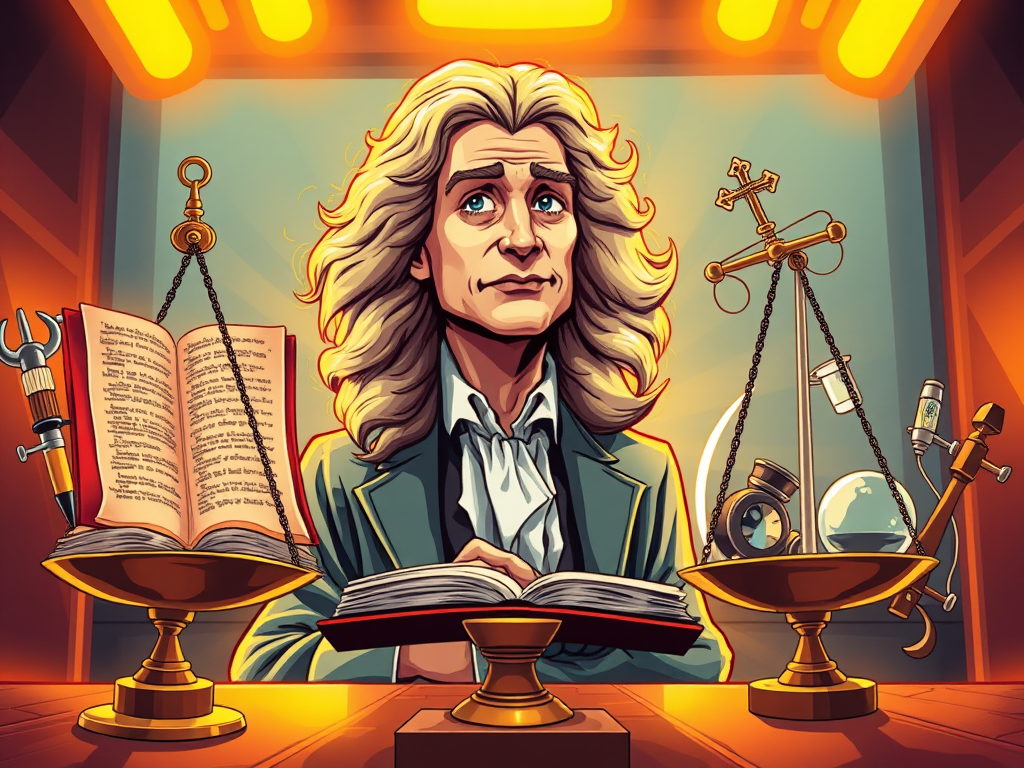
Many were quick to point out the Newton was a Christian or that his birthday is more commonly recognized as January 6, 1643. The discrepancy stems from the use (at the time) of the Julian Calendar which had the birthdate as December 25, 1642.
Which, of course, is a key element of the satirical nature. I’d never mentioned anyone else, but Christians seem to be fixated on a perception of persecution. This contention, in a majority Christian country like the United States, is a bit of a stretch.
The hyper-religious responded with the usual avalanche of biblical tracts and outrage. Why, you might ask? I have no idea. Because, even if we agree to the calendar change, on December 25, 0000, I am certain Jesus was not the only birth worldwide nor the only consequential one. Nor is there any consensus on that date except it conveniently co-opted a much older Pagan celebration. And we know how the church does not like competition.
When this was all shouted at me with the vigorous use of all capital letters and the usual accusation of my being a disciple of Satan, mixed in, I will admit, with the good intentions of praying for my soul that I may see the light and come to Jesus, I said I would stick with Newton and Galileo.
This caused another round of claims that Newton AND Galileo were Christian. When I pointed out the rather threatening treatment of Galileo by the Church, i.e., house arrest and forced recantation at the threat of immolation, I was sent a slew of “authoritative” postings about the “myth” of Galileo’s treatment by the Church.
This consisted of claims that; it wasn’t so bad, his house arrest was benign, many in the church agreed with him but the bureaucracy was responsible, as if that would have somehow cooled the flames. Then, I pointed out, there is Giordano Bruno who was not afforded the “luxury” of house arrest but was put to the flame.
This is a fine example of history being interpreted by those with an agenda. And these differences arise regarding events from just a few hundred years ago for which we have fairly substantial records. Yet, they express no concern about the accuracy of their claims regarding events two thousand years ago for which we have few contemporaneous records.
What these sincere but misled individuals fail to see is their argument supports my contention. The Bible is not the inerrant word of God, but the sometimes inspirational and beautiful, sometimes banal and pedestrian, yet more often horrific words of men trying to understand a complex world, give meaning to their short, violent, and plague-filled lives, and, more troubling, exert control over the lives of others masked by the claim of doing God’s work.
The Church first resists with deadly vigor any challenges to doctrine, be it heliocentrism, genetics, or evolution. Then, after the evidence becomes overwhelming, it attempts to rewrite history with claims that Galileo was punished for his attitude toward the church and his house arrest was evidence of the church’s true goal and good intention.
Then, back to the parables and passages to reinterpret them as supporting the science all along.
Galileo, Newton, and many of the most influential pioneers of science were Christian at a time when not to be was fraught with both economic and physical challenges. It is also true that many within the Church understood the Biblical explanations were merely placeholders until discoveries based on evidence came along.
Before we understood geology and plate tectonics, a 6,000 year old earth sounded ancient.
Before we understood planetary mechanics, we believed our eyes and the sun rose in the east and set in the west.
Before we understood the symptoms and pathways of epilepsy, demonic possession made sense.
Before we turned the first telescopes on the “heavens,” we believed our planet to be unique in the universe.
Whether or not Newton was born on December 25, 1642 or January 6, 1643 is irrelevant. Whether he proclaimed himself a Christian at the time is also irrelevant. His Philosophiæ Naturalis Principia Mathematica changed the world in ways even more startling than the legend of a savior born centuries beforehand whose story was manipulated by those with an agenda to make it fit prophecies affirming their particular faith.
Next year, let’s celebrate the Dec. 25th birthday of Carlos Castenada, a writer of extraordinary mystical literature. Surely that won’t offend anyone.
In 2006, in the cold Arctic north, in an area on Ellesmere Island in Nunavut, Canada, the fossilized remains of our great, great, great to the nth degree uncle Tiktaalik were discovered. The name, Tiktaalik, is a Inuktitut word meaning “large freshwater fish.” The fossil was estimated at 375 million years old.
What this fossil did was fill in one of the “missing links” in the fossil record between amphibians and the tetrapod (four-legged animals.) The skeleton of the fish bore the unmistakable evidence of early formation of shoulder and wrist structure.
One of the scientists involved in the discovery, Jennifer A. Clack, a Cambridge University expert on tetrapod evolution, said of Tiktaalik, “It’s one of those things you can point to and say, ‘I told you this would exist,’ and there it is.”
Just as evolution described it would exist, it did. Uncle Tiktaalik is just one example. It filled a gap previously occupied by the intelligent designer fallacy, the god of the gaps.
The (inane) argument against evolution, the promotion of the teleological argument for the existence of god, aka intelligent design, is gaining ground in public education. It is the opening round of the dumbing down of America.
Proponents assume both are on equal footing and should be “taught” in school. Nothing could be more detrimental to education than teaching students unquestioning acceptance of information without proof.
It is not teaching, it is indoctrination. Science admits it cannot explain everything, but continues to seek the answers. Religion claims you can’t explain it so it must be god and no further inquiry is necessary.
The contradiction arises in what one considers teaching. In teaching science, one details not just the result or most comprehensive theory (in the scientific sense) but the process and the emphasis on skepticism. Science is based on the ability of independent verification, or falsification, of the conclusions. Nothing more so than the unquestionable evidence for evolution.
Teaching Intelligent design, the teleological argument for the existence of god, is the educational equivalent of “Because I said so…” As are most religious instructions. No fundamental understanding of the process is necessary. Understanding is an anathema to faith. As a matter of fact, I would argue the teaching of Intelligent Design specifically prohibits and discourages any questioning of the logic (or lack thereof) behind the contention and demands it be accepted.
It is similar to the argument for the god of the gaps. where “god” fills the gaps in scientific knowledge. This argument fails, of course, with each new scientific advance. And, to demonstrate the inconsistency of these arguments for existence of a supreme being, whenever science fills in one of these gaps, a new interpretation of Biblical verse is proposed, i.e. the Bible knew this all along.
Here’s one example.
“The idea is that as scientific research progresses, and an increasing number of phenomena are explained naturalistically, the role of God diminishes accordingly. The major criticism commonly states that invoking supernatural explanations should decrease in plausibility over time, as the domain of knowledge previously explained by God is decreasing. However, with modern advances in science and technology, the tables have been literally turned. With the advent of electron scanning microscopes, we have been able to observe the intricate workings of the cell for the first time. What had originally and simplistically been thought to be nothing more than a “blob” of protoplasm is now seen to be far more complex and information-packed than had ever been conceived of previously… …In reality, a belief in God can be derived by means of an objective assessment, rather than the subjective conjecture that may have been the case millennia ago. But many people simply deny what is obvious to them. The Bible addresses those very people: “The wrath of God is being revealed from heaven against all the godlessness and wickedness of men who suppress the truth by their wickedness, since what may be known about God is plain to them, because God has made it plain to them. For since the creation of the world God’s invisible qualities—his eternal power and divine nature—have been clearly seen, being understood from what has been made, so that men are without excuse” (Romans 1:18-20). The God-of-the-gaps argument is an example of “suppressing the truth” because it relegates God to a “backup” explanation for those things which cannot yet be explained by natural phenomena. This leads some to the faulty conclusion that God is not the omnipotent, omnipresent, absolute Being of whom Scripture testifies. …There is much for which the natural sciences simply cannot provide an explanation, such as the origin of the time/space/matter continuum and the fine-tuning thereof; the origin and subsequent development of life itself; and the origin of the complex and specified information systems inherent in all living things, which cannot (nor ever will be) explained by natural means. Thus one cannot rationally divorce the supernatural from the observed universe, proving once again that “in the beginning God created the heavens and the earth” (Genesis 1:1).” https://www.gotquestions.org/God-of-the-gaps.html
They apparently can’t even recognize the inconsistency in their own writing. “God’s invisible qualities—his eternal power and divine nature—have been clearly seen.” Ah, if they are invisible how can they be seen? Or that the fine-tuning argument has long been overcome by evidence. Nor can they get past the “uncaused cause, the unmoved mover, or the who created god” issue.
Nothing could be more detrimental to education than teaching students unquestioning acceptance of information without proof.
Joe Broadmeadow
This invasion of public secular education by the religious evangelicals was foretold by one of the most preeminent conservative Republicans, Barry Goldwater, and called out for what it was, a usurping and diminishing of public education, secular government, and the separation of church and state.
“Mark my word, if and when these preachers get control of the [Republican] party, and they’re sure trying to do so, it’s going to be a terrible damn problem. Frankly, these people frighten me. Politics and governing demand compromise. But these Christians believe they are acting in the name of God, so they can’t and won’t compromise. I know, I’ve tried to deal with them.” Barry Goldwater.
If evangelicals get full control of public education, we are in serious trouble. There would be blind acceptance of this type of nonsense, the devil in the smoke of 9/11. Another mythological creature “seen” by the hysterical faithful to justify their faith.
Something that can easily be explained by the behavior of heat and gasses and a powerful example of how our evolution made pattern recognition a key to survival. Better to think what you see is a danger, i.e. a lion, a snake, etc. than to ignore it because of uncertainty.
Given the opportunity, evangelicals would replace the periodic table with the decalogue, a map of the solar system with an earth-centered universe, and replace teachers who encourage students to question everything with parrots of the irrational who teach blind acceptance.
I write quite a bit about religion and the objections to it that I’ve developed over the years. My objections are not about religion itself, but the insistence on the dominance of one over any other.
When religion is defined “as an interest, cause, belief, or activity that is intensely or passionately held to,” or, “to turn to or adopt an enlightened course of action or point of view,” I have no quarrel.
Under this definition, embracing science as an enlightened course of action is a form of religion. There are distinct differences: science revises its texts when new evidence is uncovered, whereas most religions insist their holy texts are not to be refined or updated.
My main issue with what most people would consider religion—Christianity or Judaism in this country, Islam in others—is the insistence that theirs is the only true religion and that there is a being who is the eternal overseer, has us under constant surveillance, and can intercede on our behalf if one engages in an appropriate level of worship, recites prayers seeking this intercession, and accepts the results, no matter what happens, as a “mystery.”
And in particular, when they insist on defining this country as a “Judeo-Christian” nation as if that is somehow both necessary and beneficial.
Now, to engage in one of my favorite practices, the Devil’s Advocate (which, under the title of Advocatus Diaboli, was once a position within the Catholic Church), I’d like to talk about some of the known benefits of embracing religion and misconceptions as well.
Study of the Benefit of a Religious Upbringing
In 2018, Harvard University published a study in the American Journal of Epidemiology that demonstrated that being raised with religious practices had a positive effect on early adulthood. (“Associations of Religious Upbringing With Subsequent Health and Well-Being From Adolescence to Young Adulthood: An Outcome-Wide Analysis,” Ying Chen and Tyler J. VanderWeele, American Journal of Epidemiology, online September 13, 2018, doi: 10.1093/aje/kwy142)
“Participating in spiritual practices during childhood and adolescence may be a protective factor for a range of health and well-being outcomes in early adulthood, according to a new study from Harvard T.H. Chan School of Public Health. Researchers found that people who attended weekly religious services or practiced daily prayer or meditation in their youth reported greater life satisfaction and positivity in their 20s—and were less likely to subsequently have depressive symptoms, smoke, use illicit drugs, or have a sexually transmitted infection—than people raised with less regular spiritual habits.” https://hsph.harvard.edu/news/religious-upbringing-adult-health/
I would argue that these religious prohibitions on certain activities are a temporary measure, effective until one matures into a rational being. Religion then serves a diminished, or perhaps even an unnecessary, purpose.
Study of the Efficacy of Prayer
1998. Herb Benson, a cardiologist at Harvard, led what became known as the “Great Prayer Experiment,” or technically the “Study of the Therapeutic Effects of Intercessory Prayer (STEP). (https://pubmed.ncbi.nlm.nih.gov/16569567/)
The study consisted of three control groups. A control group (no prayer) and two groups that received intercessory prayer from various Christian denominations. The two groups receiving prayer differed: one knew they were being prayed for, while the other did not.
“Complications did not vary as a function of prayer. But 59% of those who knew they were being prayed for experienced at least one complication compared with 52% who received no prayer, a statistically significant result. This might reflect the creation of unrealistic expectations from knowing one is the recipient of prayer and experiencing stress when those expectations are not met.” (https://www.templeton.org/news/what-can-science-say-about-the-study-of-prayer)
What does this mean? I suppose that would depend on one’s perspective. At a minimum, it challenges the belief that inexplicable things must be the work of an interested or faithfully petitioned god.
Perhaps it is the pageantry of religious ceremony in our formative years that provides a benefit. As I am writing this, I am listening to a mix of Gregorian Chant and Handel’s Messiah, works inspired by faith. No one can resist being inspired by the sounds of Plain Chant or the Alleluia Chorus from the Messiah echoing in a magnificent cathedral.
And I can still recite the Mass in Latin and remember the cue to ring the bell.
I think believing in something beyond one’s understanding isn’t necessarily bad, unless one insists, by persuasion or force, that others adhere to the same concept.
I have a good friend I’ve known since the 8th grade. Kent Harrop is a retired minister who fully embraces his faith. He and I once collaborated on a blog called the Heretic and the Holy Man, where we discussed our different perspectives on faith in a civil manner. I enjoyed it quite a bit. I’ll leave it to you to figure out which of us is the heretic.
I would encourage you to read Kent’s writing. He often turns me back from the brink of total dismissal of organized religion through his well-crafted words. Now that I am back in New England, I plan on attending one of these events. I hope Ken won’t mind if I go with the Fish and Paddle version.
Embrace your religion however you see fit, be fervent in whatever faith you embrace. But remember, no one path, not religion or science, has all the answers, and we are all seeking them in our own way.
One of the most striking differences between the United States and Britain is the level of religiosity paraded in the public square.
In England, which has an official church and a monarchy in which the King is the titular head of the church, religion is almost a sidenote in public discourse.
In the United States, which, by our Constitution, is a secular nation ostensibly devoid of any official religion, the faithful seem determined to infect and infiltrate every aspect of our public and private lives.
We are a Christian nation, they shout, apparently never having actually read the writings of the men who crafted the Constitution or noticed that, not once, is the word god in this founding document.
One would think that, if we are a “Christian” nation, god would at least merit an honorable mention. This fallacy of our founding causes unrelenting difficulties in our lives.
Government functionaries demand the right to refuse to perform their duties based on a faith-based objection to other lifestyles.
Companies demand to refuse health care coverage for their employees that provides contraception.
A significant majority of Republicans insist on the Hyde Amendment, which prohibits the use of federal money to fund abortions, being included in any revision of the Affordable Care Act. An objection substantially based on religious grounds.
I believe the government has no business in religion. I would also argue that religion has no place in government.
Joe Broadmeadow
School boards seek to post the Decalogue, a fundamentally Judeo/Christian set of proscriptions by their god, as a sound basis for improving the educational environment.
Those who support these actions see it as their moral duty and an exercise of their First Amendment right to free speech. When the Free Speech argument fails because their speech is tantamount to hate speech and bigotry (God Hates Fags is one example), they rely on the religious freedom argument.
“Congress shall make no law respecting an establishment of religion, or prohibiting the free exercise thereof; or abridging the freedom of speech, or of the press; or the right of the people peaceably to assemble, and to petition the Government for a redress of grievances.”
I believe the government has no business in religion. I would also argue that religion has no place in government.
But what about morality, justice, fairness, the religious might argue? We need religion as a moral guide. I would argue the opposite.
Herein lies the problem.
Every act by the government in enacting laws, defining criminal acts, and ensuring the rights to life, liberty, and the pursuit of happiness should be based on open and frank discussions, empirical evidence, and a sound consideration of the benefits and costs of such legislation.
Yet when it comes to religious practices, we defer to the faithful simply because it is a religion. We offer a presumption of respect for the practice absent any offering of a basis in fact.
Suppose someone believes, as part of their doctrine, that offering a prayer is necessary before engaging in a sports competition or beginning their school day, or that they cannot engage in some aspect of their job because their religion tells them they cannot. In that case, we just accept that without restriction.
Why?
Why is it that we cannot question the validity of a religious doctrine or practice simply because it is part of a religion?
Why is it that we must accept practices or behavior that impact secular existence simply because some religious doctrine demands it from its adherents?
Why is religion never subjected to the same rigorous analysis or dissection of its foundations or presumptions in the same manner as we would question a proposal for a change in the law, or medical treatment, or the tax code when it directly impacts the public?
Why is religion entitled to any respect simply because it is a religion?
Why is it that we cannot ask this question? Can you prove your religious doctrine is the inerrant word of an omnipotent, omniscient, and omnipresent immortal being?
It may well be impossible to offer such proof, which in and of itself should be enough to discount it, but I think this is still a valid question.
By this point, I know the Christians are up in arms, screaming about this as another example of the discrimination heaped upon them. They are joined by the Jews and Muslims in this outrage, although each group believes the others are worshipping a false version of god.
If someone came to a school board meeting and said their son or daughter needed to sacrifice a lamb before they could take to the football field or basketball court, no one would consider denying such a request as prohibiting the practice of religion.
We would consider it a prevention of animal cruelty and curbing insanity.
Or, even more dramatically, if an individual were seen brandishing a knife over their bound child on an altar, preparing to slit their throat because they were instructed to by an unseen voice, would we stand idly by and just say, it is a command from god?
I think not.
Why is praying to an invisible being, variously defined by myriads of sects and faiths in distinct and conflicting ways, any different?
Having traveled quite a bit, I’ve been exposed to a variety of religious practices. In Morocco and Turkey, whenever I saw someone laying out their prayer rug in response to the call for prayer, it seemed strange to me.
When I encountered Buddhist Monks in Thailand and Vietnam, their incantations and manner of dress seemed exotic.
Yet, if I were to encounter a nun or priest wearing the habit or the Roman collar, it would hardly raise a notice. This is just a matter of familiarity and the fortunes of geography, which is more determinative of religious upbringing than any special validity of the particular faith.
Since the Enlightenment, we have made steady, if inconsistent, progress toward a more rational existence. Science has become the sound basis for almost all human progress.
Most religions recognize this, even if a bit reluctantly. They stopped burning heretics for stating the Earth revolves around the Sun, for example. They also update their interpretations of their “holy” texts to accommodate the new information.
The scientific method works because it is based on skepticism, the ability to recreate or refute the contentions of a hypothesis, and the constant verification and validation of any developed theory.
The three primary religious texts in our world, the Torah (or Pentateuch), the Bible, and the Quran (interestingly enough, all essentially plagiarized from earlier texts), are often used as the basis for arguments about the free exercise of religion and its applicability to secular matters.
Yet these works are rarely, if ever, subjected to thoughtful, thorough analysis of their origins or basis before acceptance. Instead, they are offered, with various levels of interpretation, as proof of the religious tenets.
Why?
If a school board wants to post the Ten Commandments in classrooms, shouldn’t we expect a demonstration that these were the word of god?
If a person wants to wear a T-shirt that says “There are Only Two Genders” because their faith demands it, shouldn’t they have to demonstrate the source of such commands?
The case above, L.M. v. Town of Middleborough, is an excellent example of how religion is a form of child abuse. While I admire the stand taken by the fourteen-year-old boy who wore the t-shirt to school, his indoctrination into the Christian faith began long before he was able to make any rational judgment or choice. This practice, taking innocent children and subjecting them to religious indoctrination before they reach the age of reason, is, in my view, an act of abuse.
What would happen to most religions if we let children grow to the age where they can intellectually choose to accept or reject their parents’ religious faith? I think everyone knows the answer to that.
The call to prayer sounds strange yet I often listen to Gregorian Chants, an artifact from my own indoctrination.
I think much of the fervor for these religious positions is the result of this early involuntary indoctrination. We should demand more than fervent belief before we accept something as a valid position.
Suppose a company wants to refuse health care coverage to employees because their faith opposes contraception. Shouldn’t there be something offered as proof for the origin and validity of the contention?
Where is the line in the sand where religious beliefs and practices cross from embracing a harmless philosophy into a dangerous practice capable of causing significant harm?
While sacrificing goats and one’s own child because you believe your god compels you to may be extreme examples, they are all well-detailed, and accepted as fact, in the very texts the religious would have us use as the basis for morality and practices in the public square.
Embrace your religion in any way you see fit. Argue, based on that faith, for the morality or immorality of laws and practices in public life. But if you choose to submit that faith or religious texts as the very foundation of the argument, you should be prepared to offer evidence of their validity, origin, and rational basis.
You may sincerely believe your god is well pleased by the aroma of burnt offerings. I think we need more than your faith before we accept, unchallenged, these practices in our secular world.
Due process is such a woke thing. About time someone ignored it for a more expedient form of American Justice. Something those Central and South American countries apparently don’t remember, but we are reminding them.
Don’t make us come back there like we did before. Our CIA has a long memory and plenty of new tools. Nobody wants that again, do you?
But what do you expect by sending your poison to our country? And don’t give me that “we wouldn’t sell it if Americans weren’t buying it and making money” nonsense. You are doing this to yourselves.
I mean, if it looks like a drug-carrying boat, operates like a drug-carrying boat, and is located on the common course of drug-carrying boats, what else could it be? A fishing boat? Come on, be serious.
Three strikes and we have every right to turn you into a thoroughly disassembled with extreme prejudice former drug carrying boat.
Right?
Sure, the unintended consequences may drive up the cost of fish in some areas of South America, but who cares? We can send our American fishing boats there to sell fish to them and we won’t make them pay any tariffs on it for the service.
Why should we wait to have incontrovertible evidence of their purpose?
Why should we have to wait for them to enter our jurisdictional waters before we use one of our very effective weapon systems and obliterate them?
What did you say? “What if we tried the same logic?” Is that some kind of threat? It’s a foolish one.
I can’t imagine you’d be so naïve as to target one of our commercial fishing vessels and blow them up. You must realize that would be a Trump-Hesgeth wet dream come true. They’ve been itching for a war of their own to prove the effectiveness of their concept of lethality.
But we know what you’ll do, nothing. You’ll just wail and gnash your teeth over the unfairness in the balance of power.
And now that we’ve found an effective deterrent, why stop there?
I mean, if we know somebody is dealing drugs and we know where they are and we know when they’ll be there, let’s dispense with the formalities of due process and just kill ‘em.
Come to think of it, what better way to decrease the prison population? I mean, with a recidivism rate of 66% (the highest in the world, woo-hoo! we’re number 1) and the highest incarceration rates (woo-hoo, we’re also number 1), our current get-tough approach to lock ‘em up ain’t working. We keep making the mistake of letting them go.
But wait, there’s more.
What if we made every felony a death penalty case, especially if we do it at the time of the arrest? Think of all the money and time we could save. Sure, there’ll be a lot of unemployed judges and correctional officers. Still, there’ll be plenty of jobs open on American fishing vessels plying the waters off Central and South America, or at companies building new boats for the Central and South Americans who actually want to fish.
And on the odd chance that we kill an innocent person (something that probably has happened with the death penalty, but doesn’t diminish its deterrent effect, right?) our faith as a Christian nation will soothe our troubled souls with the comforting thought they are safely in the hands of a loving American flag wrapped God.
After all, we are the real chosen people, as the Bible says.
I do wonder about something though.
We do have incontrovertible evidence that the Chinese, and perhaps some American companies, provide many of the precursor chemicals producing these drugs.
Haven’t seen us sink one Chinese freighter yet. Or send DEA or the FBI after those American companies, perhaps due to their largesse in political contributions. Or I guess the agents are too busy deporting the entire McDonald’s and Walmart workforce and making us safer. I certainly feel safer knowing it wasn’t me who couldn’t understand what the drive-up at McDonald’s was saying when I wanted a cheeseburger. Damn foreigners, speak English!
Or could it be something else?
It’s easier to pick on the ones who can’t fight back. It’s the favorite tactics of schoolyard bullies. Just out of curiosity, I wonder where the masks ICE agents wear are produced? The irony would be too much to bear if it’s China, but bringing those jobs home could balance the budget and help pay for the Trump Ball Room.
I say we go for broke and use all those expensive weapon systems at home (but far enough away so the left-wing media doesn’t start posting images of bodies with some reassembly required floating in the water) instead of giving them to other countries.
P.S. Speaking of the Trump Taj Mahal Ballroom and Bankers Banquet Facility, will the first dance between Donald and Melania be accompanied by the theme from Beauty and the Beast?
Of all the terrifying trends under the umbrella of Mr. Trump, the rise of Christian Nationalism is the most sinister and dangerous. It is a descent into the vortex of anti-science, anti-knowledge, anti-enlightenment leading to a society run by dominant males and subservient females.
In a country of 300 million people with access to modern medicine, terabytes of data, and instant worldwide communication, a significant number still believe in signs, astrology, magic, angels, and Biblical abiogenesis.
These fundamentalists, preying on these dark ages beliefs, would drag us back into the era of witchcraft and demons with their medieval philosophies.
Their authority for such a philosophy resides in a book translated from ancient languages to Greek, Latin, German, and English, with hundreds of versions and conflicting translations of the text. And keep in mind that for most of the period since the first written versions of the Bible were translated into Latin, the lingua franca of the church, it was a sin punishable by death to translate it into a language anyone outside the clergy could read.
And when these Christian Nationalists offer Mr. Trump as the one to battle the rise of this mythical Anti-Christ, it goes beyond the hysterical to tragic.
Trump is the least likely of any to be an example of Christian piety or defender of the faith. Even if he had the good fortune to be around during the time of Jesus Christ and heard him speak, his only chance at entering heaven would be to ride one of the crosses in the back row. Redemption by way of good timing rather than a shining paragon of the faith.
Which leads me to wonder why people fail to see the contradiction in that story. If we assume the circumstances of the crucifixion to be accurate, those two criminals on the crosses in the back row didn’t need to seek redemption, didn’t need to repent, didn’t need to do anything but have the good/bad fortune to be crucified at the same time as Jesus. Hmm.
But putting Mr. Trump and other contradictions aside for the moment—oh, that I wish that to be possible—let’s look at this authority.
The version of the Bible most people are familiar with, the King James Version (KJV), was a product of, wait for it, political intrigue. James, the son of Mary Queen of Scots, needed to shore up his power with the ardent Scots, who hated the English Catholics, and with the other various factions.
Meanwhile, the Protestants created their own version in the Geneva Bible. And in an interesting side note to the history of the Bible in America, it was the Geneva Bible that accompanied the Pilgrims to America.
Here’s the same passage in the KJV and Geneva Bible.
Isaiah 7:14 1599 Geneva Bible 14 Therefore the Lord himself will give you a sign. Behold, the virgin shall conceive and bear a son, and she shall call his name Immanuel.
KJV 14 Therefore the Lord himself shall give you a sign; Behold, a virgin shall conceive, and bear a son, and shall call his name Immanuel.
Not a lot of difference, but how can the inerrant word of God be different depending on who is doing the translation?
Just for fun, here’s a version from the Orthodox Jewish Bible.
Yeshayah 7:14 14 Therefore Hashem Himself shall give you an ot (sign); Hinei, HaAlmah (the unmarried young virgin) shall conceive, and bear Ben, and shall call Shmo Immanu El (God is with us)
Here’s the same verse in the New Revised Edition Anglicized Catholic Edition
Isaiah 7:14 14 Therefore, the Lord himself will give you a sign. Look, the young woman is with child and shall bear a son, and shall name him Immanuel.
Now here is where it gets interesting. The whole virgin thing has a glitch. In the original Hebrew, the word in the verse is “alma” which means young woman. Other words represent “virgin” such as “betulah.” Why is “alma” translated as ‘virgin’ in most versions, you might ask? And why do we call him Jesus instead of Immanuel or Shmo Immanu El?
Again, the politics of power and control.
The Catholic Church in 451 A.D. was the dominant force in the known world. There were factions and disagreements, so a meeting was called to resolve and consolidate the faith into one doctrine. The Council of Chalcedon.
You may have heard about an earlier meeting, the Council of Nicaea, which resolved the issue of the dual nature of Jesus. At the time, some believed God to be eternal and Jesus to be created by God, also eternal but only from the point of his creation. The Council at Nicaea said nope. Jesus and God are the same; thus, the beginning of the Holy Trinity, or at least leading to more creative interpretations to concoct that myth.
By 451 A.D., more heretics began teaching conflicting doctrines, an intolerable situation to Rome, thus a more refined explanation arose from this new council.
1. God the Father almighty and in 2. Jesus Christ his only Son, our Lord, 3. who was born of the holy Spirit and the virgin Mary.
“These three statements wreck the tricks of nearly every heretic. When God is believed to be both almighty and Father, the Son is clearly proved to be co-eternal with him, in no way different from the Father, since he was born God from God, almighty from the Almighty, co-eternal from the Eternal, not later in time, not lower in power, not unlike in glory, not distinct in being. The same eternal, only-begotten of the eternal begetter was born of the holy Spirit and the virgin Mary. His birth in time in no way subtracts from or adds to that divine and eternal birth of his: but its whole purpose is to restore humanity, who had been deceived, so that it might defeat death and, by its power, destroy the devil who held the power of death. Overcoming the originator of sin and death would be beyond us, had not he whom sin could not defile, nor could death hold down, taken up our nature and made it his own. He was conceived from the holy Spirit inside the womb of the virgin mother. Her virginity was as untouched in giving him birth as it was in conceiving him. ” The Council of Chalcedon – 451 A.D.
The reality of an eternal God and of Jesus —the key to everlasting life —was the source of the Church’s authority. John 14:6 (KJV) “Jesus saith unto him, I am the way, the truth, and the life: no man cometh unto the Father, but by me.”
Her virginity was as untouched in giving him birth as it was in conceiving him.
The Council of Chalcedon – 451 A.D.
But some thought of Jesus and God as separate. The council put an end to this heresy. “Whilst remaining pre-existent, he begins to exist in time.” More illogical contortions to prove the impossible.
But that wasn’t enough to satisfy the needs of religious abhorrence of earthly pleasures. Jesus could not be tainted by such things.
“By an unprecedented kind of birth, because it was inviolable virginity which supplied the material flesh without experiencing sexual desire. What was taken from the mother of the Lord was the nature without the guilt. And the fact that the birth was miraculous does not imply that in the lord Jesus Christ, born from the virgin’s womb, the nature is different from ours. The same one is true God and true man. … Her virginity was as untouched in giving him birth as it was in conceiving him. The Council of Chalcedon – 451 A.D.
And the subsequent translations of the Bible were molded to fit the doctrine.
If one wants to submit a document as evidence in court, one must prove both its origin and authenticity. We have hundreds of court cases trying to interpret the language of the Constitution, and that is in the original English.
Why would any modern nation, or world for that matter, choose to ignore science and enlightenment and base a society on a book of questionable origin, with myriad interpretations, and modified over the millennia by organizations with a stake in the results?
Because it’s in the Bible?
P.S. Another interesting tidbit. The American Standard Edition of 1952 used the words “young woman” instead of “Virgin.” It took the fundamentalists until 1978 to get it changed. Biblical politics? Who knew?
A recent piece I wrote, Why Write? Finding Undiscovered Places, sparked some enthusiastic discussion. In the piece, I quoted a line from Ecclesiastes 1:9.
“What has been is what will be, and has been done is what will be done; and there is nothing new under the sun.”
Ecclesiastes 1:9 (at least in one translation)
One reader, Dan Walsh, a former high school English teacher with a significant influence over my love of reading and writing, commented that his favorite quote from Ecclesiastes is,
“Vanitas Vanitatum… All is vanity. All is chasing after the wind.”
Ecclesiastes 1:14
My five years of Latin—which today seems to have been taught to me just shortly after the language went out of style—is rusty, but the Latin phrase seemed straightforward, if incomplete. Summoning the Oracle of Google, I searched for the entire phrase.
The full phrase in Latin is “Vanitas Vanitatum, omnia vanitas” which translates to “Vanity of Vanities, all is Vanity.” This gave me pause as I wondered where the “all is chasing the wind” part came from.
Back to Google to search the phrase in Ecclesiastes. This led me to Biblehub.com and sparked this piece.
Listed on Biblehub.com are thirty English translations of this same verse. ThirtyEnglish interpretations of the same line. If there can be so many interpretations of English, how many versions are there from the original?
Ekklisiastés is the original Greek (actually Εκκλησιαστές is the original, original) predecessor of Ecclesiastes. Ecclesiastes is the Greek translation of the Hebrew name קֹהֶלֶת–Qohelet. So the path of translation, jagged and fraught with variations and interpretation, of just this one line started with Ancient Hebrew, to Greek, to Aramaic, to Latin, to German, to Old English, to Modern English.
If we do simple math, allowing for fewer numbers of literate people able to do the translating in ancient times, one version in Ancient Hebrew X 5 versions of Greek X 10 versions of Latin X 20 versions of German X 25 Versions of Old English X 30 versions of Modern English means there are possibly 750,000 translations since the original. Mathematical progression is unrelenting.
So those who would argue the Bible is the inerrant word of God might need to revise that view since there are so many versions. If one argues the underlying meaning is unaltered, it still opens much to interpretation.
This reminds me of an old joke.
A well-respected Cardinal retires. He is invited to an audience with the Pope.
Pope: “So, my son, is there anything I can do to make your retirement more meaningful?”
Cardinal: “There is, your Holiness, I’d like to have access to the Church’s archives so I may spend the rest of my days in deeper understanding of the foundation of the faith.”
Pope: “Then you shall have full access with my blessing.”
Several months later, the Pope wanders into the archive to check on the Cardinal. He finds him in tears, sobbing, an old manuscript beneath his hand.
Pope: “What troubles you, my son?”
The Cardinal looks up from the manuscript, points to a word and says, “The correct translation is Celebrate, not Celibate.”
Spring Reading Sale. All my Kindle books $0.99! Download a copy today http://amzn.to/2cyabM9
JEBWizard Publishing (www.jebwizardpublishing.com) is a hybrid publishing company focusing on new and emerging authors. We offer a full range of customized publishing services.
Everyone has a story to tell, let us help you share it with the world. We turn publishing dreams into a reality. For more information and manuscript submission guidelines contact us at info@jebwizardpublishing.com or 401-533-3988.
Signup here for our mailing list for information on all upcoming releases, book signings, and media appearances.







 The Writing of Joe Broadmeadow