It Could Never Happen Here (It Already Has)

I am rarely one to engage in conspiracy theory, but, if one embraced the scientific definition of theory in this case, when there is mounting, verifiable, and consistent evidence pointing to a rising conspiracy one has to consider it.

Mr. Trump has often “joked” about serving a third term. As recently as just a few days ago he “jokingly” suggested there was reason to cancel the mid-term election citing the normal pattern of the party in the White House losing seats in Congress. He bemoaned the problems that would cause for his “perfect” agenda.

I see no humor in such statements from a sitting President of the United States. What I see is a man intent on solidifying his grip on government, neutering any checks and balances on his power, and testing the waters to see just how far he can go.

He has instigated a rash of questionable investigations—lawfare—he claims was a tactic of the Democrats and taken it to a new level of abuse of power. When career prosecutors who have served under a variety of Presidents and political climates resign as a matter of conscience rather than play along with this blatant abuse of power, it shows where this practice of using the Department of Justice as a Department of Retribution actually originated.

And do not be fooled by reassurances that suspending the Writ of Habeus Corpus cannot happen here. It already has as recently as 1942 with Executive Order 9066 and the unlawful internment of over 120,000 American citizens of Japanese ancestry.

Mr. Trump and administration are following the totalitarian’s playbook to set the stage for similar actions. Exaggerate a problem (crime by illegal immigrants), create an “enemy” (all illegal aliens), blame the problems faced by Americans on this “enemy.”

Then, when people of conscience (dare I say people who actually embrace the philosophy of Christianity so many claim is necessary and elemental to our nation) argue for a more equitable and realistic approach to dealing with the matter, the President paints them as unpatriotic rabble rousers poised to engage in insurrection.

All that’s needed is a catalyst to claim the revoilt has begun and Mr. Trump has his opening.

As tragic as the shooting of Renee Good is, it wasn’t the one he needs most. As harsh as this may be to say, what the President and those who endorse his policies would love to see would be a couple of more dead cops or National Guard members. That would be the excuse to crank up the “we need to impose martial law and suspend the Constitution to save the country.”

It is reminiscent of a quote from an American field commander in Vietnam who said, “we needed to destroy the village to save the village.”

Sound crazy? Not if one’s eyes have been open these past few months. Remember January 6th?

In a rare national emergency, such as a foreign invasion or widespread civil unrest threatening the constitutional order, the president could invoke emergency powers to temporarily suspend elections. This would be justified as a measure to preserve national security and ensure the functioning of government during the crisis. However, any suspension would be highly controversial, subject to judicial review, and likely require congressional approval to avoid violating democratic principles and constitutional protections

“Presidents can also rely on a cornucopia of powers provided by Congress, which has historically been the principal source of emergency authority for the executive branch. Throughout the late 18th and 19th centuries, Congress passed laws to give the president additional leeway during military, economic, and labor crises. A more formalized approach evolved in the early 20th century, when Congress legislated powers that would lie dormant until the president activated them by declaring a national emergency.” (https://www.brennancenter.org/our-work/analysis-opinion/what-president-could-do-if-he-declares-state-emergency

Summary of the President’s Power to Suspend Habeas Corpus

The authority to suspend habeas corpus, a foundational protection against unlawful detention, is established under Article I, Section 9 of the United States Constitution. This clause unequivocally states that the privilege of the writ of habeas corpus may be suspended only “when in cases of rebellion or invasion the public safety may require it.” The constitutional text places this power within the jurisdiction of Congress, as Article I pertains exclusively to legislative functions. While certain historical instances—most notably President Abraham Lincoln’s actions during the Civil War—illustrate the executive branch’s assertion of this authority in times of national crisis, such actions have provoked enduring legal controversy and judicial scrutiny. The prevailing constitutional interpretation affirms that only Congress has the explicit and legitimate power to suspend habeas corpus. Still, the boundaries of executive authority under extraordinary circumstances remain a subject of legal debate and analysis within American constitutional law.

In an article published on the National Constitution Center website, then Circuit Judge of the United States Court of Appeals for the Seventh Circuit; Professor of Law at the University of Notre Dame Law School and now Supreme Court Justice Amy Barrett along with Neal A. Katyal, then Paul and Patricia Saunders Professor of National Security Law at Georgetown University Law Center; Partner at Hogan Lovells and now a partner at Milbank LLP and the Paul and Patricia Saunders Professor of National Security Law at Georgetown University Law Center, publishes an article addressing this issue.

“The Suspension Clause follows in this tradition. It protects the writ by imposing a general bar on its suspension. At the same time, it makes an exception for cases when an invasion or rebellion endangers the public safety. A suspension is temporary, but the power it confers is extraordinary. When a suspension is in effect, the president, typically acting through subordinates, can imprison people indefinitely without any judicial check.
The Clause does not specify which branch of government has the authority to suspend the privilege of the writ, but most agree that only Congress can do it. President Abraham Lincoln provoked controversy by suspending the privilege of his own accord during the Civil War, but Congress largely extinguished challenges to his authority by enacting a statute permitting suspension. On every other occasion, the executive has proceeded only after first securing congressional authorization. The writ of habeas corpus has been suspended four times since the Constitution was ratified: throughout the entire country during the Civil War; in eleven South Carolina counties overrun by the Ku Klux Klan during Reconstruction; in two provinces of the Philippines during a 1905 insurrection; and in Hawaii after the bombing of Pearl Harbor.” (https://constitutioncenter.org/the-constitution/articles/article-i/clauses/763)

The most troubling part of this article, written by a now sitting Supreme Court Justice who would be one of the justices deciding the issue if it came to fruition, is that it does not say the President cannot suspend the right, it argues that it is not clear.

Such uncertainty plays directly into the hands of someone like Mr. Trump, his most ardent supporters, and those who crafted Project 2025, who hold a callous and dismissive view of the law and legal precedent.

We are facing a crisis tantamount to an an invasion. But it is an invasion from within by those whose idea of the law and the protections of the Constitution are only necessary to protect them. They can be ignored when it comes to those who disagree.

The President’s senior advisor Stephen Miller said they are “actively looking at invoking the insurrection act” to detain illegal immigrants. The next step is using it against those protesting such actions.

Such considerations should chill every American.

This may be a crazy conspiracy theory we can hope never bears fruit. But the signs and the evidence show it is a real possibility. It is based on the words, actions, and history of the man in the White House.

That it should never come to pass is our fervent hope. That we should be ready to face this possibility and be ready to face the consequences is our wisest course of action.
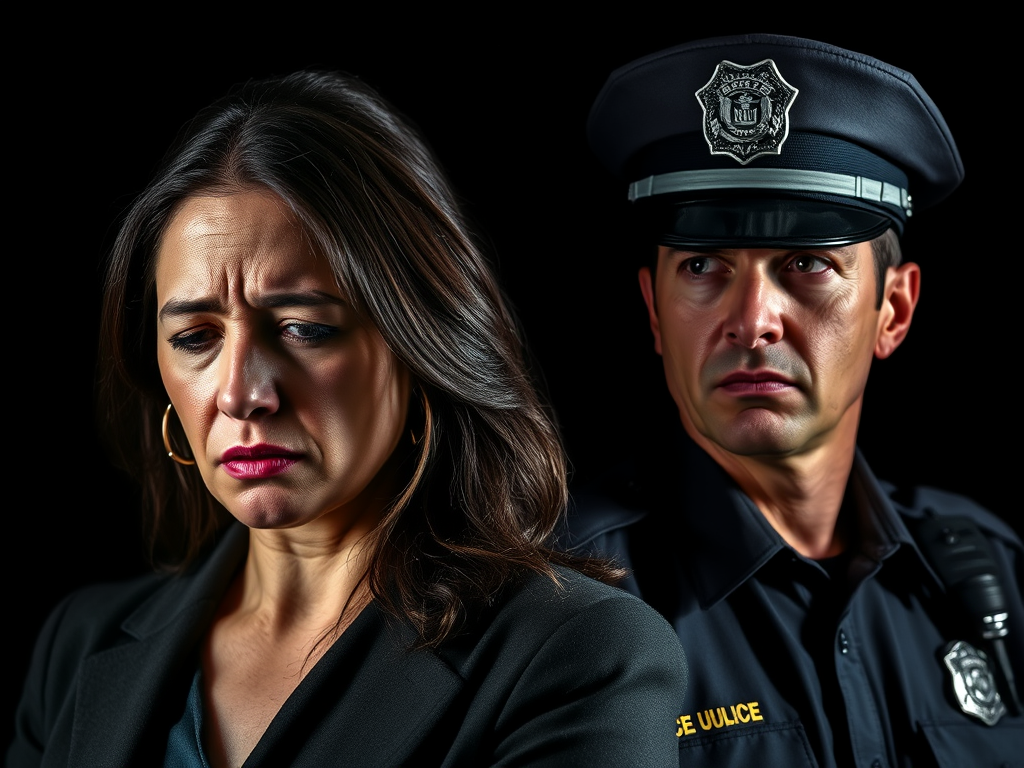
Bearing Witness to the Unjust Slander: Defending Renee Good and the ICE Officer

Why Dishonestly Besmirching Character Hurts Us All

In an age where reputations can be destroyed with a few keystrokes, the vicious phenomenon of besmirching the character of individuals we may disagree with has become a troubling norm, and few cases illustrate this more painfully than the recent attacks against Renee Good and the ICE Officer. The culture of public shaming, rumor-mongering, and baseless accusation not only harms the individual but also erodes the foundation of our collective trust and civility. The relentless character assassination of these two individuals offers a case study in why we must resist such destructive tendencies and reclaim the values of fairness and respect.

The Dark Power of Slander in the Digital Age

The digital revolution was supposed to democratize information and increase transparency. Instead, it has often provided fertile ground for half-truths, personal vendettas, and outright lies to flourish. In this environment, where anyone with keyboard courage can post anything anonymously, there is no justifiable reason or benefit—a campaign not rooted in facts or legitimate criticism, but rather in innuendo and unsubstantiated claims. Online platforms, amplified by the echo chambers of social media, allow damaging narratives to spread far beyond the reach of reasoned rebuttal. Once a reputation is sullied, it’s almost impossible to fully restore, regardless of the truth.

The Personal Toll: A Life Turned Upside Down

For those who have observed or experienced it, the defamation of an individual is not an abstract concern; it is a lived nightmare. The impact is not limited to professional setbacks or fleeting embarrassment. Slander can lead to loss of livelihood, social isolation, and even mental health crises. In Renee’s case, what is lost in the noise that she is a victim here. In the officer’s case, his presumption of innocence is tossed away for political purposes. The pain inflicted by such attacks is long-lasting and deeply personal, affecting not just the target but also their family and friends.

Slander as a Social Disease

We must ask ourselves: what kind of society do we become when we allow character assassination to go unchecked? This  is not just an attack on one person; it is a symptom of a broader social malaise. When the public rushes to judgment, prioritizing outrage over investigation, we undermine the principles of due process and empathy. This culture of suspicion and cynicism weakens our social fabric, making it less likely that people of principle will step forward to serve or lead. The chilling effect on civic engagement is considerable, as few are willing to risk being the next target of mob justice.

Standing Up Against Unfounded Accusations

It is not enough to shake our heads in dismay about the treatment of Renee Good and the ICE Officer. As a community, we have a responsibility to counteract the forces of rumor and slander. This means refusing to share or engage with unverified allegations, demanding evidence and fairness in all matters of public concern, and holding ourselves to the same standard of respect we would wish for ourselves. Defending the maligned is not just an act of kindness, but a defense of our shared humanity.

Reclaiming the Value of Character

Ultimately, the way we treat individuals is a reflection of who we are as a society. We must remember that character is built over years, but can be destroyed in minutes if we are not vigilant. Let us reject the easy path of gossip and condemnation and instead choose the harder, nobler road of discernment, forgiveness, and support. In doing so, we restore not only the reputation of those unfairly maligned, but also the values that make our communities strong.

The campaign against these two is a tragedy, not just for them but for all of us who aspire to decency and fairness. Let this story serve as a call to action—a reminder that our words matter, and that we are all responsible for the world we create with them.

The Right to Protest Comes with Responsibility

The recent tragic event in Minnesota is convoluting two separate and serious issues; the validity and efficacy of the President’s immigration enforcement policy and the use of deadly force by police officers.

These issues need to be separated to ensure a fair and impartial analysis and investigation of the officer involved in the shooting.

The are several elements which are indisputable.

The officer was engaged in a legitimate law enforcement effort.

The officer was acting in accordance with his responsibilities as a member of Immigration and Customs Enforcement.

When one engages in protest,
this right comes with responsibilities.

Renee Good was exercising her right to “petition the government for a redress of grievances.”

From the moment the officer involved first encountered Ms. Good until the moment he made the decision to employ deadly force, the only facts that need be considered are if the officer’s encounter with Ms. Good was within the parameters of his job, whether Ms. Good was in a position to harm officers, and what the officer perceived of that threat.

If an officer, acting within the color of law and performing a function of his job, perceives a threat or act of deadly force directed against himself or others he has the absolute right to engage the threat with the force necessary to stop it, up to and including deadly force.

Investigating this incident needs to be limited to the facts of the incident, not the issue of the policies that put the officer there in the first place.

The tragedy here is Ms. Good may very well have not intended to harm the officers. From all the reports of family and friends, she was a caring and considerate person who was upset by the government policy and felt obligated to voice her protest.

Now many of you will find this hard to accept, but none of Ms. Good’s admirable qualities matter. The officer had no way of knowing that in the short time of the encounter. All the officer involved had to go on was what unfolded before him.

Everyone has the right to protest against government policy. No one should fear engaging in protest because of the potential threat from the government.

The overwhelming majority of ICE officers are conscientious and professional. They perform a difficult and sometimes dangerous job. The officer involved will live with his decision to take a human life for the rest of his, it will not be easy to accept that responsibility. People who don’t understand that have never faced the possibility.

When one engages in protest, this right comes with responsibilities. The officers tasked with keeping the peace do not know anything about the protesters. They have no way of gauging the individual threat level of a crowd of people.

If you engage in protest, you need be mindful of your actions. This is not to blame the victim here, but if you are operating a several thousand pound vehicle. and are engaged in a verbal confrontation with the police, you have a responsibility to make sure you don’t inadvertently pose a threat.

The investigation of this incident needs to focus solely on the circumstances from the moment of the initial encounter up to the use of deadly force and nothing else. Arguing about the validity of the policy or the legitimacy of the officer’s presence clouds the issue.

This may well be a tragic consequence of an ill-conceived policy. An unnecessary death is the result of such circumstances, but we have to consider the alternative. If the officer had been fatally struck, would the level of outrage be the same?

Policy didn’t kill Ms. Good, circumstances did.

Police officers are faced with making these decisions in seconds. An officer is expected to make these decisions in less time than it takes to read this sentence. They do not have the luxury of deliberation and extensive consideration of their options. They have to deal with immediacy of the moment.

To expect them to do otherwise is ludicrous.

Clearly some review of the use of force policy and procedures in place needs to happen. It is legitimate to ask whether firing at a vehicle is an effective method of ending the threat, a dead driver behind the wheel of a running vehicle may be more deadly. But any change or modification to the policy cannot alter the circumstances of the incident. The officer, in his perception, believed his life or the lives of his fellow officers were in jeopardy.

He had the right and responsibility to act.

The tragedy of the result notwithstanding, this is all that should be considered in determining the legitimacy or illegality of the officer’s actions.

A Crisis of Our Own Making

We face a multi-pronged existential crisis in this country.

A perfect storm of anti-science dumbing down of critical thinking, a growing intolerance for those who may be different than the majority, and an increasingly dangerous march toward an imbalance of power in government.

These phenomena are further inflamed by co-opting normally benign religious faith by Christian Nationalists which is merely a mask worn by those seeking to oppress any other belief system to further their own agenda and is most unchristian in practice.

It is nationalist in the worst sense of seeking domination over all others, is intolerant of any dissension, and is Christian for convenience not doctrinal integrity.

Whatever your faith may be, no true religion seeks to turn their god into a bullet and shoot it into another human’s heart. Claiming that any God has chosen one people over all others is a manmade fallacy whose only purpose is to justify dominance over and oppression of others.

The fact that in the 21st century, the most powerful nation in the world would seek to justify their policies based on primitive beliefs from an age dominated by illiteracy is frightening. That it even enters into the discussion is inexplicable.

The danger of such a course for government policy should be self-evident.

A significant number of Americans firmly believe that God can suspend the immutable laws of physics to perform miracles absent one iota of evidence. They then interpret their success in light of this faith as proof of the dominance of the Christian god.

This religious façade then fuels the most unchristian treatment of their fellow humans, reckless disregard for the sanctity of life of those of different cultures and faiths, and justifies their embracing a philosophy more characteristic of the bloody religious crusades then a pursuit of justice and peace.

“…no true religion seeks to turn their god into a bullet
and shoot it into another human’s heart.”
Joe Broadmeadow

We are engulfed in a battle for the soul of this country. The hobgoblins representing the worst of what humans can do to their fellow humans are guiding many of our actions. They have attacked the very foundation of this nation. Laws are tools wielded by those in power and ignored when they are inconvenient.

When a sitting President can exhibit callous disregard for the Constitution, and Americans who should know better remain silent because it feeds their prejudice, it is a sign of dangerous times.

There are indications of a growing resistance to this corruption of country. There is still the framework for the balance of government to reassert itself. But we are in a tenuous position.

The dangerous mix of twisting sincere religious beliefs into something that supports intolerance and ignores the Constitution underscores the danger and reinforces the brilliance of the founding fathers in explicitly separating church and state.

If we don’t resist this march into anarchy, we may find ourselves at the point of a gun loaded with bullets under the patina of religious commandments and aimed at our hearts. And they will squeeze the trigger with a smile on their face, certain they are acting as God wants them to.

All Is Right with the World

(It says so right in the Bible, some of it in the red words!)

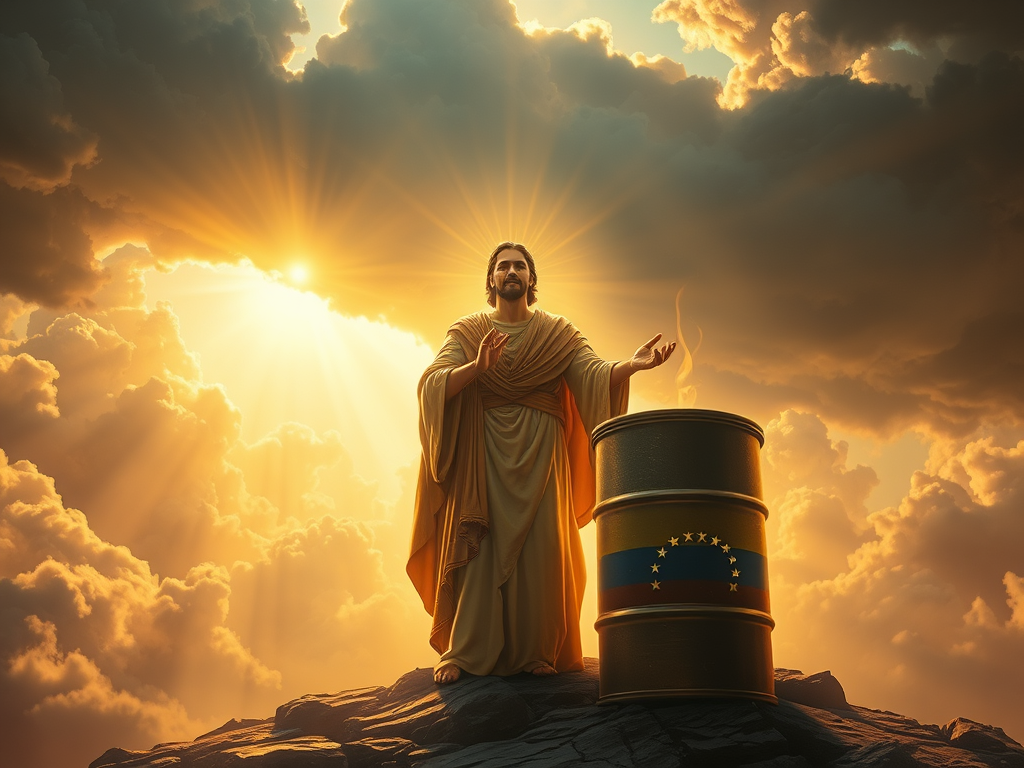
All is well. We’ve nothing to fear for the lord is with us in our righteousness! We are guided by the lord in all our works, to glorify him by seizing the oil from the dark forces. The Lord compelled us to defeat his enemies wherever they may be. We will find them.

As the Bible so clearly says,

“Make these into a sacred anointing oil, a fragrant blend, the work of a perfumer. It will be the sacred anointing oil.” – Exodus 30:25

“The wise, however, took oil in jars along with their lamps.” – Matthew 25:4

Now, knowing the Bible is absolute truth where it best suits us and allegory where it gets a bit awkward, these words bring joy to our hearts for our President must be the one sent to deliver us from evil.

Venezuela was fallen to Satan, and we have redeemed them at $60.00 per barrel and a nice profit for our efforts.

And the Lord tells us where next we will find the devil…

The tempest comes out from its chamber,
    the cold from the driving winds.
10 The breath of God produces ice,
    and the broad waters become frozen.
11 He loads the clouds with moisture;
    he scatters his lightning through them.
Job 37:9-11 (NIV)

Our crusades have just begun. It says so in the Bible.

Praise the lord and pass the ammunition.


The Last Americans…

All Hail, Geezer!

It has always been the old men who send the young off to war.

They pump them full of hatred for an unfamiliar enemy, fuel their addiction to a love of country that blinds them to reality, and arm them with a cause they perceive as a holy crusade in the pursuit of justice.

And, although this may be a bit of a generalization, it is the young ones who managed to avoid going to war that grow old and repeat the process with a different enemy, a new generation of young people, but using the same methods.

 As so we find our commander in chief, the quintessential poster boy for avoiding combat, crafting a policy that is the antithesis of what millions in the country fought for in World War II.

We lost more than 400,000 American lives in a cause to prevent countries from using force to subvert, subject, or subdue other countries absent a world-wide consensus of the need.

We wrote, promoted, and signed the United Nations charter so that one country or group of countries cannot use power against others without facing the rest of the world standing in their way.

The system is not perfect, it is fraught with problems, but it is better than unilateral actions taken by would-be dictators or those with delusions of some perceived grievance against sovereignty.

We always tried to act in a manner that supported the spirit of that agreement. We made mistakes but corrected them and learned from them. We did not use force unless force was used against us.

How things have changed.

We are led by a Nero-like megalomaniac whose self-delusions and warped concept of American greatness has infected the minds of his followers.

They suffer blindness when it comes to his actions and the cost to this nation.

They are like the cheering Nazis applauding Hitler’s restoration of their standing in the world unable to see the coming disaster soon to befall them.

Today Venezuela, tomorrow Greenland. Where next we should ask? Where does it end?

If we would fight to the death to protect our own rights of sovereignty from foreign aggression, why should we expect others to surrender to ours?

By what right is our country’s security more important than the people of Greenland or any other targets of this President?

If Greenland is critical to our security, then wouldn’t we strive to be good allies, not potential invaders?

We formed NATO as a bulwark against the Communist dominated Eastern Europe. The core element is an agreement that an attack on one nation was an attack on all of us.

Now, we may find ourselves engaging in aggression against a NATO ally (Denmark) and pitting ourselves against the other NATO members’ obligations to come to their defense.

How does this make America great again? It doesn’t.

It does make us just another country that finds itself in a seemingly unchallengeable position of power being led by a delusional Caesar. What he, and all those other despots who came before him, fails to see is that not one of those empires survived.

But we truly have an opportunity to alter the seemingly inalterable path of history. But that window is closing quickly. These next three years will determine if we right the course of our errant national policy or turn out to be the last Americans.

Hail, Geezer, destroyer of Pax Americae!

(Author’s note: I must acknowledge and thank my friend, Jane Auger, for the “Hail, Geezer” line. Well crafted and on the money.)

What’s the Difference?

Russia claims Volodymyr Zelensky is not the legitimate elected President of Ukraine.

The United States claims Nicolas Maduro is not the legitimate elected President of Venezuela. (They had a practice run in 2020 about claiming election fraud and learned from that.)

Russia initiates unilateral actions against the Ukraine.

The United States initiates unilateral actions against Venezuela.

Russia takes territory and citizens of a sovereign nation without cause.

The United States seizes the President of Venezuela and his wife by military force.

Russia unilaterally demands the Ukraine surrender territory and the Ukrainian people within those territories to Russia.

The United States unilaterally claims the authority to “run” Venezuela and bring in American companies to run the oil industry to the benefit of the Unites States.

Expediency should never be a rationale for circumventing our Constitution and our commitment to international law.

Joe Broadmeadow

Can somebody explain the difference other than we have a more effective military capability?

Can somebody explain on what basis they think the Venezuelan people will welcome the imposition of a government run by the United States on their sovereignty?

Can somebody explain why we choose not to commit similar actions in other countries controlled by dictators, North Korea, Saudi Arabia, Russia, China, Vietnam (oh wait, we tried that one), Sudan, Nigeria…

Here’s the list of the current 59 dictatorships in the world, https://planetrulers.com/current-dictators/

That anyone in this country supports the actions by President Trump in Venezuela is terrifying.

Whether Maduro is a narco-terrorist or not is irrelevant. We are a country of laws living in a tenuous post-World War II world that is based on international law.

Whether or not we have the ability and resources to execute such actions is irrelevant. Expediency should never be a rationale for circumventing our Constitution and our commitment to international law.

Rallying around successful but questionable military operations ostensibly seeking to right a wrong is fraught with risk.

We need to keep in mind the people of Venezuela have the right and the obligation to find their own solutions to their internal problems.  Inasmuch as the narcotics business affects us, we need to look inside ourselves for the fundamental reason for the existence of this business, the demand for narcotics by Americans.

If we accept the rationale that narcotics trafficking is an act of terror, then we are a country where millions of our citizens support terrorists and some reap financial benefits from their actions.

Perhaps dealing with the problem should begin at home.

We offer a market for the business and do little, if anything, to reduce that demand. Rest assured the flow of narcotics will not diminish substantially until this demand is reduced. And our using extrajudicial means to combat it is a slippery slope.

We could try to jail them all in keeping with our worldwide lead in the number of citizens we incarcerate.

Or, go right to the summary executions to avoid those pesty technicalities under the law. Perhaps pay-per-view executions in the Presidential Ballroom.

These operations make for glitzy press conferences, flag waving hysteria, and testosterone-fueled fist bumping, cue the patriotic music, but do little to address the problem.

The moronic comparisons to our imposing caretaker governments in Japan and Germany after the war are laughable. We did not do that without the consent of most of the nations united against Axis fascism. This is an unjustifiable and extrajudicial use of military force to seize a citizen of another country, taking unprovoked military action against that country, and rationalizing it by claiming we are helping the Venezuelans, righting a historical wrong, and combatting narco-terrorists.

There will be a great deal of ranting about how Venezuela nationalized the oil industry and unlawfully seized American assets. This is not the place for a history lesson, but one might want to try to at least have a fundamental understanding of this complex issue.

Nationalization, which took place over several years and presidential administrations, beginning in 1971, did not happen overnight. It was a progressive process meant to address the imbalance of the profits taken by the American companies as compared to the profits shared with Venezuela. American companies were given concessions to drill for oil, they were not given possession of the land, and they took billions in profits.

Any attempt to justify this as righting the wrong of this nationalization is a white-washing of history to paint the United States as a victim, it was not.

What we are doing is helping ourselves to the Venezuelans oil and there is no doubt Mr. Trump will get his cut of the profits.

And we will be left with an indelible stain on the history of our country and irrefutable evidence of our hypocrisy.

What’s the difference? There is none.

Author’s note.

(Now, I’ll sit back and wait for the vitriol pointing out how I am unpatriotic, support dictators (I have my voting record to refute that one), and my sympathizing with narco-terrorists to come pouring in.
In preparation for the barrage, I’ll put on the coffee. I hope you enjoy the show as much as I will. I particularly enjoy the ones in CAPITAL LETTERS!)

The Honesty of Childhood: Lessons from a Four-Year-Old

It’s so simple, just ask a four-year-old.

The innocence of children, a common theme, is a misnomer. The innocence implies they had some capability to surrender it. They do not until we teach them how.

What children are is honest, uninhibited by the artificial constraints of a “polite” society. We tell them, do not lie. But when we ask them if they like the food offered, we expect them to be polite and say “yes, thank you,” and eat every morsel. Even things as abominable, unpalatable, and disgusting as Brussels sprouts (sometimes incorrectly known as Brussel Sprouts).

An honest person would recoil at the sight of these things and say “no, I do not.” But we train away their natural honesty and replace it with a false politeness.

Kids have a way of looking at life that time often erodes. And that is unfortunate.

The other day, my grandson, Levi, asked to go to a local playground, despite the temperature hovering in the low 20s and a windchill factor making it feel like Siberia.

Since I often encourage any activity that avoids the use of digital apparatus, and not to appear hypocritical, I agreed to a brief visit.

It is during these often-unplanned events that some of the most profound and deep philosophical thoughts arise from these uninhibited beings.

Placing him on the only swing not coated with ice, he began swinging away. I would push him hard to get him moving, then jam my hands back in the pocket of the outer vest, which was over an inner vest and two sweatshirts. I would silently curse the invisible force of gravity requiring me to remove my hand from the warmth of the pocket and repower the momentum.

He seemed impervious to the cold as children often are. I was not, but I was committed to my principles.

And, of course, the conversation was non-stop. His face sometimes clouded with the warm-breath mist accompanying his words.

This is a small but memorable part of that conversation.

Levi: “I remember the first time I tried a swing.”
JB: “You do?”
“Levi: “Yup, I remember all my memories.”

“I remember all my memories.”

The words stuck with me the whole rest of the day and were waiting to replay in my mind first thing this morning.

I thought, wouldn’t it be nice to retain that ability to hold fast to all your memories. It would remind us to learn from the memories of our mistakes, appreciate the memories of all those who have influenced our lives, and embrace the simple memories of a conversation with a wise four-year-old philosopher whose turn of phrase can enlighten a world.

Remember all your memories!

An American Crossroad

“When you come to the fork in the road, take it.”
Yogi Berra (sort of)

Ozymandius

I met a traveller from an antique land
Who said: “Two vast and trunkless legs of stone
Stand in the desert . . . Near them, on the sand,
Half sunk, a shattered visage lies, whose frown,
And wrinkled lip, and sneer of cold command,
Tell that its sculptor well those passions read
Which yet survive, stamped on these lifeless things,
The hand that mocked them, and the heart that fed:
And on the pedestal these words appear:
‘My name is Ozymandias, king of kings:
Look on my works, ye Mighty, and despair!’
Nothing beside remains. Round the decay
Of that colossal wreck, boundless and bare
The lone and level sands stretch far away.”
-Percy Bysshe Shelley

America faces the most challenging crisis since the Civil War. Our government of checks and balances is now woefully unbalanced, controlled by those with checks and deep pockets.

The distortion of power between the uber-wealthy and the majority of Americans teeters on the brink of totalitarianism and total loss of our constitutional rights. And the most frightening thing about it is the willful blindness or stunning indifference of a significant number of American citizens.

We have a President who lacks even the slightest element of empathy or commitment to the greater good. His callous pronouncements about others, be they those recently deceased or the weakest and most vulnerable among us, are a sad commentary on his lack of humanity.

Like Ozymandius, he struts to engrave his name all over the country as if he deserves such honor, failing to learn from history the emptiness of such efforts by other maniacal egos. First, it was the unlawful and shameful renaming of the Kennedy Center for the Performing Arts (it’s only a matter of time before the only events they can book there will be UFC and some failed country-western acts who mourn the loss of the Old South).

Then it was the unilateral decision to tear down the East Wing of the White House to build another testament to ego and self-aggrandizement. It is only a matter of time before he decides to dynamite Mount Rushmore, rename national parks (Trump-Yellowstone, Trump-Grand Tetons) after they pump out all the oil and decimate the environment, and imprint his picture on the one-hundred-dollar bill.

‘My name is Ozymandias, king of kings:
Look on my works, ye Mighty, and despair!’
Nothing beside remains. Round the decay
Of that colossal wreck, boundless and bare
The lone and level sands stretch far away.”

We have a neutered majority in Congress who sit silent in the face of these outrages, using the cowardly argument that they hold their tongue to prevent Trump from seeking vengeance on the states they represent.

Is there any worse example of cowardice than that?

These Senators and Congresspeople have forgotten the lessons of the great women and men who came before them and, while working for their particular districts, kept in mind the greater responsibility to do what is in the best interest of the American people.

We may be a nation of Irish-American, Italian-American, Jewish-American, Catholic-American, Muslim-American, African-American, and a host of other hyphenated Americans. Yet, we need to keep in mind that the word before the hyphen is but an adjective. The essence of all people in the country is American, and we deserve a President and a Congress that keeps that in the forefront of all their considerations.

Our commonality as Americans is our most cherished characteristic, and we should resist with all our will any effort to segregate us into the haves and have-nots.

2026 is America’s crossroads. Unless we send a clear message that we will resist this march toward an authoritarian President with unrestrained power, we may not survive as the country our founding fathers created.

When a President can order the military to kill wounded individuals, even if we accept they are enemies of the United States and wish us harm, how can we object the next time an American pilot is shot down, captured, then executed by others?

Combat, despite the horrors and fog it engenders, has rules of engagement. We cannot hold ourselves up as people to be admired and emulated if we descend into the behavior of those we most criticize.

Mr. Trump has denigrated, diminished, and demeaned the Office of the President of the United States and this country in the eyes of the world. That most people outside this country are shocked by the sudden decline in our standing is telling. That many people within the United States are blind or indifferent to it is horrifying.

The list of acts that confirm this contention is long and dismaying, but there is hope. There are positive signs of resistance within the once-admirable Republican Party and encouraging signs of a revitalized and refocused Democratic Party.

Let’s strive to put people in office who will re-establish the balance of power among the three branches, remember their oath is to the Constitution of the United States, not partisan political parties, and seek a consensus among differing perspectives to preserve and protect this country.  

Now is the real moment to make America great again. If these last few months have not demonstrated the danger of the alternative, nothing will.

A Happy “New” Year

“For in that sleep of death what dreams may come?”
Shakespeare, Hamlet, Act 3, Scene 1

Once again, we face the changing of the numbers, assigning an artificial appellation to the passage of time.

2026. Two thousand and twenty-six years marking the passage of time, for the US-European centric world at least, since an event that may or may not have occurred in an obscure town, in a distant area of the Roman Empire, in a time before mass communication or widespread literacy.

Yet here we are adjusting all our calendars to show the change to this new 365-day cycle.

Depending on the number you use, some 80-90 generations have been born since the start of the Common Era (C.E., formerly known as Anno Domini, Year of our Lord, when the church ruled the world), with most, but the last 4 or 5, long since deceased.

Now my generation, born in the 1950s, passes into another stage of life. Since our arrival, three more generations have arrived, and we are hurtling towards what will likely be the last arrival of a generation in our lifetime.

And that is the way of the universe.

We are made of the atoms forged in the nuclear fires of the first stars and will, in our time, return to that form. We, all of us and the things we are made of, have existed for billions of years and will continue to exist long after this current form disintegrates.

This is nothing to fear, nothing to dread. Not that one should look forward to it. There are so many things to experience in this life before it returns us to our original form. But it is an inevitability we all share.

These numbers are meaningless when seen against the timelessness of the universe. Most of us live to about 80 to 100 years, and that should be enough if one remembers to “always look on the bright side of life,” as Monty Python put it.

Shakespeare, of course, found a way to define the human lifespan. A bitter-sweet telling of the seven stages of man.

All the world’s a stage,
And all the men and women merely players;
They have their exits and their entrances,
And one man in his time plays many parts,
His acts being seven ages. At first, the infant,
Mewling and puking in the nurse’s arms.
Then the whining schoolboy, with his satchel
And shining morning face, creeping like snail
Unwillingly to school. And then the lover,
Sighing like furnace, with a woeful ballad
Made to his mistress’ eyebrow. Then a soldier,
Full of strange oaths and bearded like the pard,
Jealous in honor, sudden and quick in quarrel,
Seeking the bubble reputation
Even in the cannon’s mouth. And then the justice,
In fair round belly with good capon lined,
With eyes severe and beard of formal cut,
Full of wise saws and modern instances;
And so he plays his part. The sixth age shifts
Into the lean and slippered pantaloon,
With spectacles on nose and pouch on side;
His youthful hose, well saved, a world too wide
For his shrunk shank, and his big manly voice,
Turning again toward childish treble, pipes
And whistles in his sound. Last scene of all,
That ends this strange eventful history,
Is second childishness and mere oblivion,
Sans teeth, sans eyes, sans taste, sans everything
— William Shakespeare, As You Like It, Act II, Scene VII

Since much of my time is (joyfully) occupied by entertaining two energetic members of the latest generation, I’ve morphed into the childishness of the last stage but still hold fast to my teeth, my eyes, my taste, and everything else this life offers.

I came into this world amazed at the wonder of it all and will leave, in my time (decades from now, I hope), with the same sense of wonder. If you think about it, getting to journey among the stars and galaxies of this universe has an attraction to it. To return to be among everything that came before us and all that will follow seems fitting.

A reward for a life well lived.

Happy New Year, and however many years you get to number, may they all be filled with a sense of wonder.

See you in the stars.

Joe Broadmeadow
July 25, 1956-TBD