Author’s note: The Christmas season is coming soon. So the other day, rushing it just a little bit, I enjoyed one of life’s finest moments watching Rudolph the Red-Nosed Reindeer with my grandson, Wyatt.
Having watched this show more times than I can count, I remember so many great lines. But one of the saddest ones has always stuck with me. It is Christmas Eve on the Island of Misfit Toys before Santa arrives.
The Charlie in the Box says, “Well, might as well go to sleep and start dreaming about next year.”
Then, the girl doll sighs, “I have no more dreams left.” When I heard that line for the nth time, this story suddenly germinated in my mind. Flowing out of the keyboard without pause.
So, in the run-up to Christmas, I give you “The Girl Who Had No Dreams Left.”

Nora was nine the winter she stopped dreaming.
It didn’t happen all at once. Her dreams went quietly, one at a time, the way snow slips off a porch rail when nobody’s watching.
The first to go was the puppy. She’d wanted one since she was four, a scruffy brown one she’d already named Biscuit. Then they moved into the apartment over the laundromat, and the landlord said no pets, and Biscuit went wherever unborn puppies go.
The second was her father. For a while his letters came from a town out west, full of promises. Soon, kiddo. As soon as I get on my feet. Then the letters got shorter. Then they stopped. Nora kept the last one under her pillow until the paper went soft as cloth, and then one night she threw it away.
The last dream was the piano. It was an old upright with a chipped middle C, and her mother had taught her to play “Silent Night” on it with two fingers. Nora used to imagine herself in a long blue dress, playing for a room full of people who held their breath to listen. Then her mother’s hours at the diner got cut, and a man with a truck came and took the piano away. Nora watched from the window. Her mother didn’t watch at all.
By December, they were living at the Saint Brendan’s family shelter, in a room with two cots and a radiator that clanked all night like someone trying to get in. Her mother worked double shifts and came home with tired eyes and a smile she put on in the hallway.
Nora had stopped asking for things. It seemed kinder that way.
So when the shelter volunteer handed her a paper star and asked her to write her Christmas wish on it, Nora left it blank.
“Nothing?” the old man asked. His name tag read WALTER, and his hands shook slightly as he held out the marker. He had a cardigan with leather patches on the elbows and a voice like gravel in warm water.
“Wishes are for people who get them,” Nora said.
Walter didn’t argue. He just nodded, slowly, like she’d told him something true and important. Then he hung her empty star on the tree, right in the front, between a star that said BIKE!!! and one that said for my mom to stop crying.
Every night that week, Nora noticed something. When the other volunteers went home, Walter stayed. He sat in a folding chair by the tree and read the stars one at a time, his lips moving as if he were saying each one out loud to someone only he could see.
On the fifth night, she asked him why.
“Because somebody ought to hear them,” he said. “Even the blank ones. Especially the blank ones.”
“Mine doesn’t say anything.”
“Sure it does.” He reached up, took her star down, and held it under the lamp. “It says I used to hope, and it hurt too much. That’s the loudest wish on the whole tree.”
Nora didn’t cry. She’d gotten too good at not crying. But she sat on the floor next to his chair and didn’t leave.
After a while, Walter told her about himself. He’d been a mailman for thirty-one years. He’d had a wife named Rose who sang off-key in the kitchen and a little house with a green door. Then Rose got sick, and the bills came, and the house with the green door went the way of Nora’s piano.
“After that,” he said, “I figured if I didn’t want anything, nothing could ever disappoint me again. I was really proud of that idea. I thought it made me tough.” He shook his head. “Turns out it just made me cold. A man can freeze to death indoors, kid, if he stops wanting things.”
“So what fixed it?”
“Nothing fixed it. Nothing fixes it.” He smiled. “I just started small. One morning I wished for a hot cup of coffee. Got one. The next week, I wished for somebody to talk to on Tuesday. Got that too. A lady at the library. Talked my ear off about birds.” He tapped his temple. “Dreams are like muscles. You don’t lose them. They just get weak from not being used. You gotta start with the light ones.”
Nora thought about that for a long time.
“What do you wish for now?” she asked.
Walter looked at the tree, at all the paper stars, the crooked letters, the misspellings and the big ones and the brave ones.
“That every one of these gets heard,” he said. “That’s mine.”
On Christmas Eve, the shelter had a dinner with paper tablecloths and a ham someone’s church had donated. Nora’s mother got off work early and sat beside her, and for an hour her smile was real, not the hallway one.
On Christmas morning, there was no puppy. No father. No piano. Nora had known there wouldn’t be, and she’d told herself that was fine.
But under the tree sat a small box wrapped in the Sunday comics, her name on it in shaky capital letters.
Inside was a harmonica, worn smooth and silver, and a folded note.
This belonged to Rose. She couldn’t play it either, but she tried every day, and that was the best part. Music doesn’t need a crowded room, Nora. It only needs one person listening. I’ll be the first.
W.
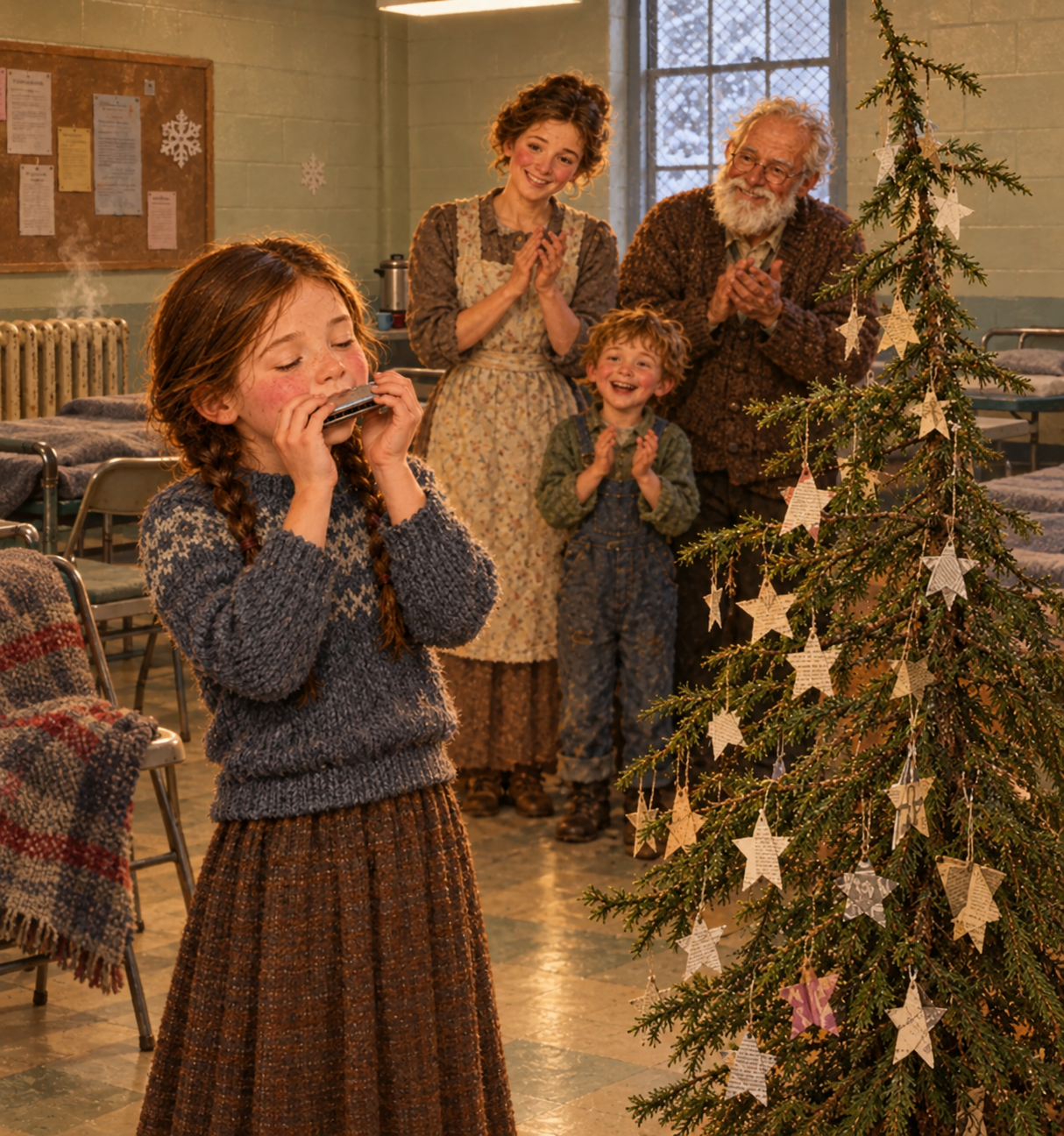
That afternoon, in the shelter corner by the clanking radiator, Nora lifted the harmonica to her lips. It took a long time to find the notes. The first ones came out wobbly and thin, like a bird testing its wings. But slowly, carefully, three notes became six, and six became the first line of “Silent Night.”
Walter clapped like she’d just finished a concert at Carnegie Hall. Her mother clapped too, with tears on her cheeks. And a little boy from down the hall, the one who’d wished for a bike, sat down cross-legged to listen.
That made two people. Then three.
That night, after the lights went down, Nora tiptoed out to the tree and found her blank paper star. She held the marker for a long, long time.
Then, in small, careful letters, she wrote one word.
Tomorrow!
It wasn’t a big dream. It wasn’t a puppy or a piano or a father coming home.
But it was hers. And it was a beginning.
And sometimes, that’s all Christmas really is. Not the getting. Just the brave, small act of hoping again.
The End.


Leave a Reply