Inspired by true events...
Teddy was three and a half, which he would tell you was practically four, and he had planned the evening with the seriousness of a mission director.
Dinner was at the little Italian place on Main Street. He would have the spaghetti, but only the noodles, and he would have a roll, but only if it was warm.
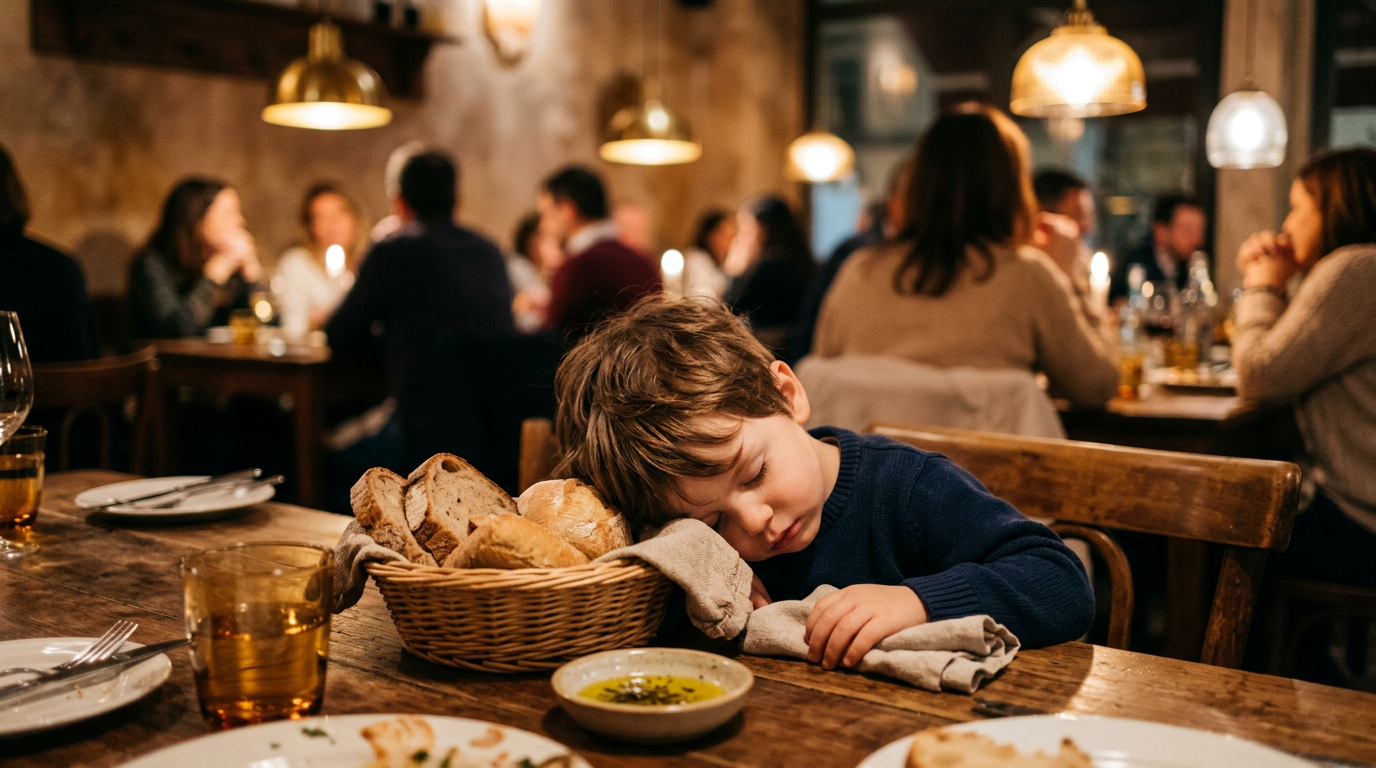
He made it through the bread basket. He made it through the crayons, the placemat maze, and most of a long story about a dinosaur named Gerald who lived in a volcano and did not like pickles. He was halfway into a sentence about the moon when his voice slowed, like a record winding down.
“And then the moon is… the moon is…”
His head dipped toward the bread basket. His mother caught it an inch short of the butter. Teddy opened one eye, announced, “I’m not tired,” and was gone again.
The waiter, a young man with a pen behind his ear, arrived with the booster seat and a look of professional sympathy. “Happens every night,” he said, though it clearly did not. “Want me to box up the noodles?”
“Let him rest,” said his grandfather, and everyone agreed, because the only alternative was to wake him, and nobody wanted to be the one who did that.
So Teddy slept. He slept with his cheek on the tablecloth and one fist closed around a fork. He slept through the clatter of plates and the hiss of conversation. He slept while a waiter sang “Happy Birthday” two tables over, loudly and badly, and through a toddler at the next booth shrieking with joy at a balloon.
Once, he lifted his head, glared at the ceiling as if it had said something rude, and went back down.
A tiny whistle came out of him every few breaths, somewhere between a kettle and a sleepy duck. The older couple at the next table kept glancing over and smiling.
Eventually the woman leaned across and whispered, “He’s got the right idea,” and her husband nodded as though he had been waiting his whole life for someone to say it out loud.
His grandfather watched him and started thinking about the thing Teddy had without knowing he had it.
Nobody expected anything from Teddy. He had no performance to give, no reputation to protect, no ledger of things he was supposed to be worried about.
He could fall asleep in a room full of strangers because the strangers were not a threat, and the room was not a test. Every stage of his day ran on the same unspoken agreement: the world would keep turning while he rested, and his only job was to be present for the parts that interested him.
When he was hungry he said so. When he was done he said so, sometimes mid-sentence. Nothing he felt had to be justified, filed, or explained.
Somewhere along the way, most people lose that. Nobody announces the loss. It happens in small pieces.
You start rehearsing conversations in the shower. You check the bank balance before you order dessert. You notice that your body has opinions now, about stairs, about late nights, about the cold. You learn that being tired is something you have to schedule around, not a signal to lie down wherever you are. You begin to sleep badly, not because anything terrible has happened, but because your mind has taken on a second shift: lists, what-ifs, the tone of an email you read three times.
The ease does not vanish all at once. It leaves quietly, like warmth from a room when the door stays open.
The grandfather thought, too, about how long he had spent trying to earn the right to rest. There had always been one more thing first: the paperwork, the next deadline, the thing that would make him feel finished.
Teddy had never once asked for permission to be finished. He just was, and then he slept.
Teddy woke up the moment the check arrived, sat bolt upright, and looked around as if returning from a long voyage.
“Did I miss the moon?” he asked.
“You missed a lot,” his mother said.
He considered this with great seriousness, nodded, and reached for his noodles, which were cold, and which he ate anyway, every last one, with the total commitment of someone who has never once wondered whether he deserved them.
On the drive home he was asleep again before the first stoplight. His grandfather glanced back at him in the rearview mirror, a small shape in the booster seat with a speck of cheese on his cheek.
Somewhere in the back of his mind was a memory of being that free himself, though he could no longer say exactly when it ended.
He wished he could tell Teddy to hold onto it. But Teddy was already gone, breathing his little kettle-whistle breaths, and the best thing the grandfather could do was drive carefully, keep the radio low, and let the boy sleep.

Leave a Reply