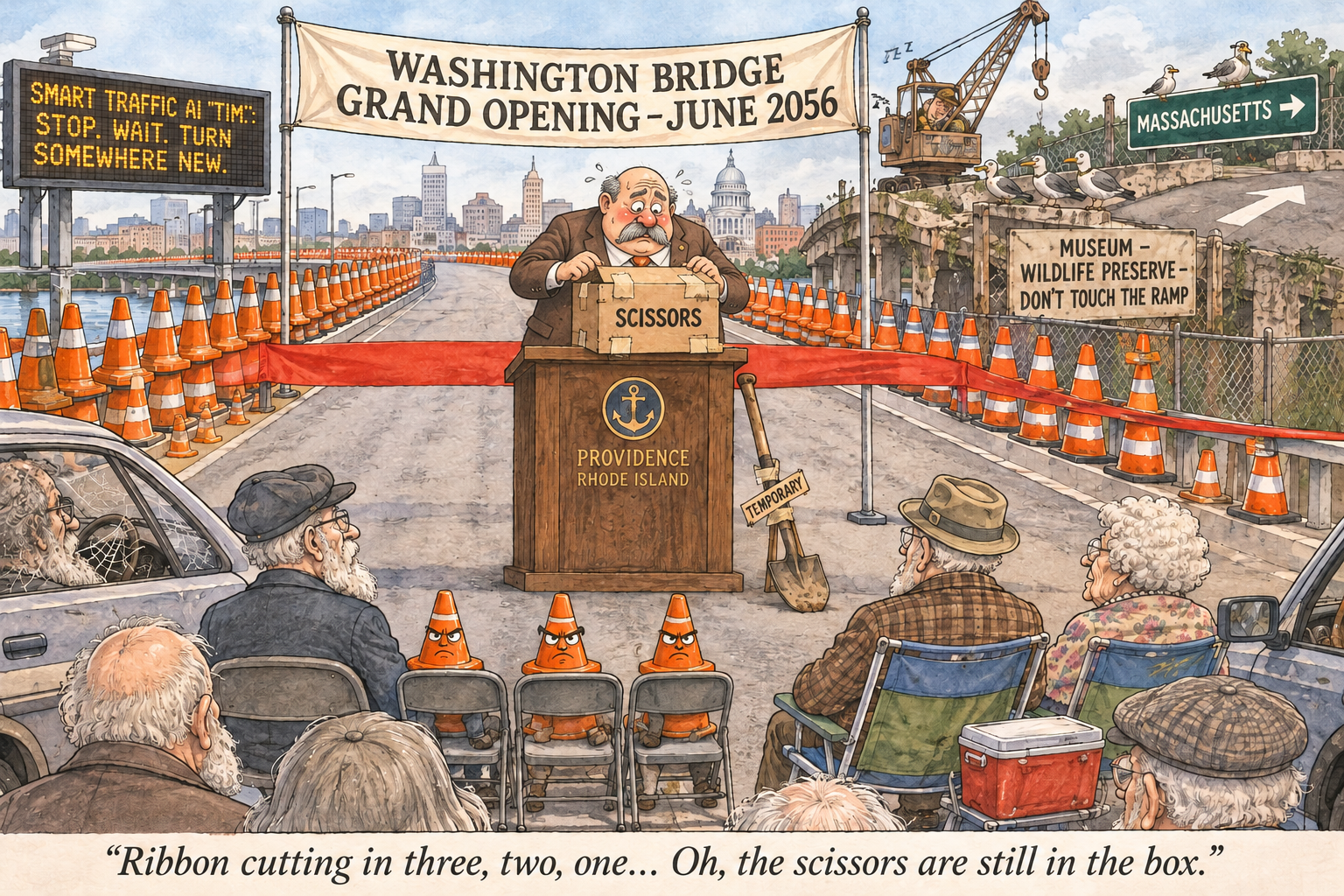
In a time, far, far in the future, a long-awaited ceremony finally begins...
Ladies and gentlemen, thank you for coming. Please remain seated, because the last time we asked a crowd to stand for a bridge, we lost forty-one people to a sudden cone-related incident, and the Department has since been sued.
I’d like to start by thanking the people who made this day possible: the engineers, the contractors, the twelve successive Transportation Secretaries, and the orange traffic cones, which were never officially employed by anyone but have nonetheless been on the job for thirty-three years.
My how the time has flown.
When the project was announced in 2023, it was a simple plan. Build a new bridge, open it in three years, and go home.
The first sign of trouble came during the groundbreaking, when the ceremonial shovel was lost. It was later found in 2038 under a detour lane on Route 37 in Cranston, under construction since Word War II, still wearing its tag, which read “TEMPORARY.”
The original design went through eleven revisions. Each one was more beautiful than the last, and each one required a new study to prove that the river still existed.
A consultant was hired to determine whether a bridge was needed at all. He concluded that yes, one was needed, and billed the state for the phone call.
By 2041, the old bridge had become the longest-running reality show in New England.
People set up lawn chairs on the shoulder to watch the crane. The crane, to be fair, was also a little slow.
The Commute became a cultural institution.
Families planned weddings around it. A man in Warwick once proposed to his girlfriend on the Route 10 on-ramp and she accepted because she had nowhere else to go for the next four hours on their way to East Providence.
Then came the Great Detour of 2044.
The state rerouted all traffic onto a temporary lane marked with a white arrow that pointed, technically, at Massachusetts. Engineers insisted this was a coincidence.
Massachusetts disagreed.
The matter was resolved by a joint committee, which met for nine years and produced a 400-page report recommending that the arrow be repainted in a more neutral direction.
Our technology has come a long way since then.
Today’s bridge is built from self-healing concrete, carbon-neutral steel, and seven hundred tons of recycled traffic cones, which we are told is a symbol of the project’s enduring commitment to the people of Rhode Island.
The cones objected to this description but were overruled.
We are also proud to unveil the bridge’s new smart-traffic system. It uses artificial intelligence to optimize the flow of cars across the river in real time.
Within four minutes of its activation in our test run, it had determined that the most efficient route for every vehicle was to stop, wait for a while, and then turn onto Route 195 in a direction nobody had ever seen before.
The system has since been named Tim, after the first engineer who got a parking ticket here in 2031, and who still has not paid it.
I want to thank my predecessor, Dolores Fontaine, who passed away in 2051 after a long and distinguished career. Dolores was the only person who ever read the entire contract.
Her last words to her staff were, “Don’t touch the ramp.”
We didn’t. The ramp is now a museum piece, and I’m told it’s been declared a wildlife preserve, mostly for seagulls, who are the only organization to have consistently met every deadline on this project.
And so, ladies and gentlemen, it is my honor to declare the Washington Bridge officially open. Please drive safely. Please do not stop on the new bridge. And if you feel a sudden urge to merge onto the old one, please remember that it’s been a museum since 2049, and that the arrow still points to Massachusetts.
Ribbon cutting in three, two, one. Oh, the scissors are still in the box. We’ll need a moment.
Leave a Reply