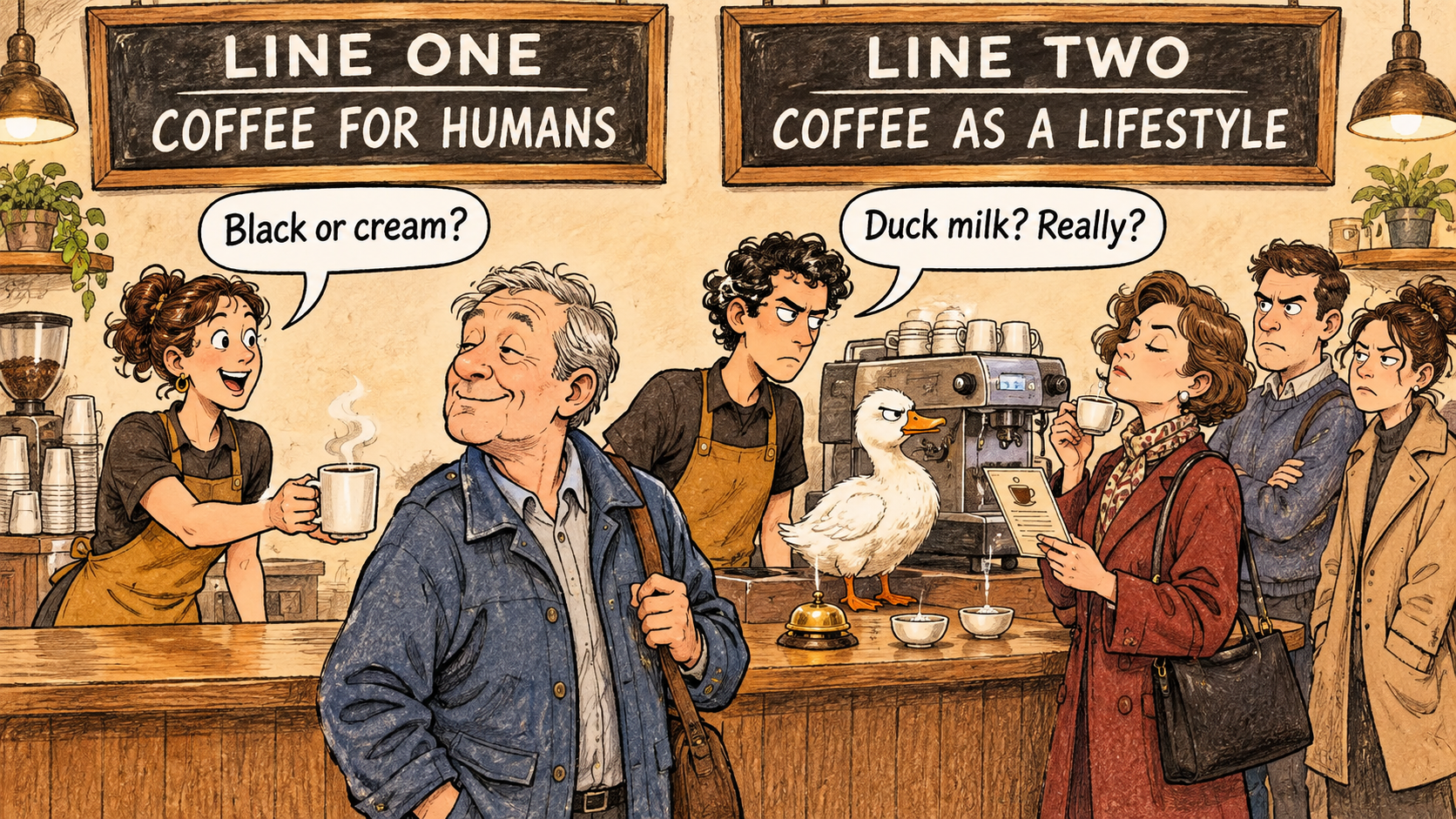

Every morning, in cafés from Brooklyn to Berlin, a quiet injustice unfolds at the register. A person who wants a cup of coffee stands behind a person who appears to be ordering a small wine.
Consider the typical order: “Grande oat-milk cortado, half-caf, extra hot, two pumps vanilla, one pump cinnamon dolce, foam dry, please.” The barista nods gravely, as if receiving scripture. No one has ever been served a cortado by a cow. No one has ever wanted dry foam. The drink is not a beverage. It is a résumé.
I therefore propose that Starbucks install two lines.
Line One: Coffee for Humans. Two options: black, or with cream. The barista asks, “Black or cream?” You answer. You receive a cup. You walk to a table and become a person again. Those of us who use sugar are perfectly capable of putting our own in the cup, no barista skill needed. Ordering takes four seconds, and nobody leaves feeling they failed a test they didn’t know they were taking.
Line Two: For Those Who Have Been Asked To Describe Their Coffee. Here the sign would read something like, Todays’ Special: Mocha chocolata ya ya with half cow milk, half duck milk, five grains brown sugar, twenty grains white sugar grown by previously indentured servants. Customers in this line would receive a laminated tasting card, a small bell to ring when the drink is ready, and the quiet satisfaction of knowing exactly what they are paying for, which is the feeling of having been seen.
The Case for Two Lines
Honesty. The current system pretends everyone is in the same queue, when clearly they are not. Line Two would simply admit what the café already knows. Like first-class boarding, it is a class system, but at least it is labeled.
Efficiency. Line One would finally move at the speed of human thirst. Line Two would move at the speed of a sommelier, which is to say, slowly, while a barista explains the difference between two grades of sugar that were harvested by people who were never paid for it. (That is a detail the menu would need to address, and perhaps a separate line for the guilt.)
Dignity for the Baristas. Right now, every employee must memorize an unending liturgy of pumps, foams, and temperatures, and perform each one with a straight face. Under my plan, baristas in Line One would say “Black?” and bask in simplicity. Baristas in Line Two would finally be allowed to say what they are thinking, which is, “Duck milk? Really?”
Social Honesty. Most important, Line Two would never be a place where a person must pretend. Nobody would stand in it out of fear of looking unsophisticated, because the line itself would be the announcement. Those who wanted a ritual would have one. Those who wanted coffee would get coffee. Everyone would stop performing for the stranger behind them.
The Objections
Critics will say Line Two is elitist. I say it is the opposite: it is the only honest line in the building. Line One has no pretensions, and Line Two has no secrets. What is elitist is the current arrangement, in which a person who orders a plain coffee is quietly made to feel like a rube for not knowing that foam can be dry.
Others will say that everyone would simply stand in Line One and feel superior to the people in Line Two. Yes. That is precisely the point. It is the most efficient status-anxiety engine ever devised, and it would be free of charge.
A Closing Thought
Coffee was once a democratic drink. It was the thing a dockworker and a poet could share at the same counter. Somewhere along the way, it acquired a vocabulary, a hierarchy, and a faintly accusatory tone.
Somewhere along the line, likely the beginning of the end of life on this planet, the menu for coffee grew longer than the wine and food menu combined!
Want to MAGA this country? Shorten the choice for coffee!
Until then, two lines would not destroy that vocabulary. They would simply give it a room of its own, and let the rest of us get our coffee, black or with cream, self-administer sugar as needed, and go sit down.
Dry foam? Really?

Leave a Reply