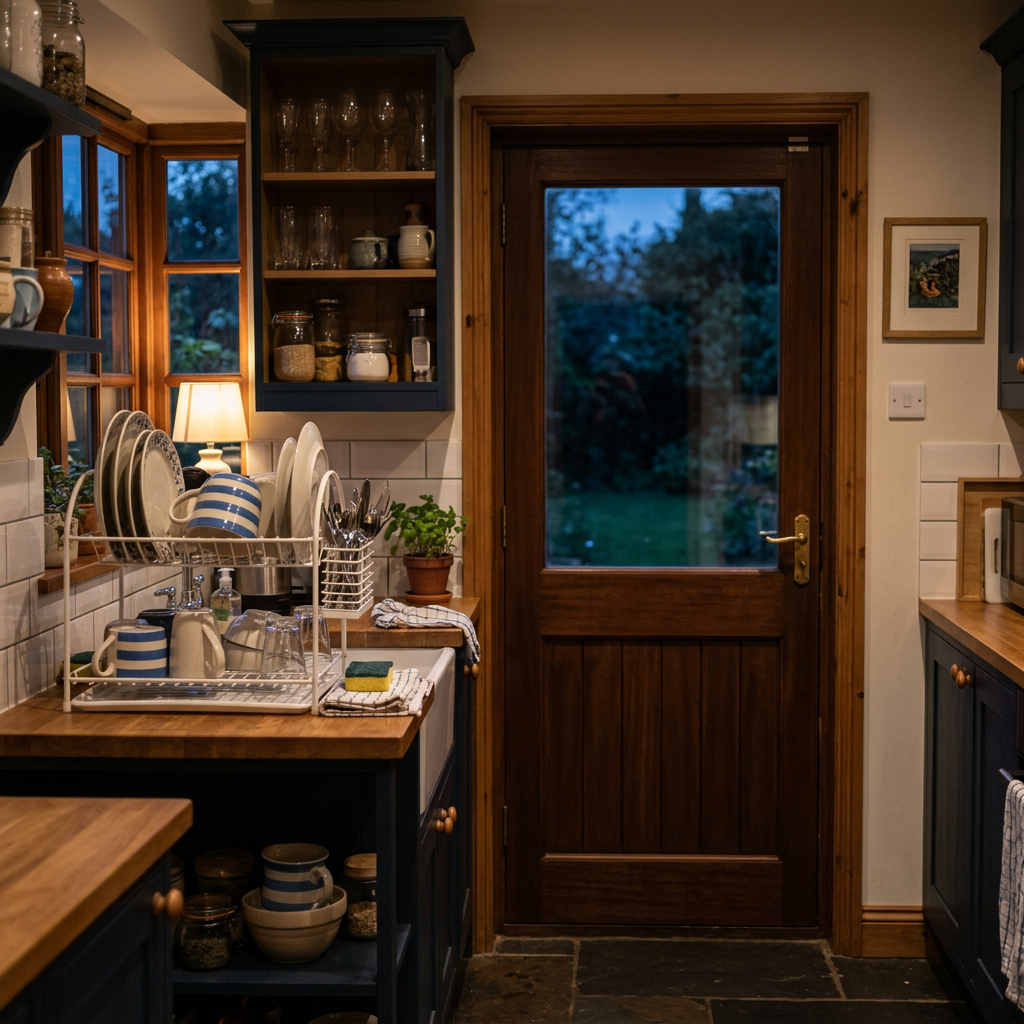
Marta had been leaving the side door unlocked for eleven years before she realized no one was coming through it anymore.
She noticed on a Tuesday in November, the kind of morning where the light never quite commits. She was standing at the kitchen sink rinsing a single coffee cup when she saw the door latch, saw the old thumb-turn she always left horizontal, and thought: when did that stop meaning something?
The door had been for her son, Danny. Not so he could sneak in drunk — Danny wasn’t that kind of kid — but because he worked early shifts at the fish market on Clement Street and sometimes left before the neighborhood fully woke, and sometimes came back in the middle of the day when she was out, and she had wanted him to be able to get in, to eat something from the refrigerator, to sit in the kitchen where the light in the afternoon fell across the yellow linoleum in a way she knew he liked even if he never said so.
Danny had been gone nine years.
Not dead. She wanted to be clear about that, even in her own mind. He was in Portland now, or had been six months ago when he sent the card with no return address that said only: doing fine, don’t worry, D. She had studied the handwriting for longer than she would admit.
She set the cup in the drying rack and dried her hands on the dish towel that hung from the oven handle. Outside, a delivery truck was reversing down the narrow street, its backup alarm a steady complaint. The latch stayed horizontal.
At eleven she walked to the hardware store on Judah. Not because she needed anything — the lock worked fine — but because she needed to do something with the idea that was forming in her. She told herself she was looking for weatherstripping.
The man behind the counter was named Gerald. She knew this because she had bought a new toilet float from him three years ago and he had the kind of face that attached itself to its name. He was somewhere in his seventies, thick through the shoulders, with the patient stillness of someone who had spent decades answering questions he already knew the answers to.
“Weatherstripping,” she said.
He led her to the right aisle without asking what door or what size, which meant he trusted her to know, and she found that she appreciated this.
She stood looking at the display longer than weatherstripping required. Gerald didn’t rush her. He moved to the end of the aisle and began straightening boxes of drawer pulls with a kind of unhurried attention that she recognized as the performance of not watching her.
“Do you ever get people in here,” she said, “who come in for something and then can’t quite say what it is?”
He considered this without looking up. “Hardware store is full of people who think they have a plumbing problem when they have a marriage problem. Or a grief problem. Or a I-don’t-know-what-I’m-doing-with-my-life problem.” He set a box of brushed nickel pulls square with the shelf edge. “I just try to sell them what they actually came in for.”
She picked a roll of foam weatherstripping and carried it to the register.
On the walk home she stopped at the park where she used to bring Danny after school. There was a bench she had a memory attached to — not an important memory, just one of those ordinary ones that survive for no clear reason. He had been maybe eight, and he’d found a stick, and he’d been dragging it along the iron fence rail as they walked, filling the afternoon with a rhythmic clattering, and she’d thought: I will remember this. As if she’d known even then that the ordinary moments were the ones that needed witness.
She sat on the bench. A woman jogged past with a dog. Two kids on scooters argued about something in a language Marta didn’t know. The sky was doing its November thing, flat and noncommittal.
She tried to think about what had gone wrong with Danny, but that was the problem — nothing had gone wrong in a way she could name. He had grown up. He had become someone she didn’t fully recognize. Not someone bad. Just someone separate, with interior rooms she didn’t have access to, and at some point the distance between them had solidified the way water goes to ice, not in a single moment but through an accumulation of degrees.
She had thought keeping the door unlocked would help. As if he might pass through the neighborhood one day, might try the latch on a whim, might walk into the kitchen and find her at the sink and they would simply — resume.
She understood, sitting on the bench, that this had been a fantasy. Not a bad one. Just a fantasy.
When she got home she stood at the side door. She held the roll of weatherstripping in both hands. The latch was still horizontal.
She thought about what Gerald had said. About people who thought they had one problem when they had another. She thought: what do I actually have?
She had a son who was alive and who had sent a card. She had a door that didn’t lock out the cold as well as it should. She had eleven years of a gesture that nobody had received, which was not the same thing as a gesture that had failed. It had kept her oriented in a particular direction. It had kept something open in her.
But there was a difference, she thought, between keeping something open and refusing to close it. One was an act of faith. The other was an act of waiting for a version of events that had already been written differently.
She peeled the backing off the foam stripping and pressed it along the door frame. It was satisfying work, the kind that showed its results immediately, and she took her time with the corners. When she was done she opened the door and closed it and felt the difference — the slight resistance, the seal.
She turned the thumb-turn to vertical.
She stood there for a moment in the kitchen, in the afternoon light on the yellow linoleum, and waited to feel something break open in her chest. It didn’t happen. What happened instead was quieter: a small release, the way a muscle feels when you stop clenching it and aren’t quite sure how long you’d been holding on.
She got out a piece of paper and wrote Danny a letter. Not because she expected him to write back. Not because she had something new to tell him. She wrote it because she finally understood that communication was not a door you left unlocked hoping someone would walk through — it was a thing you did, again, on purpose, with the full knowledge that it might not be received the way you meant it.
She wrote about the fish market on Clement Street, which had closed and become a wine bar. She wrote about the park, and the bench, and the two kids on the scooters. She wrote: I have been waiting for you in a way that wasn’t fair to either of us. I’m going to try something different. She wasn’t sure yet what the something different was, but she thought naming the change might be the first part of making it.
She sealed the envelope and put it next to her keys so she’d mail it in the morning.
Outside, the delivery truck had found its destination and gone quiet. The light on the linoleum was going amber, then going thin. Through the window she could see the side door, its new weatherstripping, the thumb-turn pointing up.
She put water on for tea, stood at the stove, and listened to the house.
It sounded, she thought, like her house. It sounded like hers.

Leave a Reply