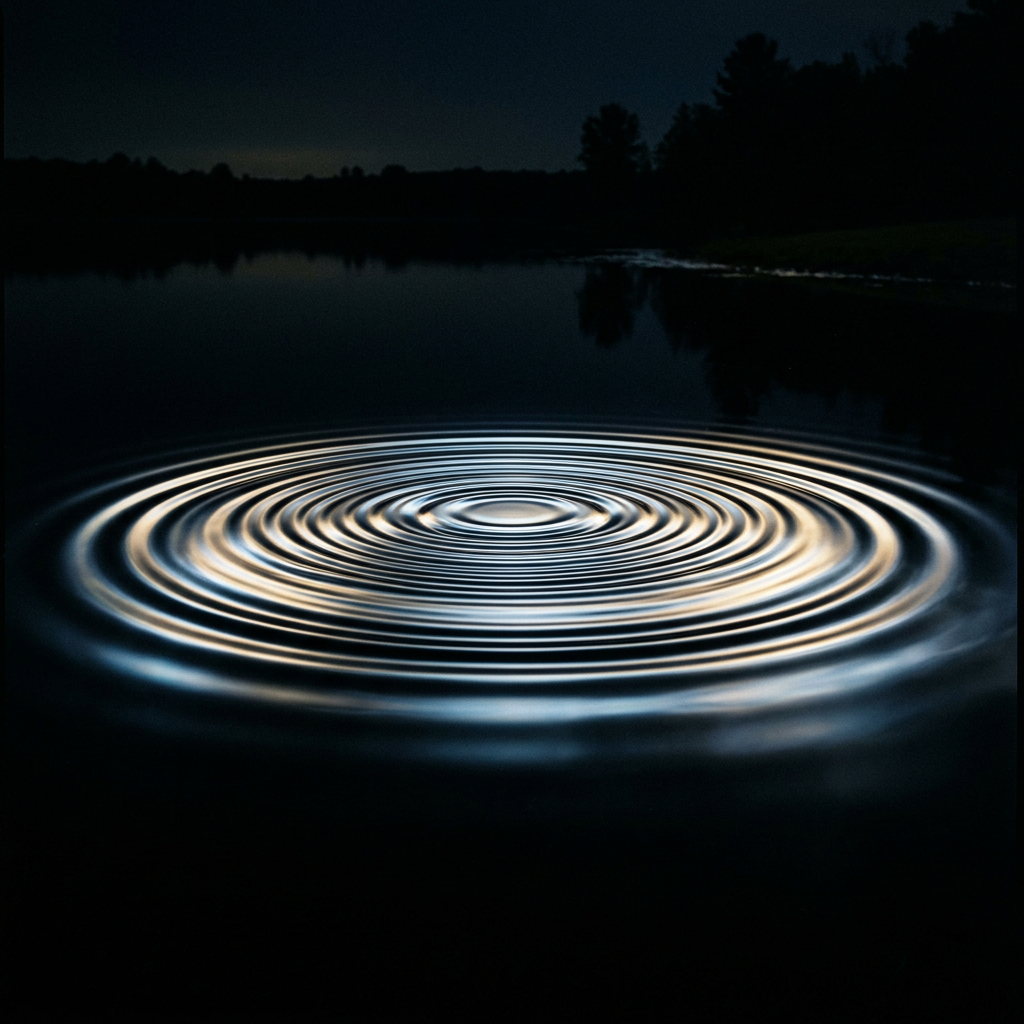
by Joe Broadmeadow
❧
There is a single moment that has never ended, and you are standing inside it.
We speak of time as a river—Heraclitus dipping his hand into a current that has already moved on. But the river is a story we tell to make our losses bearable. Sit beside it long enough, and a stranger thing reveals itself: the water moves, the banks hold, and the act of watching never once leaves the present tense. You have never, not for a single instant, been anywhere but here.
You have never lived one second of the past or one second of the future. The whole of your life—every grief, every kiss, every ordinary Tuesday—was lived in the same unbroken now in which you are reading this line.
Augustine, fifteen centuries ago, turned the question over in his hands and could not set it down. “What then is time?” he wrote. If no one asked, he knew; if asked to explain, he did not. The past has gone and is nothing. The future has not come and is nothing. And the present, if you try to measure it, has no width at all—the instant you reach for it, it has already slipped behind you. By that arithmetic, time is built entirely of nothing, and we are ghosts haunting a length of road that does not exist.
But there is another way to hold it.
The mystics made a quieter, more dangerous claim. They said the present moment is not the thinnest sliver of time but the place where time opens onto something that does not pass. Meister Eckhart called it the nunc aeternitatis—the now of Eternity—and insisted it was not a long, long duration but the absence of duration altogether: an everlasting present in which there is neither before nor after, where all the work is done in a single now. Eternity, in this telling, is not endless time. It is the loosening of time’s grip, and the door to it has only ever been one width—the width of this breath.
You know the door, even if you have never named it. It opens by accident. A turn in a piece of music where the counting falls away, leaving only sound. The top of a long climb where the trail gives out onto a valley, and your own breathing becomes the loudest thing in the world. The face of a sleeping child, in which the future you were anxious about and the past you were mourning, both quietly go still. In those moments, you are not remembering or anticipating. You are simply, wholly present—and you notice, with something like vertigo, that the present was never small. It was the only thing large enough to contain you.
You have never lived one second of the past or one second of the future. The whole of your life—every grief, every kiss, every ordinary Tuesday—was lived in the same unbroken now in which you are reading this line.
Joe Broadmeadow
We flee it, all the same, almost without rest. The mind is a machine for being elsewhere—replaying the conversation we lost, rehearsing the one we fear, and paying out our one irreplaceable attention into two countries that do not exist. The past is a debt we keep servicing. The future is a tax we pay in advance. Between them, the present—the only place anything has ever actually happened to us, the only place we have ever been loved or done a single good thing—goes by almost unwitnessed. We are like a man who owns one house and lives his whole life in its hallways, hurrying between rooms he never enters.
This is the secret the word aeternum keeps. We imagine Eternity as a vast afterward, a time that begins once this one runs out. But every tradition that has looked closely says otherwise. Eternity is not later. It is deeper. It does not wait at the end of the corridor of your days; it stands at a right angle to every one of them, touching each at the single point we call now. The eternal is not the opposite of the present moment. It is the present moment, seen without fear.
So there is nothing to wait for. The thing you were saving for the end of the climb is already here, on the path. The peace you meant to feel once the work was finished is available in the unfinished work. You do not have to die to enter Eternity, and you cannot postpone your way toward it, because it keeps no address in the future to arrive at. It has only ever had one location, and you are living there now and have always been and will never leave.
The moment has not ended. It is not going to. Look up from the page—that is it; that is all of it. Nunc aeternum.
Leave a Reply