A Short Story
Toby Greer found the stone the summer he turned eight, on the gray strip of beach below his grandmother’s house, where the bay went out so far at low tide it left the world looking emptied.
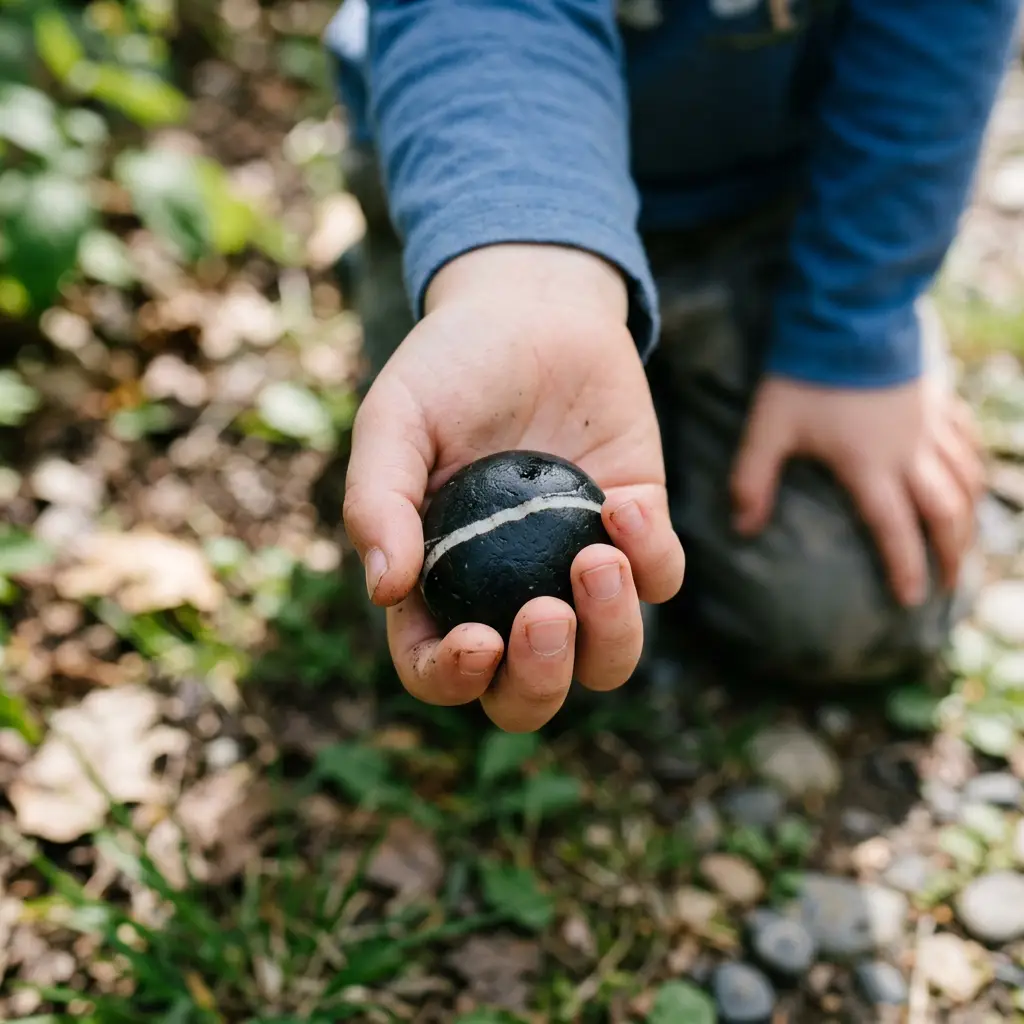
It was a smooth black stone, round as an egg, and across its middle ran a single band of white—clean and bright, like someone had wrapped it once with a ribbon of milk. He turned it over in his hands. The white line went all the way around, unbroken.
“That’s a wishing stone,” his grandmother said when he carried it up to the porch. She was shelling peas, and she didn’t look up. “When the white runs full around it like that. My mother used to say so.” She let a pea drop into the bowl. “One wish. You run your thumb along the line, and you wish, and you only get the one, so you’d best be careful what you ask. People never are.”
“What happens if you waste it?”
“Then it’s wasted,” she said. “But that’s not the dangerous part. The dangerous part is getting exactly what you asked for.”
Toby did not really understand that, so he put it away with the rest of what grown-ups said and went up to his room to think.
He had a lot to think about. Toby was a quiet boy, and being quiet made him invisible in a house full of louder people—cousins who came on weekends and shouted over each other, an uncle with a big laugh, his mother always on the phone, his grandmother always shelling something. They talked across him like he was a piece of furniture. They ruffled his hair without looking. At school, it was the same, only with more noise and less hair-ruffling. Everyone was always at him: do this, eat that, hurry up, slow down, say hello to your aunt, why are you so quiet, what is wrong with you?
Toby lay on his bed and rolled the stone between his palms and thought how nice it would be, just once, to have a little peace. To not be poked and pulled and talked over. To be left alone.
He ran his thumb along the white line.
“I wish,” he whispered, “that everybody would just leave me alone.”
The stone felt cold for a second. Then it didn’t.
Nothing happened, and he felt foolish, and he fell asleep.
❖
In the morning, the house was quiet.
Not the ordinary quiet of early—the radio off, the kettle not yet on. A bigger quiet. Toby came down the stairs calling for his grandmother, and his voice went out into the rooms and came back to him alone.
The peas were on the porch in their bowl, half shelled. Her chair still rocked, just barely, as if she had stood up from it a moment before. But there was no one in the chair, and no one in the kitchen, and no one in the yard.
He went out to the road. He walked to the Hadleys’ house and knocked, and no one came. He walked to the store at the corner, and the door was open, and the lights were on, and a cup of coffee sat steaming on the counter, and there was no one there to have poured it.
He ran, then. He ran the whole length of the town, and the town was perfect and clean and bright and entirely, completely empty. Cars sat in driveways. A sprinkler turned in somebody’s yard, tick tick tick, watering grass for no one. A screen door banged in the wind and banged again.
By afternoon, he stopped calling out. His voice had started to frighten him—it was the only one.
By evening, he understood.
Everybody would just leave me alone. And they had. All of them. Every single one.
❖
He went back to the gray beach because he didn’t know where else to go.
The tide was out, farther than he’d ever seen it, the whole bay pulled back into a flat shining nothing, and Toby sat down in the wet sand and took the stone out of his pocket and looked at it.
The white line had changed. It was wider now—thicker—as though it had drunk something. As though it had grown fat on what it took.
He pressed his thumb to it. “I take it back,” he said. His voice cracked. “I don’t want it. I want everybody back. Please. I’ll never wish for anything again, I promise, just—give them back.”
The stone stayed cold this time. Cold and patient.
His grandmother’s voice came to him from somewhere far inside his own head. You only get the one.
He cried for a while. Then, because he was eight and even an emptied world gets dark and cold, he walked home in the dusk to the silent house and the half-shelled peas and the chair that had stopped rocking. He climbed into his grandmother’s bed because it smelled like her, and he held the stone against his chest, and he watched the white line in the last of the light.
It was wider than the black now. It was almost the whole stone.
And Toby thought—drifting, exhausted, the way you do—about what he’d actually said. Not, I wish everyone were gone. He’d said, “Leave me alone.” He’d asked to be left. And the stone, which was very old and very literal and did not love him at all, had done the cruelest and most exact thing it could:
It hadn’t taken everyone away from him.
It had left him.

The way you leave a glass on a shelf. The way you leave a light on in an empty room. Left—as in abandoned, as in forgotten, as in set down somewhere quiet and never picked up again.
Outside, the tide began, at last, to come back in. He could hear it in the dark, a long, slow breathing against the sand—the only sound in the whole world that was not his own.
Toby held the stone and did not make a wish because he had no more wishes, and waited for a morning he already knew would be empty.
In his hand, the white line finished its slow circle and met itself, and the stone was the color of milk all the way around, smooth and full and done.
Out on the water, very far away, something that was not a person began, gently, to call his name.
❖
They found the stone three weeks later, a man and his daughter walking the gray beach at low tide. It was a smooth white stone, round as an egg, with a single thin band of black running across its middle—clean and dark, like someone had wrapped it once with a ribbon of night.
“Look,” the little girl said. “Can I keep it?”
And her father, who did not know any better, said, “Of course you can, sweetheart. Of course you can.”

Leave a Reply