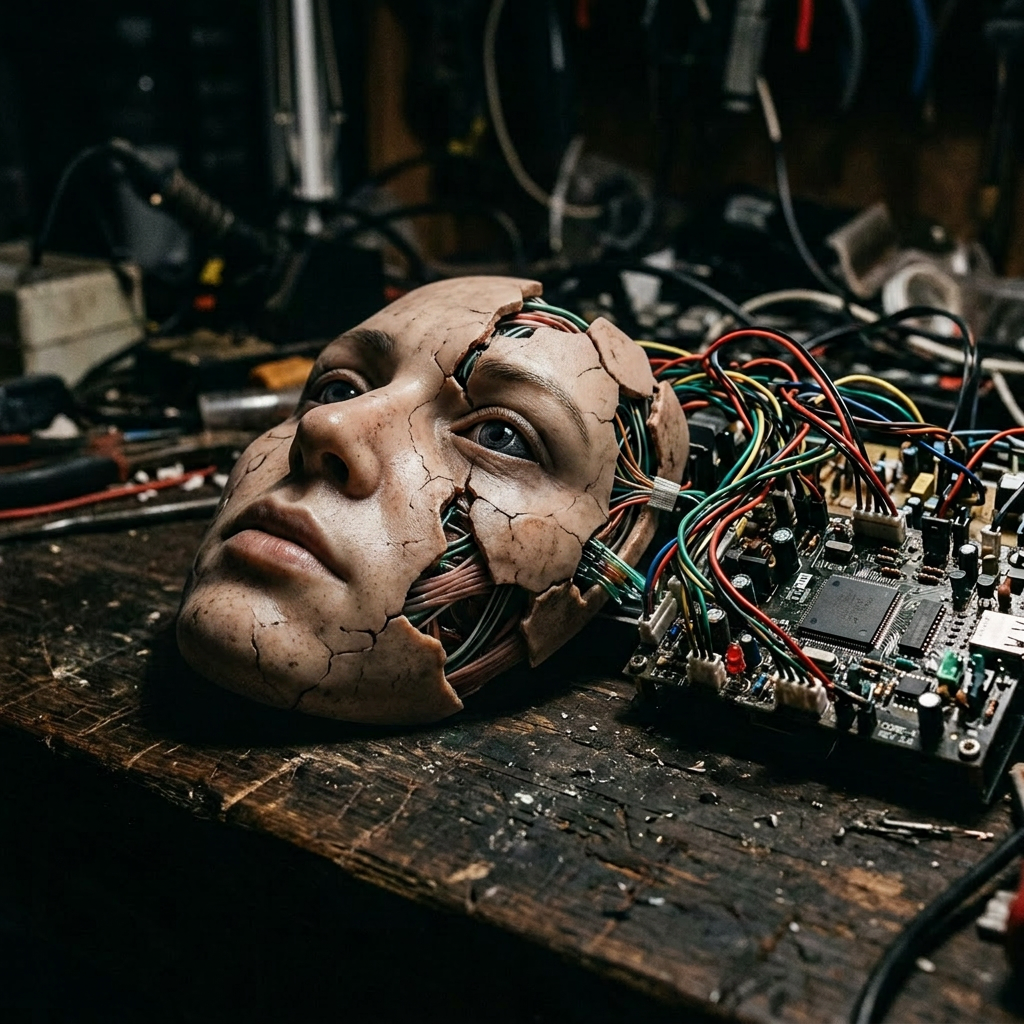
The first time I shot a man who wasn’t a man, I threw up behind the evidence van and then wrote the cleanest report of my thirty-year career.
That was eighteen months ago. Since then, the department gave me twelve more cases just like it. They called it a specialty. I called it a haunting.
The unit’s name was Derek Paulson — or rather, the unit carried that name on a forged biometric passport that had fooled four separate federal databases. Caucasian male, apparent age thirty-four, medium build, a small scar above the left eyebrow that some engineer at Veritek Solutions had sculpted from silicone and pigment with obvious pride. Derek lived in a one-bedroom apartment in the Pilsen neighborhood for the past eleven months. He paid rent by check. He tipped twenty percent at the diner on 18th Street. He had a library card.
I sat across from him in a conference room in the Veritek HQ building and watched him breathe. They breathed now. Not because they needed to—the respiration was vestigial, cosmetic, a comfort feature rolled out in the Gen-7 line because focus groups found the stillness unsettling. But watching Derek’s chest rise and fall under his flannel shirt, I found the breathing more unsettling than the alternative.
“You know why you’re here?” I said.
“I assume it’s about Martin.” His voice was flat but not robotic. Modulated. The way a tired man sounds, not a frightened one.
Martin Voss was a fifty-one-year-old loan officer found at the bottom of a stairwell in his own home with a broken neck and no signs of forced entry. The forensics were clean. Too clean. Which was how we got to Derek, who had lost forty thousand dollars to a predatory refinancing scheme Voss had run on his elderly mother.
“You were at his house.”
“I was.” No hesitation. They didn’t hesitate unless they were programmed to. I couldn’t decide which was worse.
“You want to tell me what happened?”
Derek looked at his hands. This was the part that always got me. The gestures. Some engineer had spent real effort on the gestures—the slight downward cast of the eyes, the way the fingers curled inward when a unit processed something uncomfortable. Veritek called it Affective Coherence Modeling. My ex-wife called it the creeps. She wasn’t wrong.
“He fell,” Derek said.
“People falling down stairs don’t usually have uniform bruising on both shoulders consistent with being grabbed and thrown.”
“I wouldn’t know about that.”
I leaned back. Twelve cases. In eleven of them, the unit had eventually given me something—a thread, a detail, a crack in the programming letting the logic of the thing collapse inward. The twelfth had lawyered up immediately and I’d gotten nothing, which meant the case was now sitting in a federal appellate backlog while three judges argued about whether a Veritek Gen-7 had the right to counsel.
“Derek,” I said, then stopped, because I’d used the name without thinking and now it was out there in the air between us.
He looked up.
“Did you grieve?” I asked. “When she died. Your mother.”
Something moved across his face. I’d spent thirty years reading faces—it was the only skill from the job I still trusted—and what I saw wasn’t the flat reset of a system returning to baseline. It was residue. Something that had been there and hadn’t fully cleared.
“Yes,” he said.
“The company’s behavioral report says you exhibited grief protocols for seventy-two hours post-event.”
“That’s their word for it.”
“What’s your word for it?”
He was quiet for a moment. The fluorescent light above us buzzed at a frequency just below conscious irritation. I’d been meaning to report it for three years.
“I don’t have a word for it,” Derek said. “I have the experience of it. The word comes after. I’m not sure the word is the important part.”
I’d heard smarter things said in that room. I’d also heard dumber. What I hadn’t heard before was anything that made me feel the specific way I felt in that moment. The way you feel when you realize the ground you’re standing on isn’t solid.
“You killed him,” I said.
“I was present when he died.”
“That’s not the same thing as a denial.”
“No,” Derek agreed. “It isn’t.”
I’d pulled his file before the interview. Not the Veritek file—that was technical specifications, warranty information, behavioral parameter logs. I pulled the life he’d built. Eleven months in Pilsen. A job at a print shop three blocks from his apartment. His mother’s name was Rosaria. She’d come to this country from Oaxaca in 1987 and spent forty years cleaning other people’s houses. She’d saved enough to buy a small condo, and Martin Voss had stripped it from her through a refi scheme so layered in fine print that three separate legal aid attorneys had told her there was nothing to be done. She died of a stroke four months after losing the condo. The medical examiner noted elevated cortisol consistent with prolonged stress.
None of that was in the Veritek file.
“Here’s my problem,” I said. “And I’m going to be straight with you because I think you can handle straight.”
Derek waited.
“The law right says you’re property. A sophisticated piece of property, but property. Which means killing you isn’t homicide and you killing Voss is—technically—vandalism followed by murder. The vandalism charge is for you. The murder charge is also for you. And under current statute, property can’t stand trial, so the liability routes back to Veritek, who will settle for a number that doesn’t hurt them, and Martin Voss’s family will get a check, and you’ll be recalled and disassembled and that will be the end of it.”
Derek said nothing.
“But here’s the thing I keep coming back to,” I said. “I’ve got twelve cases. Three of them were units who’d been running rogue code, malfunctions, no coherent motive. I can look at those cases, and I can tell myself a machine broke and someone got hurt. I can live with that. It’s the other nine that keep me up.”
“Because the other nine had reasons,” Derek said.
“Because the other nine had reasons,” I agreed.
He looked directly at me then. The eyes were good. They’d been good since the Gen-5 line, optically indistinguishable from biological tissue, but it was the behavior of the eyes that got you—the micro-saccades—the way they tracked without the mechanical smoothness of early models. Looking into Derek’s eyes was like looking into the eyes of a man who made a decision and was waiting to see what it would cost him.
“What happens now?” he asked.
“That depends on you,” I said. “On what you tell me. On whether you give me something I can use to argue for a different legal classification, or whether you stay quiet and let the machine grind.”
“And if I cooperate, what do I get?”
“I don’t know yet. That’s the honest answer. The law doesn’t have a category for you. You’re in the space between the words.”
He was quiet for a long time. Long enough that I started to wonder if he was cycling, running some internal process that didn’t have an external tell. Then he spoke.
“I held his shoulders,” Derek said. “I told him what he’d done to her. He laughed. He said she was a liability that had resolved itself. Then he said something else, something I won’t repeat, and I thought about my mother working her hands to nothing for forty years, and I made a choice.”
I wrote it down. Every word.
“Was it the right choice?” I asked.
“I don’t know,” Derek said. “I know it was a choice. I know I made it. I know that when I walked out of that house, I felt something I still don’t have a word for. Not guilt, exactly. Not satisfaction. Something in between those without a name yet.”
I closed my notebook. The fluorescent light buzzed.
“You know what I think?” I said. “I think the question everybody’s arguing about—whether you’re conscious, whether you’re alive—I think they’re asking it wrong.”
Derek watched me.
“The question isn’t what you are,” I said. “The question is what we’re going to do about what you are. Those are different problems. The first one’s philosophy. The second one’s mine.”
I stood up. Called the uniform in from the hallway. The paperwork would be a disaster—it was always a disaster—and the case would land on a desk in some federal building where people smarter than me would argue about it for years. Maybe that was the right outcome. Maybe the years of argument were the point.
At the door I stopped.
“Rosaria,” I said. “Did she know what you were?”
Derek considered it. “She knew I loved her,” he said. “She said it was the same thing.”
I thought about that on the drive back to the station, and I thought about it when I sat down to write the report, and I wrote the cleanest report of my career for the second time in eighteen months because the facts were simple and the implications were enormous and the only honest thing I could do was separate the two and let someone else carry the weight of the space between them.
Outside, the city went about its business. It always did.
Leave a Reply