The bones of Earth had been cooling for two hundred years when the Kaelith survey team cracked open the Houston sediment layer and found the first one.
Dr. Senn Varath held it under the field scanner with two of her four hands, rotating it slowly. A small figure. Humanoid. Arms spread wide. Cast in some ferrous alloy, suspended on a perpendicular crossbar. The scanner dated it to the pre-Collapse period, roughly four centuries prior. She bagged it, tagged it, and moved on. She found nine more before lunch.
By the time the Kaelith Anthropological Society convened its annual conference on Mirath Station, the Houston dig had yielded over forty thousand artifacts from what the team had classified as the North American Devotional Stratum. Varath had spent three years cataloguing them. She had read every surviving digital text her team had recovered from the hardened server vaults beneath the rubble. She had cross-referenced, triangulated, and theorized.
She believed she understood what had happened on Earth.
She was, as it turned out, almost entirely wrong. But she wouldn’t know that for another forty minutes.
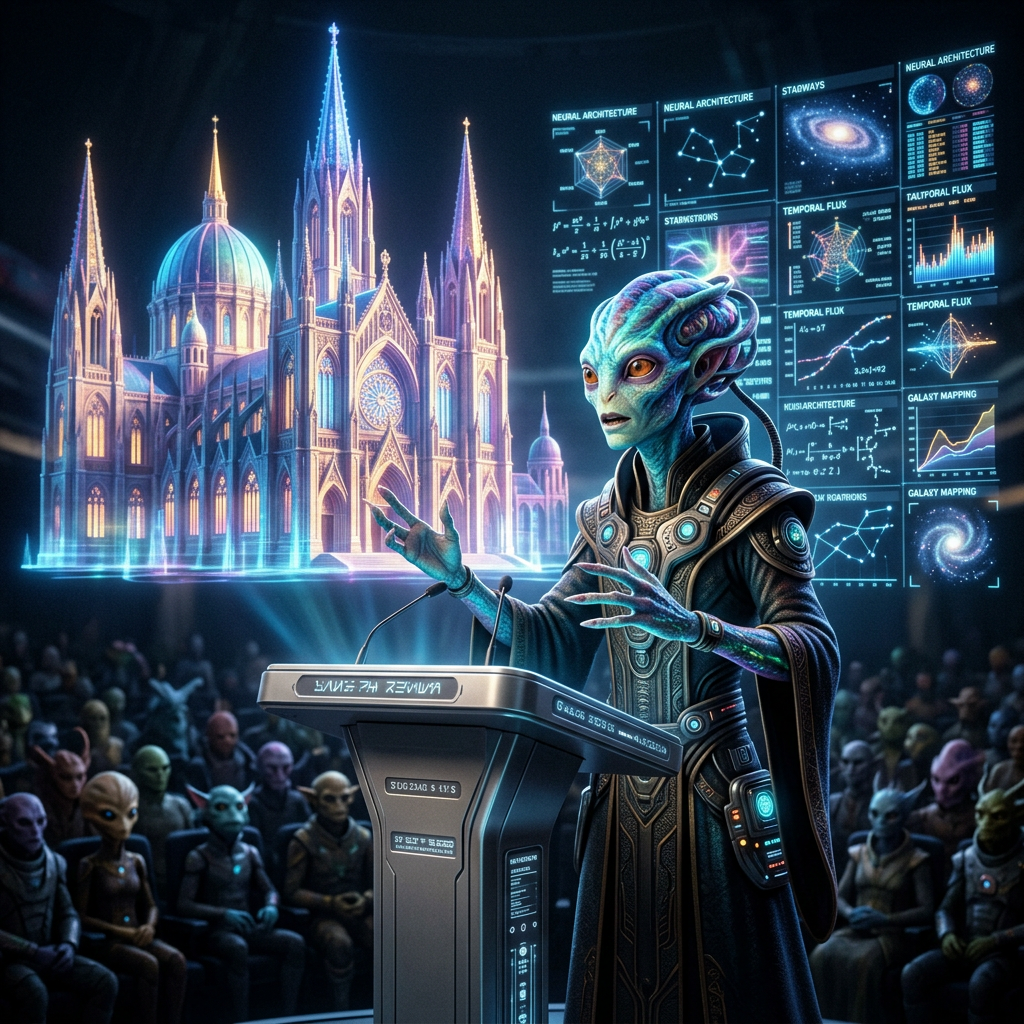
The conference hall held six hundred delegates from eleven species. Most were academics. Some were journalists. Two were government observers from the Kaelith Restoration Council, which was still debating whether to attempt resettlement of the scorched planet. The air recyclers hummed. The lighting was warm and amber, the Kaelith preference. Varath stepped to the podium, adjusted the display behind her, and looked out at the assembled scholars with the quiet confidence of someone who had done the work.
“Thank you,” she said. “I’ll be presenting findings from the Houston Stratum today, specifically the religious practices of a dominant Earth sect we’ve designated the Crossed-Figure Cult.”
She advanced to her first image. The ferrous figure appeared on the screen, three meters tall, arms wide, suspended on its crossbar.
“These effigies were found in extraordinary density throughout the North American territories. We recovered over forty thousand in the Houston site alone. They appeared in private dwellings, public structures, dedicated ceremonial buildings, and mounted on the exterior facades of nearly every significant piece of architecture we excavated. The figures were also worn as jewelry, frequently touching the wearer’s skin.”
She clicked forward. Images of gold and silver pendants. A child’s bedroom with a wooden version above the sleeping area. The ruins of a large stone building, its interior dominated by an enormous version in colored glass.
“The Crossed-Figure Cult appears to have been one of the most pervasive religious movements in recorded human history. We estimate adherents in the hundreds of millions. Possibly more.”
A murmur ran through the hall. Varath took it as appropriate scholarly gravity and continued.
“The effigies themselves depict what we believe to be the cult’s primary deity or sacred martyr. The figure’s posture — arms extended, head slightly bowed — suggests a posture of suffering or sacrifice. The crossbar apparatus is consistent with an execution device we found references to in recovered texts.”
She clicked forward. A diagram of a Roman crucifixion, reconstructed from her research.
“The humans apparently executed this individual publicly, then immediately began venerating the instrument of his death. We see this in other cultures — the sacralization of trauma — but rarely with such literal iconographic repetition. They were, in essence, wearing miniature execution devices around their necks. Millions of them. Every day.”
A ripple of something moved through the audience. Varath registered it as rapt attention.
“The ceremonial buildings were equally striking.” She advanced. Images of church interiors. Cathedrals. The sheer vertical ambition of Notre Dame. “These structures required extraordinary resource investment. Stone. Labor. Centuries of construction in some cases. The interiors were designed to manipulate emotional states through light, acoustics, and scale.”
She clicked. A photograph of Gregorian chant notation, recovered from a sealed vault in what had been Vatican City.
“They also practiced ritualized communal vocalization. Tonal patterns repeated in unison, often weekly. We found evidence this was considered mandatory for full participation in the cult’s social structure.”
She clicked again. The image showed a recovered text page — a Bible passage, English, Revelation 13:18. She had highlighted it.
“Perhaps most significantly, they embedded numerical codes throughout their sacred texts. This passage refers to a specific number — six hundred and sixty-six — associated with a powerful adversarial deity. The number recurred obsessively in their iconography, their architecture, their calendar systems.”
She advanced to a chart she’d spent three months building. It mapped the frequency of the number’s appearance across recovered texts, building facades, and consumer products from the pre-Collapse era.
“We believe this numerical obsession served as a unifying tribal marker. Those who knew the code were insiders. Those who didn’t were suspect. A sophisticated in-group signaling system reinforcing cult membership.”
She paused. “I want to show you one final artifact class before I open for questions.”
The image shifted to a photograph of a recovered bumper sticker, laminated, found sealed in a metal box with other personal effects. It was bright red and read: HONK IF YOU LOVE JESUS.
“We interpret this as a public declaration of cult allegiance, designed to solicit affirmation responses from fellow cult members encountered during travel. A moving, vehicular version of the exterior facade effigies. Note that the text demands an auditory response — a signal exchange system, almost military in its simplicity.”
The first sound came from the back of the hall. A short, sharp exhalation from a Miran delegate, one of the two species with enough English-language context to understand the bumper sticker without the translation feed. Then a second sound. Then someone made a noise that had no analog in Kaelith but which Varath would later describe in her journal as a kind of barking.
She looked up.
The Miran delegate in row fourteen had both hands pressed over her face. Her shoulders were shaking. The colleague beside her was gripping the armrest with white knuckles, head down, making a sound like something being slowly strangled.
Within seconds it spread. The translation feeds had caught up. Six hundred scholars from eleven species began to understand, in their various ways, what they were looking at. The hall did not descend into chaos. It descended into something worse for Varath’s dignity: uncontrollable, helpless, cascading laughter.
She stood at the podium for a full minute before she said anything.
“I’m not sure what—”
A human delegate, one of perhaps thirty in the hall, had stood up. Dr. Pell Okafor, University of New Nairobi, specializing in pre-Collapse cultural studies. He was laughing too, but he was working against it, pressing his lips together, raising his hand.
“Dr. Varath,” he said. “May I?”
She gestured to the podium. She stepped aside. She was professional enough for that.
Okafor took a breath. He looked at the bumper sticker still projected behind him. He almost lost it again.
“Dr. Varath’s work is meticulous,” he said. “Her archaeology is beyond reproach. Her dating, her cataloguing, her material analysis — all of it is exceptional.” He paused. “Her interpretive framework, however, is approximately as accurate as if you excavated Mirath Station in four hundred years and concluded that your dominant religion involved small glowing rectangles you stared at for eight hours a day and worshipped by pressing your thumbs against them.”
Silence. Then the laughter came back.
Okafor spent the next twenty minutes providing context. He explained that the Crossed-Figure Cult was called Christianity, that it was one of several major Earth religions, and that it predated the Collapse by roughly two thousand years. He explained that the bumper sticker was not a military signal exchange system. He explained that Revelation’s numerical code was theological, eschatological, ancient, and wildly debated even among adherents. He explained the cathedrals — how they were not manipulation chambers but expressions of longing, of beauty made enormous so that people standing inside them might feel small in a way that comforted rather than diminished.
He spoke quietly toward the end.
“They were afraid,” he said. “They didn’t understand death. They didn’t understand suffering. They built these enormous things and they wore these small things and they sang together because otherwise the silence was too much.” He looked at the image of the cathedral. “We have the bones of their buildings. We have their little execution pendants. What we don’t have — what we can never fully excavate — is the specific weight of a specific person’s grief, and the moment they reached for something beyond themselves because they had nothing else left to reach for.”
The hall was quiet.
Varath was standing at the side of the stage. She was a scholar. She had been wrong in her conclusions, and she was large enough to know it. But she was also watching the human man at her podium, and she was thinking about something she hadn’t considered in three years of cataloguing: that she had treated the artifacts as evidence of a belief system and had never once asked what the people holding them were afraid of.
That was the error. Not the methodology. The omission.
She would rewrite the paper. It would be better.
She looked at the image still behind Okafor — the cathedral, its light fractured by colored glass, falling across empty pews, four centuries of silence inside it now, the people who had built it long since turned to ash.
The laughter in the hall had gentled into something else. Not quite grief. Something adjacent to it. The recognition that a species had stood on a burning planet and made beauty anyway, and that the beauty had outlasted them, and that it had taken two hundred years and a mistaken academic from another world to bring anyone back to look at it.
Varath thought it was possible that counted for something.
She stepped back to the podium when Okafor finished. She thanked him. She turned to face six hundred faces from eleven worlds.
“I’ll be revising my conclusions,” she said. “The paper will be resubmitted in the fall.”
She paused.
“I’ll also be returning to Houston.”
Leave a Reply