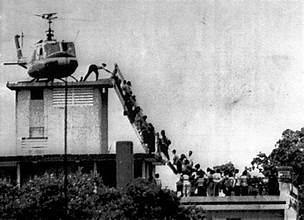
American Embassy, Saigon, Vietnam
April 1975
Since he suffered the tragedy of bone spurs keeping him out of Vietnam, Mr. Trump has craved the thought of combat command. He likely believes he’d have been like Rambo had he gone to Vietnam, but it was denied him.
Damn that doctor’s note. “Please excuse Donnie from Vietnam, he has a boo boo.”
Trump does not take kindly to be denied things; women who resist his demands, inconvenient voting results, poor sales of his Bible. He does not handle that well.
Trump wanted his own war, and now he has it.
Is it a convenient cover for changing the headlines? That does seem to be a consensus. But, to the members of the United States military who will die or be wounded, why we are there is irrelevant.
At least to this point no one has articulated a reason for it.
Bush at least dug down to the bottom of the reliability pile and found some hearsay information that Iraq had weapons of mass destruction. It may have been written in a child’s scribble with a crayon, but it was something. Bush sacrificed the integrity of one of America’s finest warriors, General Colin Powell, on it, not to mention the thousands of service members who died or were wounded.
No one who has at least one functioning brain cell believes for a second Mr. Trump ordered this attack to prevent the Iranians from mass execution of their citizens or to defend democracy, something he finds terribly inconvenient is this country. If you do, you may want to have that one brain cell replaced.
And if you’re waiting for Congress to act Congressionally, you have a long wait ahead of you.
The philosopher Georg Wilhelm Friedrich Hegel famously said,
“The one thing we learn from history it that we learn nothing from history.”
Trump has the authority to take action without Congressional approval for sixty days. Every President should have that authority. But, if you’re expecting a calm, rational deliberation by Congress to enforce their ultimate authority to control when this country engages in sustained military conflict, you are about to be gravely disappointed.
History proves it.
Vietnam vs. Iran: A Pattern of Congressional Oversight Failure
Vietnam War (1960s–1970s)
- Delegation without sustained oversight: Congress effectively ceded its war‑making authority through the Gulf of Tonkin Resolution (1964), which granted the president broad power to use military force without a formal declaration of war. [britannica.com], [archives.gov]
- Limited debate and incomplete information: The resolution passed with minimal scrutiny, later complicated by evidence that key facts about the alleged attacks were uncertain or incorrect, undermining Congress’s ability to provide informed oversight. [archives.gov], [history.com]
- After‑the‑fact correction: Only after years of escalation did Congress attempt to reassert its role through the War Powers Resolution of 1973, implicitly acknowledging its earlier failure to check executive action. [congress.gov]
Current Situation with Iran (2025–2026)
- Military action without prior authorization: Recent U.S. strikes and escalating involvement with Iran have occurred without a new, explicit authorization from Congress, prompting renewed debate over constitutional war powers. [usatoday.com], [military.com]
- Reactive rather than proactive oversight: Congressional efforts—such as proposed war powers resolutions—have largely come after hostilities began, mirroring Vietnam‑era patterns where oversight follows escalation rather than precedes it. [military.com], [cnbc.com]
- Persistent structural weakness: Despite the War Powers Resolution’s reporting and time‑limit requirements, enforcement depends on congressional will, which has again proven difficult to sustain in the face of executive initiative. [congress.gov], [time.com]
Core Parallel
In both Vietnam and Iran, Congress possessed clear constitutional tools to oversee or restrain the use of force but failed to assert them decisively at the outset. The result in each case has been an expansion of executive war‑making power, with Congress responding belatedly—if at all—once military commitments were already underway.
President Richard Nixon—one cannot help but see the parallel here—wrote a book called “No More Vietnams.” I’m willing to bet most members of Congress have never read it and I am certain Mr. Trump never did.
Nixon should have called it No More Vietnam’s…But We’ll Forget Soon Enough.
The evidence is right before our eyes.
 The Writing of Joe Broadmeadow