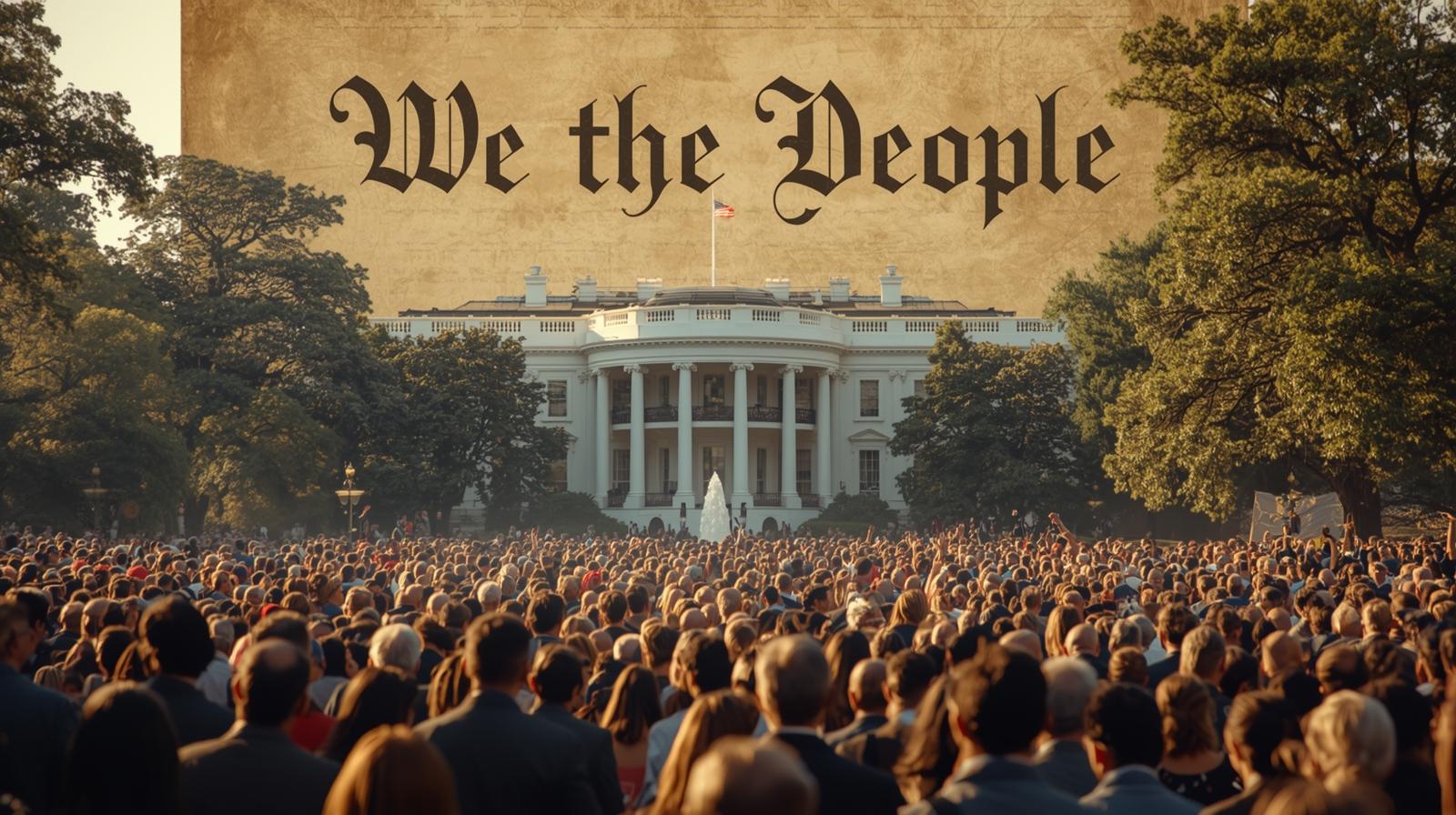
I am rarely one to engage in conspiracy theory, but, if one embraced the scientific definition of theory in this case, when there is mounting, verifiable, and consistent evidence pointing to a rising conspiracy one has to consider it.
Mr. Trump has often “joked” about serving a third term. As recently as just a few days ago he “jokingly” suggested there was reason to cancel the mid-term election citing the normal pattern of the party in the White House losing seats in Congress. He bemoaned the problems that would cause for his “perfect” agenda.
I see no humor in such statements from a sitting President of the United States. What I see is a man intent on solidifying his grip on government, neutering any checks and balances on his power, and testing the waters to see just how far he can go.
He has instigated a rash of questionable investigations—lawfare—he claims was a tactic of the Democrats and taken it to a new level of abuse of power. When career prosecutors who have served under a variety of Presidents and political climates resign as a matter of conscience rather than play along with this blatant abuse of power, it shows where this practice of using the Department of Justice as a Department of Retribution actually originated.
And do not be fooled by reassurances that suspending the Writ of Habeus Corpus cannot happen here. It already has as recently as 1942 with Executive Order 9066 and the unlawful internment of over 120,000 American citizens of Japanese ancestry.
Mr. Trump and administration are following the totalitarian’s playbook to set the stage for similar actions. Exaggerate a problem (crime by illegal immigrants), create an “enemy” (all illegal aliens), blame the problems faced by Americans on this “enemy.”
Then, when people of conscience (dare I say people who actually embrace the philosophy of Christianity so many claim is necessary and elemental to our nation) argue for a more equitable and realistic approach to dealing with the matter, the President paints them as unpatriotic rabble rousers poised to engage in insurrection.
All that’s needed is a catalyst to claim the revoilt has begun and Mr. Trump has his opening.
As tragic as the shooting of Renee Good is, it wasn’t the one he needs most. As harsh as this may be to say, what the President and those who endorse his policies would love to see would be a couple of more dead cops or National Guard members. That would be the excuse to crank up the “we need to impose martial law and suspend the Constitution to save the country.”
It is reminiscent of a quote from an American field commander in Vietnam who said, “we needed to destroy the village to save the village.”
Sound crazy? Not if one’s eyes have been open these past few months. Remember January 6th?
In a rare national emergency, such as a foreign invasion or widespread civil unrest threatening the constitutional order, the president could invoke emergency powers to temporarily suspend elections. This would be justified as a measure to preserve national security and ensure the functioning of government during the crisis. However, any suspension would be highly controversial, subject to judicial review, and likely require congressional approval to avoid violating democratic principles and constitutional protections
“Presidents can also rely on a cornucopia of powers provided by Congress, which has historically been the principal source of emergency authority for the executive branch. Throughout the late 18th and 19th centuries, Congress passed laws to give the president additional leeway during military, economic, and labor crises. A more formalized approach evolved in the early 20th century, when Congress legislated powers that would lie dormant until the president activated them by declaring a national emergency.” (https://www.brennancenter.org/our-work/analysis-opinion/what-president-could-do-if-he-declares-state-emergency
Summary of the President’s Power to Suspend Habeas Corpus
The authority to suspend habeas corpus, a foundational protection against unlawful detention, is established under Article I, Section 9 of the United States Constitution. This clause unequivocally states that the privilege of the writ of habeas corpus may be suspended only “when in cases of rebellion or invasion the public safety may require it.” The constitutional text places this power within the jurisdiction of Congress, as Article I pertains exclusively to legislative functions. While certain historical instances—most notably President Abraham Lincoln’s actions during the Civil War—illustrate the executive branch’s assertion of this authority in times of national crisis, such actions have provoked enduring legal controversy and judicial scrutiny. The prevailing constitutional interpretation affirms that only Congress has the explicit and legitimate power to suspend habeas corpus. Still, the boundaries of executive authority under extraordinary circumstances remain a subject of legal debate and analysis within American constitutional law.
In an article published on the National Constitution Center website, then Circuit Judge of the United States Court of Appeals for the Seventh Circuit; Professor of Law at the University of Notre Dame Law School and now Supreme Court Justice Amy Barrett along with Neal A. Katyal, then Paul and Patricia Saunders Professor of National Security Law at Georgetown University Law Center; Partner at Hogan Lovells and now a partner at Milbank LLP and the Paul and Patricia Saunders Professor of National Security Law at Georgetown University Law Center, publishes an article addressing this issue.
“The Suspension Clause follows in this tradition. It protects the writ by imposing a general bar on its suspension. At the same time, it makes an exception for cases when an invasion or rebellion endangers the public safety. A suspension is temporary, but the power it confers is extraordinary. When a suspension is in effect, the president, typically acting through subordinates, can imprison people indefinitely without any judicial check.
The Clause does not specify which branch of government has the authority to suspend the privilege of the writ, but most agree that only Congress can do it. President Abraham Lincoln provoked controversy by suspending the privilege of his own accord during the Civil War, but Congress largely extinguished challenges to his authority by enacting a statute permitting suspension. On every other occasion, the executive has proceeded only after first securing congressional authorization. The writ of habeas corpus has been suspended four times since the Constitution was ratified: throughout the entire country during the Civil War; in eleven South Carolina counties overrun by the Ku Klux Klan during Reconstruction; in two provinces of the Philippines during a 1905 insurrection; and in Hawaii after the bombing of Pearl Harbor.” (https://constitutioncenter.org/the-constitution/articles/article-i/clauses/763)
The most troubling part of this article, written by a now sitting Supreme Court Justice who would be one of the justices deciding the issue if it came to fruition, is that it does not say the President cannot suspend the right, it argues that it is not clear.
Such uncertainty plays directly into the hands of someone like Mr. Trump, his most ardent supporters, and those who crafted Project 2025, who hold a callous and dismissive view of the law and legal precedent.
We are facing a crisis tantamount to an an invasion. But it is an invasion from within by those whose idea of the law and the protections of the Constitution are only necessary to protect them. They can be ignored when it comes to those who disagree.
The President’s senior advisor Stephen Miller said they are “actively looking at invoking the insurrection act” to detain illegal immigrants. The next step is using it against those protesting such actions.
Such considerations should chill every American.
This may be a crazy conspiracy theory we can hope never bears fruit. But the signs and the evidence show it is a real possibility. It is based on the words, actions, and history of the man in the White House.
That it should never come to pass is our fervent hope. That we should be ready to face this possibility and be ready to face the consequences is our wisest course of action.
 The Writing of Joe Broadmeadow