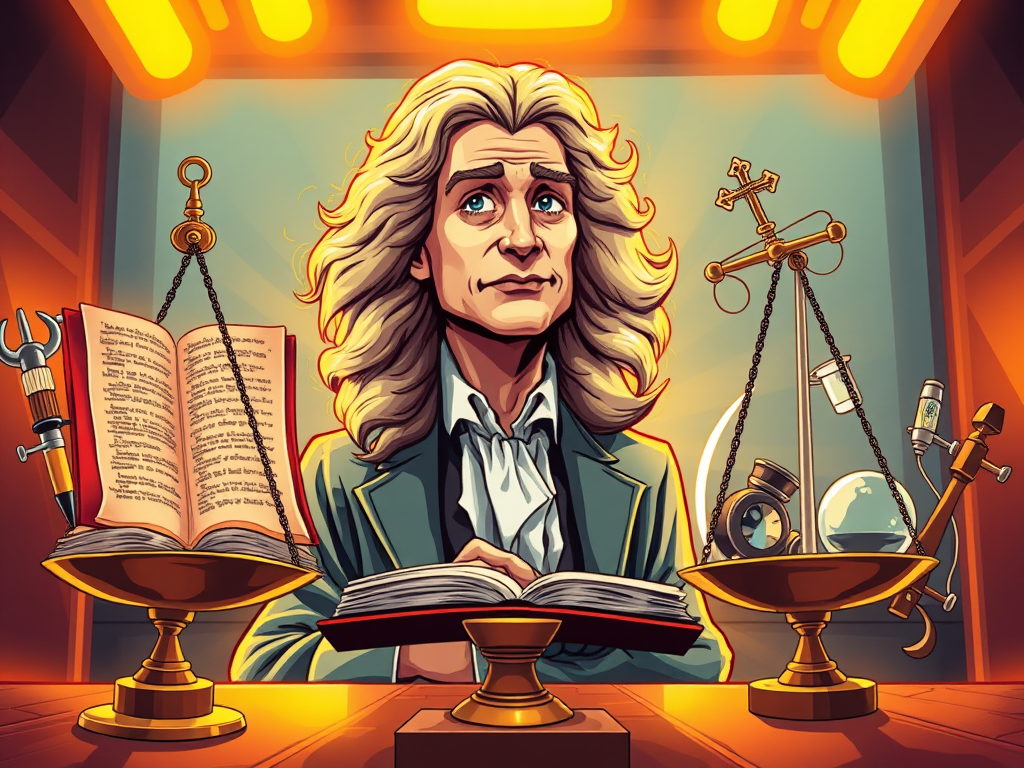
I published a tongue-in-cheek piece about the December 25th celebration of the birthday of a great human with an enormous impact on society (Sir Isaac Newton) and was met by the exact response I expected. https://joebroadmeadowblog.com/2025/12/24/for-unto-you-is-born-a-savior/
Many were quick to point out the Newton was a Christian or that his birthday is more commonly recognized as January 6, 1643. The discrepancy stems from the use (at the time) of the Julian Calendar which had the birthdate as December 25, 1642.
Which, of course, is a key element of the satirical nature. I’d never mentioned anyone else, but Christians seem to be fixated on a perception of persecution. This contention, in a majority Christian country like the United States, is a bit of a stretch.
The hyper-religious responded with the usual avalanche of biblical tracts and outrage. Why, you might ask? I have no idea. Because, even if we agree to the calendar change, on December 25, 0000, I am certain Jesus was not the only birth worldwide nor the only consequential one. Nor is there any consensus on that date except it conveniently co-opted a much older Pagan celebration. And we know how the church does not like competition.
When this was all shouted at me with the vigorous use of all capital letters and the usual accusation of my being a disciple of Satan, mixed in, I will admit, with the good intentions of praying for my soul that I may see the light and come to Jesus, I said I would stick with Newton and Galileo.
This caused another round of claims that Newton AND Galileo were Christian. When I pointed out the rather threatening treatment of Galileo by the Church, i.e., house arrest and forced recantation at the threat of immolation, I was sent a slew of “authoritative” postings about the “myth” of Galileo’s treatment by the Church.
This consisted of claims that; it wasn’t so bad, his house arrest was benign, many in the church agreed with him but the bureaucracy was responsible, as if that would have somehow cooled the flames. Then, I pointed out, there is Giordano Bruno who was not afforded the “luxury” of house arrest but was put to the flame.
This is a fine example of history being interpreted by those with an agenda. And these differences arise regarding events from just a few hundred years ago for which we have fairly substantial records. Yet, they express no concern about the accuracy of their claims regarding events two thousand years ago for which we have few contemporaneous records.
What these sincere but misled individuals fail to see is their argument supports my contention. The Bible is not the inerrant word of God, but the sometimes inspirational and beautiful, sometimes banal and pedestrian, yet more often horrific words of men trying to understand a complex world, give meaning to their short, violent, and plague-filled lives, and, more troubling, exert control over the lives of others masked by the claim of doing God’s work.
The Church first resists with deadly vigor any challenges to doctrine, be it heliocentrism, genetics, or evolution. Then, after the evidence becomes overwhelming, it attempts to rewrite history with claims that Galileo was punished for his attitude toward the church and his house arrest was evidence of the church’s true goal and good intention.
Then, back to the parables and passages to reinterpret them as supporting the science all along.
Galileo, Newton, and many of the most influential pioneers of science were Christian at a time when not to be was fraught with both economic and physical challenges. It is also true that many within the Church understood the Biblical explanations were merely placeholders until discoveries based on evidence came along.
Before we understood geology and plate tectonics, a 6,000 year old earth sounded ancient.
Before we understood planetary mechanics, we believed our eyes and the sun rose in the east and set in the west.
Before we understood the symptoms and pathways of epilepsy, demonic possession made sense.
Before we turned the first telescopes on the “heavens,” we believed our planet to be unique in the universe.
Whether or not Newton was born on December 25, 1642 or January 6, 1643 is irrelevant. Whether he proclaimed himself a Christian at the time is also irrelevant. His Philosophiæ Naturalis Principia Mathematica changed the world in ways even more startling than the legend of a savior born centuries beforehand whose story was manipulated by those with an agenda to make it fit prophecies affirming their particular faith.

Next year, let’s celebrate the Dec. 25th birthday of Carlos Castenada, a writer of extraordinary mystical literature. Surely that won’t offend anyone.
 The Writing of Joe Broadmeadow
At least your writing generates enormous response and keeps you busy answering the religous “authorities”. Yes, satire is dead and sarcasm is no long recognized, such a shame. Sarcasm has always been my go to. Keep slaying the dragons.
LikeLike