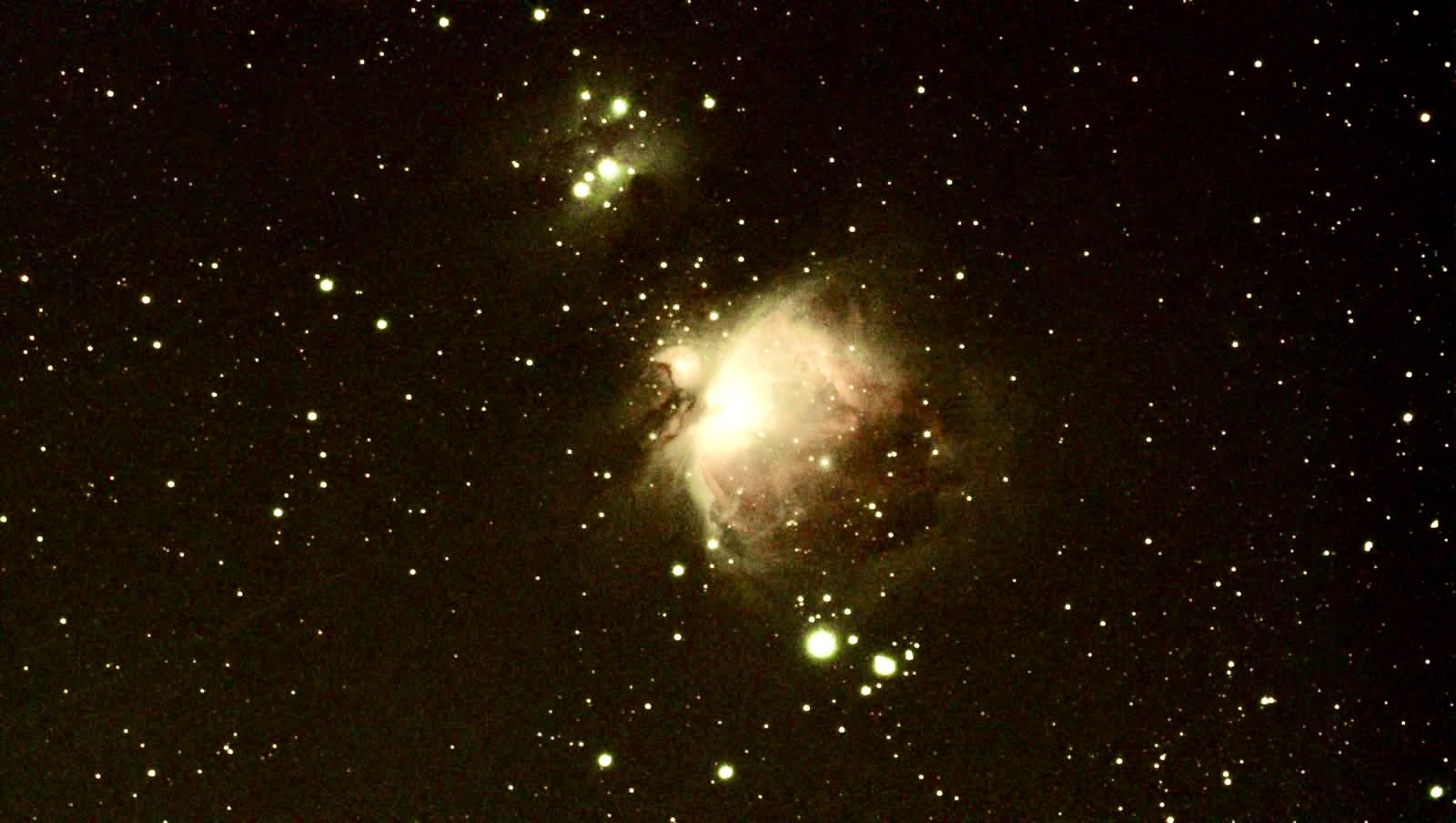
Looking at the stars has always fascinated me. As a young boy, with my first telescope, I drove my mother crazy in the winter when it was too cold to be outside. I would close the door to my room, open the window, and point the telescope at whatever happened to be in my limited viewpoint.
After not hearing from me for some time, my mother would come into my now-freezing room and make me shut the window.
But the things I saw stuck with me.
One cannot look into the night sky, if one can find a place less impacted by light pollution, without being in awe of the universe.
Since the first humans–Sapiens, Neanderthal, and others–tried to understand nature, they attributed the heavens to some form of a god. Everything must have a cause; only an omnipotent being can craft the universe.
Of course, they first thought of the stars as light peeking through from heaven. Over time, a more sophisticated view of the stars developed. Our Earth-centric philosophy, based on what appeared to be the logical observation of the sun, moon, and stars orbiting around us, seemed to confirm our central place in this god’s plan.
This belief was reinforced by the penalty of death for anyone who challenged it.
But time inexorably moved on, and our understanding of nature progressed. We went from being at the center of the universe to our actual place in a sparsely star-populated outlier in the Milky Way Galaxy. We know that the universe contains billions of other galaxies and hundreds of trillions of stars.
And that’s okay. No one should be threatened by such a truth.
Yet there are those among us who cling to the concept that life here is unique in the universe and the result of divine intervention. A god created a universe of infinite size and chose this one place to create life.
It defies logic. But no one will ever convince me that religious faith is logical. Many who hold religious beliefs are sincere. They are compassionate. They are considerate of other differing faiths.
But not all.
We face a crisis in this country. A resurging wave of fundamentalist Christians, under the guise of a philosophy known as Christian Reconstructionism and the New Apostolic Reformation, threaten our very freedom. These go beyond what most people would consider fundamentalism. These are radical religious doctrines seeking to eliminate secular government worldwide and replace it with a Christian world government.
Civil rights, constitutional guarantees, freedom of speech, and freedom of assembly are anathema to this philosophy. They have been building towards the arrival of an individual like President Trump to implement their goal.
Their plan is simple. They seek to impose the 7 Mountain Mandate, control of media, government, education, economy, family, religion, and arts & entertainment.
One would have to be blind not to see their initial efforts replacing public education with voucher systems, banning books, and supporting political candidates who embrace this philosophy.
For an in-depth look at the New Apostolic Reformation, read the article “Army of God” in the February 2025 edition of The Atlantic. Or, if you automatically discount such a source, look into C. Pete Wagner and R.J. Rushdoony (key founders of the Christian Reconstruction movement) read their own words.
If there is such a thing as God, she would hardly depend on such demonstrations of faith. A god capable of such creation would more likely care about one thing; we live our lives guided by our innate human empathy for our fellow beings.
Joe Broadmeadow
Or the writings of Jack Posobiec called “Unhumans” whose concepts are supported by J.D. Vance. And, of course, the postings and material from the America First Policy Institute and Project 2025.
So I would ask each and every one of you who believe Christianity, or any religion for that matter, is the means of saving America a few questions.
Would a god capable of creating the universe, an unfathomably immense entity, really need your prayers, church attendance, or outward signs of devotion?
Would such a god be so petty as to demand such actions?
And if we accept the premise that everything has a beginning, when did god begin?
I would submit that the concept of god began when that first human looked up into the sky and thought, what kind of being would be capable of such things? Not men. It must be a god.
If one looks at the etymology of the word god, there is this,
“some trace it to PIE *ghu-to- “poured,” from root *gheu- “to pour, pour a libation” (source of Greek khein “to pour,” also in the phrase khute gaia “poured earth,” referring to a burial mound; see found (v.2)). “Given the Greek facts, the Germanic form may have referred in the first instance to the spirit immanent in a burial mound” [Watkins]. See also Zeus. In either case, not related to good.
(https://www.etymonline.com/search?q=god)
The Constitution of the United States guarantees the right to practice your faith as you see fit and to ensure you do not impinge on others’ right to their own path of faith or lack thereof. And this, by any common sense interpretation, demands a separation of Church and State.
I do not question the sincerity of the faithful, at least most of them. But in this instance, this philosophy is one of selfishness. A twisted interpretation that to be true to one’s faith, and benefit from your devotion to your god, you must suppress all others.
That is neither Christian nor American.

Look up at the sky. Imagine you have no idea how the universe began. Would any logical analysis lead you to conclude that the being who created such wonder needs you to demonstrate your devotion by suppressing others?
If there is such a thing as God, she would hardly depend on such demonstrations of faith. A god capable of such creation would more likely care about one thing: we live our lives guided by our innate human empathy for our fellow beings.
To believe anything else is to start down a path of disaster.
 The Writing of Joe Broadmeadow