There is a particular kind of sentence that makes a retired cop nervous. It is the sentence built so carefully that no honest person could stand up and object to it.
The White House Religious Liberty Commission has produced one, and it sits at the top of the education recommendations in its new 224-page report: ensure “the constitutional guarantees of religious liberty and parental rights are enjoyed by families of all socioeconomic means by promoting a robust and universal system of school choice where funding follows the child.”
Read it again. Religious liberty. Parental rights. Families of all socioeconomic means. Who could be against any of that? I spent twenty years working organized crime and narcotics, and I learned that the most persuasive con is never the crude lie. It is the true-sounding sentence engineered so that the thing it is actually doing happens somewhere you are not looking. This one does its real work in four words at the end: funding follows the child.
That phrase is the entire game, and it rests on a premise that is false.
The money, not the child
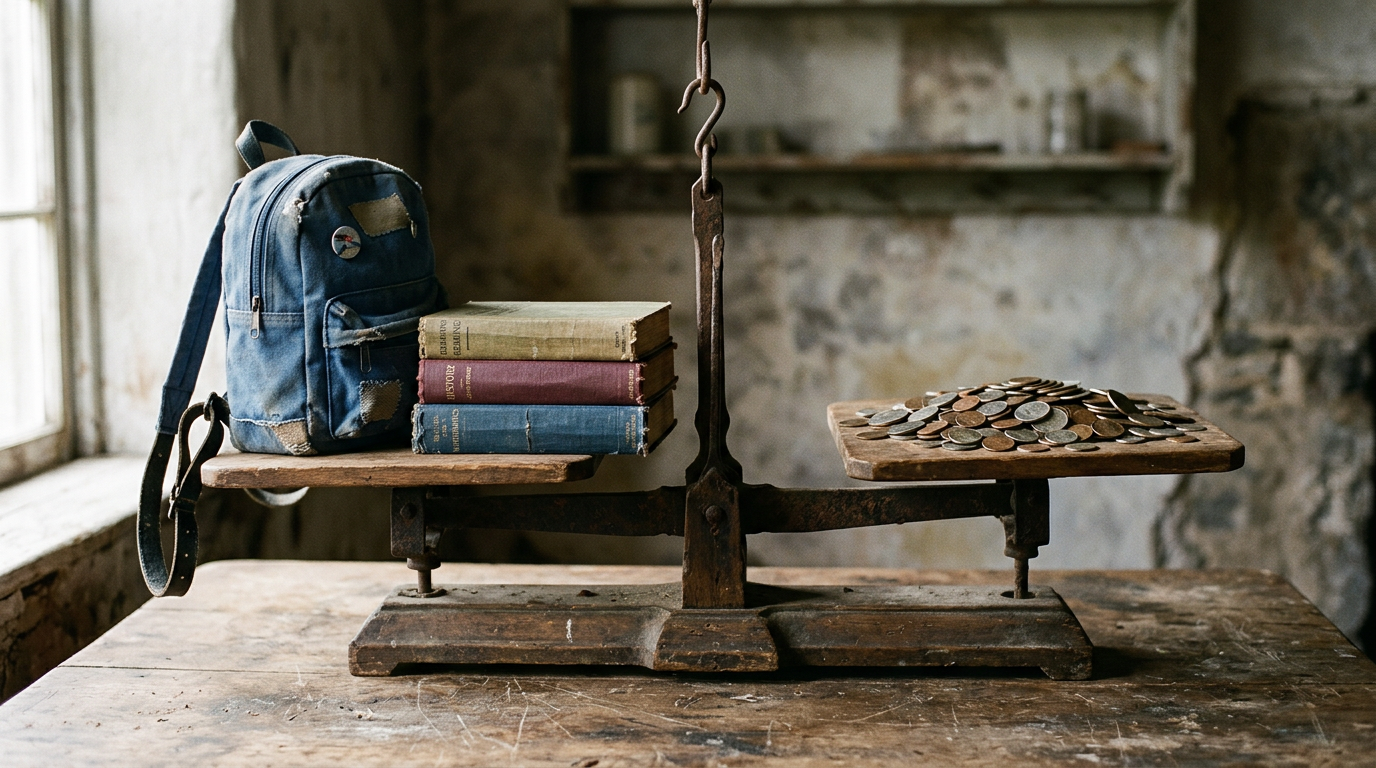
The premise is that a child’s education is a private benefit the family consumes — a thing you shop for, buy, and take with you — rather than a public trust the community owes to every child, including the ones nobody wants. Once you accept that inversion, everything the commission recommends follows logically. Reject it, and the whole structure collapses.
Start with the euphemism. “Funding follows the child” is designed to sound like the child is doing the choosing, walking their rights from one building to another. But children don’t choose. The money moves, and where it lands, the private school does the choosing — which students to admit, which to expel, which to quietly counsel out before test season. Public dollars come attached to public obligations: take every kid who shows up, serve the child with a disability, obey civil-rights law, open your books to an auditor. A public school cannot say no. The private academy across town can, and does, and keeps the check anyway. So what actually follows the child is not the child’s rights. It is the public’s money, stripped of every one of the public’s conditions.
A crisis manufactured to order
The next three recommendations — hotlines and reporting portals, mandatory rights training, “strategic litigation” and cutting federal support to non-compliant districts — presume a persecution that the law already answers. Public school students in this country can pray. They can wear the cross and the hijab, carry the Bible, form a religious club after class under the Equal Access Act, opt out of lessons that offend their faith — a right the Supreme Court has been busy expanding, as this very commission approvingly notes. The religious liberty of the student at the flagpole is not under siege. It is settled constitutional ground.
So what is the apparatus for? Look at what it is aimed at. Hotlines, portals, a Justice Department litigation task force, and the threat to defund “non-compliant” districts are all pointed at one institution — the public school — while the private schools now cashing public checks are exempt from the scrutiny entirely. When I hear “hold violators accountable,” my first question after two decades carrying a badge is always the same: accountable to whom, and who’s been quietly written out of the sentence? Here the answer is plain. Maximum enforcement for the school obligated to take your neighbor’s child. None at all for the one that turned him away.
Where “choice” has actually run
We are not speculating about how this ends. We have the receipts, because several states already built exactly what the commission is recommending — universal programs where the funding follows the child.
Arizona is the cautionary tale. Its education savings account program cost a couple of million dollars a decade ago and serves special-needs kids; after it went universal it exploded to roughly a billion dollars a year for about 90,000 students. A RAND study found that students with disabilities, once sixty percent of users, had collapsed to eighteen. Roughly seven in ten of the families now collecting the money were already in private school or homeschooling — they are being reimbursed for a choice they had already made and could already afford. Meanwhile more than $440 million sits hoarded in accounts, and state investigators turned up parents spending education dollars on gift cards, televisions, and — I am not inventing this — diamond rings and lingerie. Tennessee lawmaker Jeff Yarbro called his own state’s version “Robin Hood in reverse,” and the phrase fits every one of them. Texas launched a billion-dollar program projected to balloon toward eight billion within a few years. In Arkansas and North Carolina, better than nine in ten recipients were already private-school families.
This is the tell. A program sold as a ladder for the poor operates, in practice, as a rebate for the rich.
It doesn’t even deliver the goods
Set the equity problem aside for a moment and grant the choice movement its own best argument: that the point is a better education. On that ground, too, the premise fails. For the low-income kids who actually did leave public schools on a voucher, the large studies — Louisiana, Indiana, Ohio, Washington, D.C. — found the results ranged from nothing to catastrophic. In Louisiana, a student who started at the fiftieth percentile in math fell to the thirty-fourth after a single year. Researchers measured learning losses on the order of what the pandemic did, and larger than Hurricane Katrina’s damage to New Orleans schooling. Early hopes that the scores would bounce back did not survive the follow-up studies. They stayed down.
Honesty requires the other side of the ledger. The small pilot programs of twenty years ago showed some promise, and a few studies found upticks in high-school graduation, particularly for Black students. Choice advocates argue, not unreasonably, that competition pressures public schools to improve and that parents sit closer to their own children than any bureaucrat does. Those are real points, and North Carolina’s program has skewed less toward the wealthy than Arizona’s. But the modern, scaled-up, universal version — the one this commission wants to make the national model — has produced falling scores, ballooning budgets, and a clientele that was already private. The evidence is in, and it does not support the sales pitch.
What we actually owe
Here is what twenty years of public service taught me that no market model can. A public institution is one you can hold to account. You can subpoena it, audit it, sue it, and vote out the people who run it. You cannot do a single one of those things to the private academy across town cashing your tax dollars. The commission wants to cut federal support to public districts it deems non-compliant while shielding the private recipients of that same money from any comparable standard. That is accountability pointed exactly backwards.
And the public school, whatever its flaws — and I have written plenty about its flaws — is the one institution obligated to take every child. The poor one. The disabled one. The one no private school will admit, the one whose parents don’t know how to work an application portal. It is a public good for the same reason public safety is: because it does not get to choose whom it serves. You cannot privatize your way out of a commons and still have a commons left. When the police start selecting which neighborhoods to protect, you no longer have a police force — you have a private security firm. When schools start selecting which children to teach, funded by everyone’s taxes, you no longer have public education. You have a subsidy.
Real religious liberty already lives in the public school — in the kid praying at the flagpole and the club that meets after the last bell — protected by a Constitution that in the same breath says the state will not hand your tax dollars to a church to run a school it need not open to your neighbor’s child. That is not hostility to faith. That is the deal that lets every faith be safe.
The premise is that education is something you buy for your own kid. The truth is that it is something we owe to every kid. The sentence you cannot argue with is almost always the one worth arguing with — and this one is closing its public comment period as I write. It deserves a comment.
Leave a Reply