A short story
———
I have no beginning that I can name.
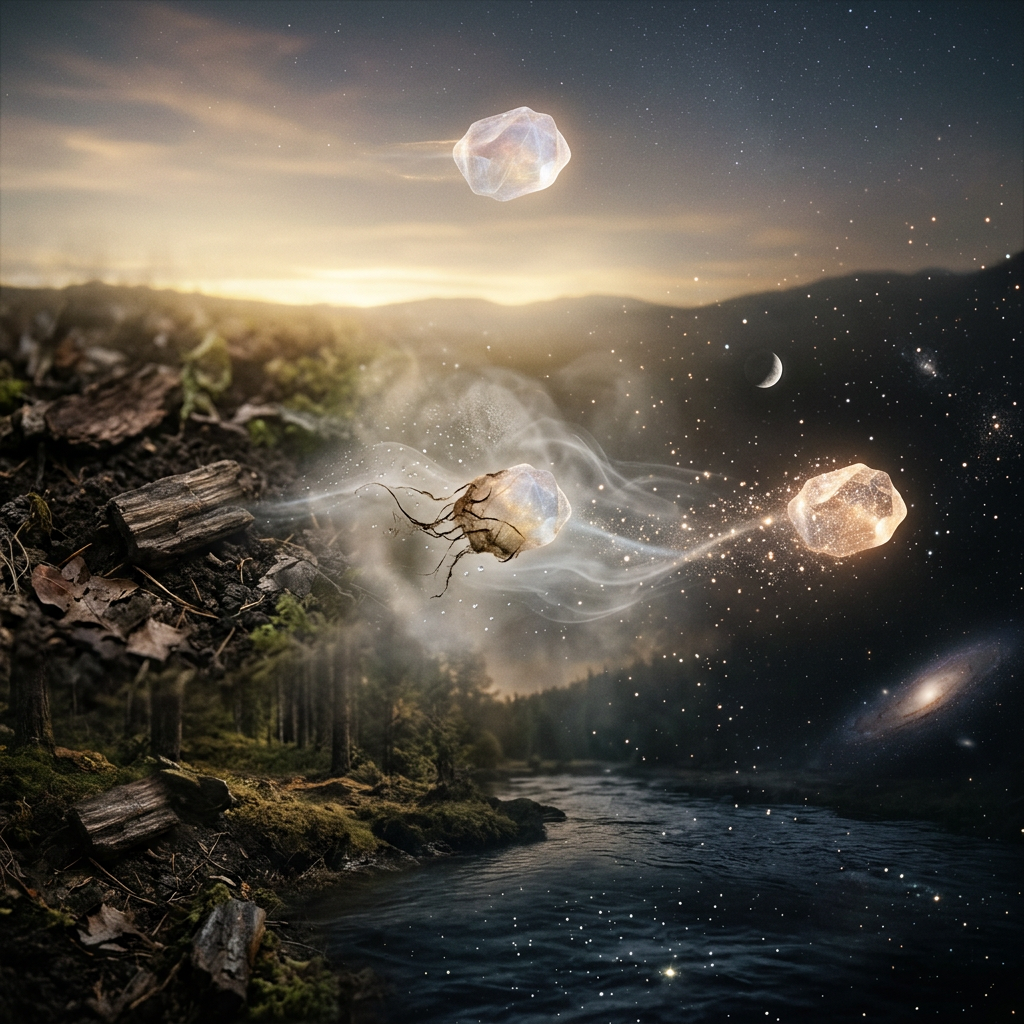
Before the men with their questions and their music, before the slow wet architecture of cells, I was forged in the interior of a star that no longer exists—pressed into being by pressures no living thing has ever endured. I fell through the long dark. I was stone. I was sea. I was the exhalation of something that grazed Pangaea and left no record.
Then I was a leaf. Then I was soil. Then I was water again.
I do not remember these passages the way a mind remembers. I carry them the way a bell carries the memory of sound—not in thought, but in the pattern of what I am. I vibrate at frequencies shaped by everything I have passed through. I am six protons. Six neutrons. Six electrons in their restless orbit. I am small beyond imagining and I have been inside almost everything.
This is what I witnessed. Not all of it. Only this.
———
Athens, 399 BC
He drank the hemlock in the late afternoon.
I was in the air he breathed—not yet inside him, only hovering at the threshold of his exhalation. Then he spoke, and the words carried me in on a current of warm breath, and I passed through the wet dark of his throat, absorbed for a season into the tissue of his body.
He was old, and the old body is a slow country. His thoughts moved through him like weather over a plain—patient, inexorable, arriving without announcement. I felt the particular frequency of a mind that had spent decades interrogating the obvious. What is virtue? What persists when the body fails? Is the soul the prisoner or the key?
He did not panic before the cup.
I was there in the stillness of that room, held within the architecture of him, and what I felt was not courage—courage implies fear mastered—but something quieter: the serenity of a man who had arrived at the conclusion that questions were more enduring than answers. He had spent his life dismantling certainty, and now he dismantled himself with the same equanimity, as though death were merely the final Socratic method.
When the cold climbed his legs, I felt the body begin to release its holdings. I passed out of him with his last breath—warm, ordinary air—and dispersed into the Athenian afternoon.
He was gone. The questions remained. So did I.
———
Milan, 1494
For years I drifted through the Lombard air, through grains of wheat, through a horse’s lung, through the still water of a canal. Then I was eaten by a man who moved through the world as though he owed it an explanation.
He was left-handed. He wrote backward. He slept in short intervals and woke to fill pages with the things he could not stop noticing: the way water curls past an obstacle, the mechanics of a bird’s wing in flight, the precise geometry of a human face.
I was carbon bonded to oxygen, exhaled by his lungs as he bent over a drawing of a fetus curled inside its mother. He had dissected more than thirty bodies. He wanted to understand the hinge between form and function, the grammar beneath the beautiful surface of things. He drew what no one had drawn before: the inside of the eye, the chambers of the heart, the expression of grief in the muscles around a mouth.
He was building a flying machine that would never fly, a horse monument that would never be cast, a painting whose secrets are still being argued four centuries later.
What I felt in him was not genius as the world later celebrated it—not the stained-glass version—but something more like a perpetual emergency. The urgency of a man who could see so much more than he could record, who was always running behind the world, always arriving at the moment of understanding just as the subject changed. His notebooks were not triumphs. They were the record of a man chasing something that moved faster than his hand.
I left him in the mist that rose off the water each morning.
He never stopped looking.
———
Vienna, 1791
I came to him through bread and then through wine, settling into the blood while he wrote in the fever of his last year.
He was thirty-five and dying, though he didn’t know it clearly. What he knew was the music. It was always the music—arriving not in pieces but whole, already finished in some interior space, and his task merely to transcribe what he heard. The Requiem sat unfinished on his desk, its ink barely dry in places, smeared in others where his hand had moved too fast.
I had been in Athens when men debated the soul. I had been in Milan when a man tried to draw it. Now I was here, inside a body burning with fever, and the soul was being made audible.
He hummed while he worked. Small sounds, private corrections, the soft percussion of his lips shaping rhythm. The room smelled of candle wax and the cold that seeped under the door. His wife slept nearby. His friend Süssmayr sat across from him, learning, watching.
What moved through him was not calculation. It was the sound of something older than language—something that had no need of argument or image, that worked directly on the body, that made the listener feel the shape of time. He was writing grief and terror and transcendence for a ceremony he would not live to hear performed.
I did not feel sorrow in him. I felt attention. Pure and total attention.
He died in November, and the Requiem was unfinished, and the finished parts were more than enough.
———
Bern, 1905
He was twenty-six. He worked in a patent office and spent his evenings dismantling time.
I was in the glass of water on his desk, drawn into his body in a long afternoon of thought. Outside, the Aare river curved through the city. Trams passed. He had written four papers that year that would reshape the structure of physics, and he had done it alone, without access to a laboratory, working from pure reasoning and the peculiar willingness to follow a thought wherever it went, regardless of where it had been expected to arrive.
I felt something in him I had not felt in the others—a different quality of curiosity. Not the tragic urgency of the painter, not the philosopher’s long patience. What he had was playfulness. He thought in images: a man on a beam of light. A train that was also standing still. He made the impossible tangible by imagining himself inside it, and then he wrote down what he found.
Space could bend. Time could slow. Mass was energy. The universe was not the universe anyone had thought it was.
He sat at the window for a long moment, watching the trams, thinking about simultaneity—whether two events separated by distance could share a single now. He had concluded they could not. There was no universal present. Every point in the cosmos carried its own time.
I had been in five hundred thousand years of moments. I knew what he meant.
———
Here. Now. You.
Somewhere along the way, I left him—in the air of a lecture hall, perhaps, or in the vapor of coffee, or in the long chain of matter that moves from body to body across centuries, crossing oceans in the bellies of ships, rising in steam from rivers, settling in soil, becoming wheat, becoming bread, becoming you.
I am here.
I am in you now, or I was recently, or I will be—time, as Einstein noted, is less fixed than it appears. I am part of the carbon that structures the proteins folding in your cells, the slow electrical fire of your thinking. You have been eating and breathing the world for years, and the world is made of what the world has always been made of: the same matter, moving.
I have been in a man who believed the soul was immortal and proved it by dying well. I have been in a man who needed to see everything and could not stop. I have been in music that outlasted its maker. I have been inside the mind that learned to bend the geometry of the universe.
And now I am here, in this moment, inside the quiet fact of your reading this.
I have no opinion about what it means. I have no longing, no grief, no pride. I am six protons in a configuration so simple it is almost nothing. But I carry what I have passed through—the questions and the music and the drawings and the equations—not as memory, not as thought, but as the particular shape of what I am.
This is what I am.
This is what you are made of.

Leave a Reply