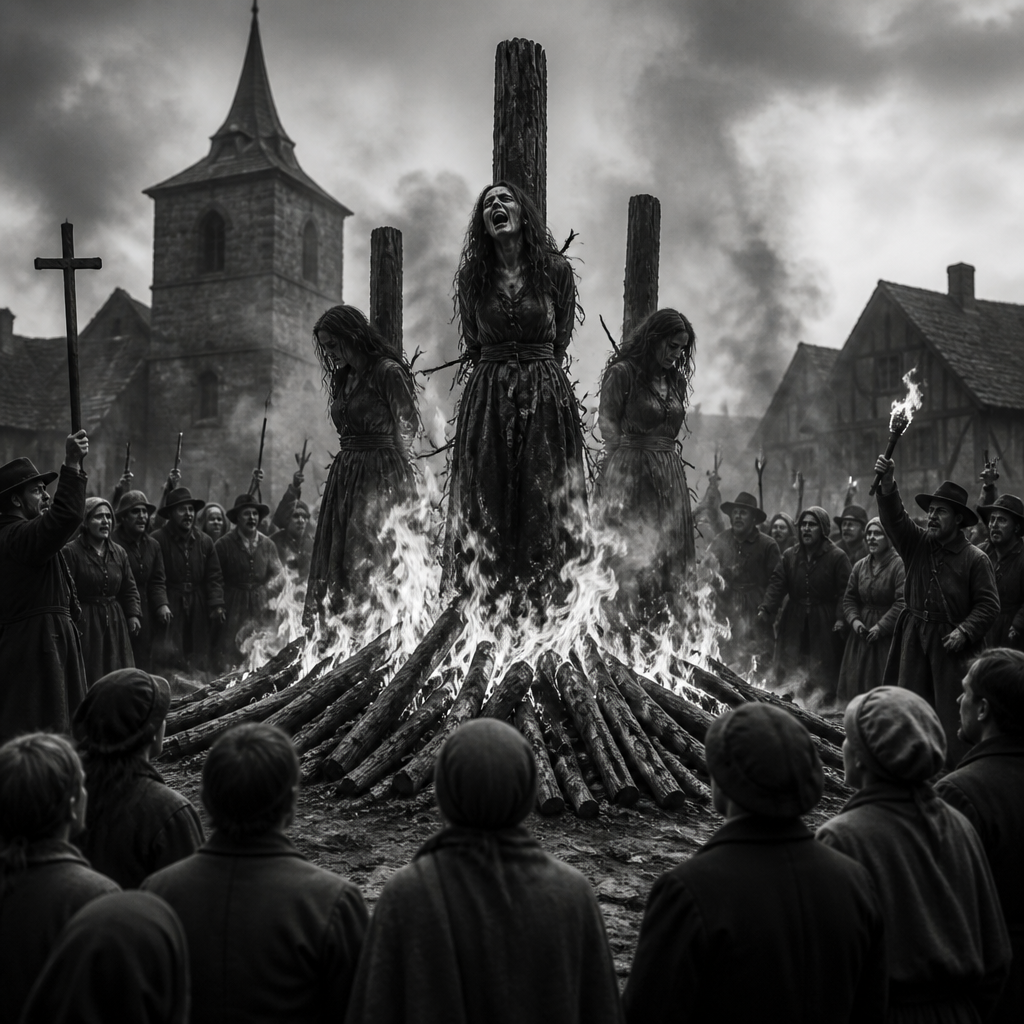
Twenty thousand victims, sixty countries, and the ministries selling the cure
by Joe Broadmeadow
“Thou shalt not suffer a witch to live…” Exodus 22-18
Kristy Bamu died in a bathtub in East London on Christmas Day in 2010. He was fifteen years old. His older sister and her partner had decided he carried kindoki, witchcraft, and they spent days trying to force it out of him before he drowned. A jury convicted them of murder in 2012.
London sits a long way from the villages where most Americans file this kind of belief. Discard the distance. It is the least reliable fact in the case.
Between 2009 and 2019, researchers documented at least twenty thousand victims of witchcraft accusations and ritual attacks across sixty countries. That count included more than five thousand murders and roughly fifteen thousand attempted killings and physical assaults.
In July 2021, the United Nations Human Rights Council adopted Resolution 47/8, the first UN resolution ever aimed at the practice. The study it ordered arrived in March 2023 and stated the obvious plainly: these abuses occur in every part of the world, they have grown rather than receded, and the recorded figures understate the problem because the crimes are secret by design.
A charge with no defense
Twenty years of police work teaches you to distrust a particular kind of accusation. Not the complicated ones. The ones arriving with the conclusion already attached.
An accusation of witchcraft is the perfect charge. It requires no evidence, permits no rebuttal, and cannot be falsified. Ask what an accused person could possibly produce to establish innocence. Nothing exists. No alibi covers a supernatural act. No forensic result excludes a spiritual one.
Under those conditions, a legal system, formal or informal, has only one instrument left, and it reaches for that instrument every single time. Beat the accused until they confess. Confession closes the file.
The charge does something that an ordinary charge cannot. It converts misfortune into a culprit. A child dies of malaria. A businessman drops from a heart attack. A crop fails, a marriage ends, or a family slides from poor to destitute. Grief wants an author, and the accusation supplies one on demand.
In 2022, in Enga Province, Papua New Guinea, nine women were accused after a businessman died of what a hospital would have called cardiac arrest. Two of them were in their sixties. One was pregnant.
Where the records are best
Papua New Guinea looks worse than its neighbors mainly because it counts. A long-running collaboration between the Australian National University, the PNG National Research Institute, and Divine Word University has built the most rigorous dataset on what researchers call sorcery accusation-related violence.
Their review of twenty years of national media and court records found that in reported cases, nearly half the accused were killed. Their field data from three provinces logged 357 accusations after 2016, of which 117 turned violent and produced 185 victims.
A separate study across two provinces between January 2016 and October 2017 examined roughly 150 accusation cases. A third ended in violence. Of those, close to three-quarters involved torture, more than one in ten victims died, and over a third were permanently injured.
In July 2025, a woman named Rosa Yakapus was tortured and killed in Hela Province. Her attackers filmed it and pushed the video onto social media. Police arrested several suspects, including her own brother, a fact that surprised no one who has read the case files.
The accusation almost always originates inside the family.
Papua New Guinea repealed its Sorcery Act in 2013 and extended the death penalty to killings tied to sorcery accusations. Neither measure changed the trend, for a reason any officer who has worked a thin rural jurisdiction will recognize immediately.
The national police force numbers well below the minimum the UN recommends for a population that size, and most of those officers are clustered in cities. Enormous stretches of the country have no police presence at all. A statute nobody enforces is a press release.
The deliverance economy
Poverty and absent policing explain where this violence survives. They do not explain who aims it. In southeastern Nigeria, the aiming happens from pulpits.
Akwa Ibom and Cross River States have generated two decades of documented cases: children denounced as witches by pastors, then beaten, starved, burned, abandoned, and in some cases killed by their own parents.
The structure is commercial and not subtle. A pastor diagnoses the witch. The same pastor sells the deliverance. The family pays.
In a region where most households live at or below subsistence, an exorcism fee is a significant sum, and a child who cannot be cured cheaply becomes a child the family stops feeding.
Helen Ukpabio built the most visible operation of this type. She founded Liberty Gospel Church in Calabar, wrote and produced Nollywood films portraying children as demonic agents, and published material coaching parents to identify a child witch by ordinary childhood symptoms. Crying at night. Fever. Restlessness.
The ministry grew to hundreds of branches. She denies responsibility for any abuse, insists her own exorcisms are free and non-violent, and maintains witchcraft is real. She also told the Associated Press she had watched a pastor break a girl’s jaw during an exorcism and that she prayed over the girl afterward.
She had no answer when asked whether anyone took the child to a hospital.
Sam Itauma has run a rescue center for accused children in Akwa Ibom since 2003. A British documentary brought the practice to international attention in 2008. The state enacted a child rights law criminalizing the accusation itself.
In 2010, the governor went on CNN to call the whole thing exaggerated. Prosecutions have been rare enough to name individually.
Kinshasa at scale
The Democratic Republic of the Congo runs the same machine with more customers. Human Rights Watch has counted more than two thousand churches practicing deliverance in Kinshasa alone.
UNICEF reported that seventy percent of the children living on that city’s streets had been accused of witchcraft by their own families. The US State Department described exorcisms of accused children involving isolation, beating, whipping, starvation, and forced ingestion of purgatives.
A ten-year-old boy interviewed at a Kinshasa shelter described being denied food and water for three days and forced to drink pigeon blood.
Congo outlawed witchcraft accusations against children in 2009. The practice continued without interruption. A Catholic priest running one of the shelters gave the cleanest causal statement in the entire literature: this has nothing to do with witchcraft and everything to do with urban poverty. A family unable to feed a child acquires a spiritual reason to stop trying, and the reason costs less than the child.
Not a foreign problem
Go back to the bathtub in London.
Victoria Climbie died in February 2000 at eight years old, after months of torture by her great-aunt and the great-aunt’s partner, who had concluded she was possessed.
They took her to a church, where a pastor agreed to help. The public inquiry into her death rewrote British child protection law. Ten years later, Kristy Bamu died the same way in the same city.
England now tracks the category formally. It is classified as child abuse linked to faith or belief. By 2019, the number of identified child victims had climbed roughly a third in two years, approaching two thousand.
Detectives and social workers have said out loud what slowed the response for years: they feared being called racist or culturally ignorant for intervening inside a faith community. The director of the Victoria Climbie Foundation put the correct answer on the record. No culture and no religion override the protection of a child.
I recognize that hesitation. Every agency has its own version, and it never admits to cowardice. It arrives wearing the robes of sensitivity, and it costs children their lives while the paperwork circulates.
Two objections worth taking seriously
The first objection is honest and correct. Witch killing is not a Christian invention and does not require Christianity to operate. India’s National Crime Records Bureau has recorded more than twenty-five hundred murders on witchcraft accusations since 2000, eighty-five of them in 2022 alone, concentrated in Jharkhand, Odisha, Chhattisgarh, and Madhya Pradesh.
No church drives those killings. Land disputes, misogyny, and the absence of medical care drive them. Northern Ghana’s witch camps operate under traditional priests. The murders of people with albinism in East Africa run on a different market entirely, one trading in body parts.
Faith is not the variable in these matters.
A 2022 study from American University found belief in witchcraft strongest exactly where institutions are weakest and governance is poorest. Read that result carefully. The accusation flourishes wherever no reliable explanation of misfortune is available, and no reliable authority exists to test one.
Remove the clinic, the coroner, and the functioning court, and something will fill the vacancy.
Revivalist deliverance ministries filled that vacancy with scale, mass media, and a price list. Ukpabio’s films accomplished in a decade what village rumor could not accomplish in a century.
Naming specific sects is not an indictment of Christianity. It is the ordinary work of identifying an enterprise: who runs it, who pays into it, and who takes money out.
The second objection deserves equal weight.
Churches also supply the resistance. Catholic priests run the shelters in Kinshasa. Divine Word University, a Catholic institution, co-authored the best research in the Pacific.
When Rosa Yakapus was killed, PNG churches were among the loudest voices demanding arrests, and the UN’s own study concluded interventions work best when communities, churches, police, and local authorities move together.
Any argument that can’t hold both of these facts at once isn’t an argument. It is a grievance.
The unglamorous remedies
Nothing about the fix is mysterious. It looks like every other enterprise investigation, and it is just as tedious.
Criminalize the accusation itself.
Ghana’s parliament passed a bill in July 2023 doing precisely that. The president declined to sign it, citing a procedural objection about private members’ bills, and returned it to parliament as his term ended. It is still not law.
Amnesty International’s 2025 report on four camps in northern Ghana found more than five hundred people living there, most of them women between fifty and ninety, driven out of their villages and short of food, water, housing, and medical care.
Akua Denteh, ninety years old, was beaten to death at Kafaba in July 2020, on video. Two women were convicted of manslaughter and sentenced to twelve years. The statute under which her banishment could have been charged before anyone raised a hand still does not exist.
Enforce the laws already on the books. Congo has had one since 2009. Akwa Ibom has had one since 2008. Papua New Guinea has had a homicide statute all along. Unenforced laws do not deter. It advertises impunity.
Count the cases. The central finding of the 2023 UN study was not a number. It was the absence of numbers and the recommendation to build real data collection. That sounds bureaucratic until you have tried to run a case without a records system.
You cannot investigate a pattern you refuse to measure, and you cannot fund a response to a problem officially recorded as rare.
Separate the belief from the act. International law protects the right to believe whatever a person chooses about the unseen. It protects no one’s right to starve a child on the strength of it. Ghanaian and Amnesty advocates have held that line precisely, and it is the only line holding both religious freedom and a child’s life at the same time.
Follow the money
Strip away the theology, and the pattern is depressingly ordinary. A person suffers a loss. A second person supplies an explanation, for a fee. The explanation requires a culprit. The culprit turns out to be a child, a widow, an old woman with a piece of land someone wants, or a person with albinism or epilepsy or dementia. Someone already sitting at the thin edge of the household budget.
Nobody powerful is ever the witch. In twenty thousand documented cases across sixty countries, that outcome never once reverses. The accusation runs downhill, every time, toward whoever costs the least to lose.
I spent twenty years working cases, including years running narcotics investigations and a stretch on a federal task force with the FBI and DEA, and I commanded the Investigative Services Division before I retired. I have seen charges built on nothing. This one comes with a fee schedule and a customer base.
That is not superstition. That is a racket, and somebody should charge it like one.

Leave a Reply