Joe Broadmeadow
Imagine someone hands you the authority to build a society from nothing.
You write the constitution. You set the tax rates, the criminal code, the property rules, the rights of the accused, the obligations of the wealthy, and the floor beneath the poor. You decide what a person owes and what a person may claim. The power is total.
The offer carries one condition.
When the work is finished, you take your place inside the society you designed, and you have no idea what that place will be. You do not know your race, your sex, your family, your health, your intelligence, your religion, or the century of your birth.
You do not know whether you will be born to a corner office or a housing project. You do not know whether you will be strong or frail, gifted or ordinary, loved or abandoned. You might be the judge. You might be the defendant.
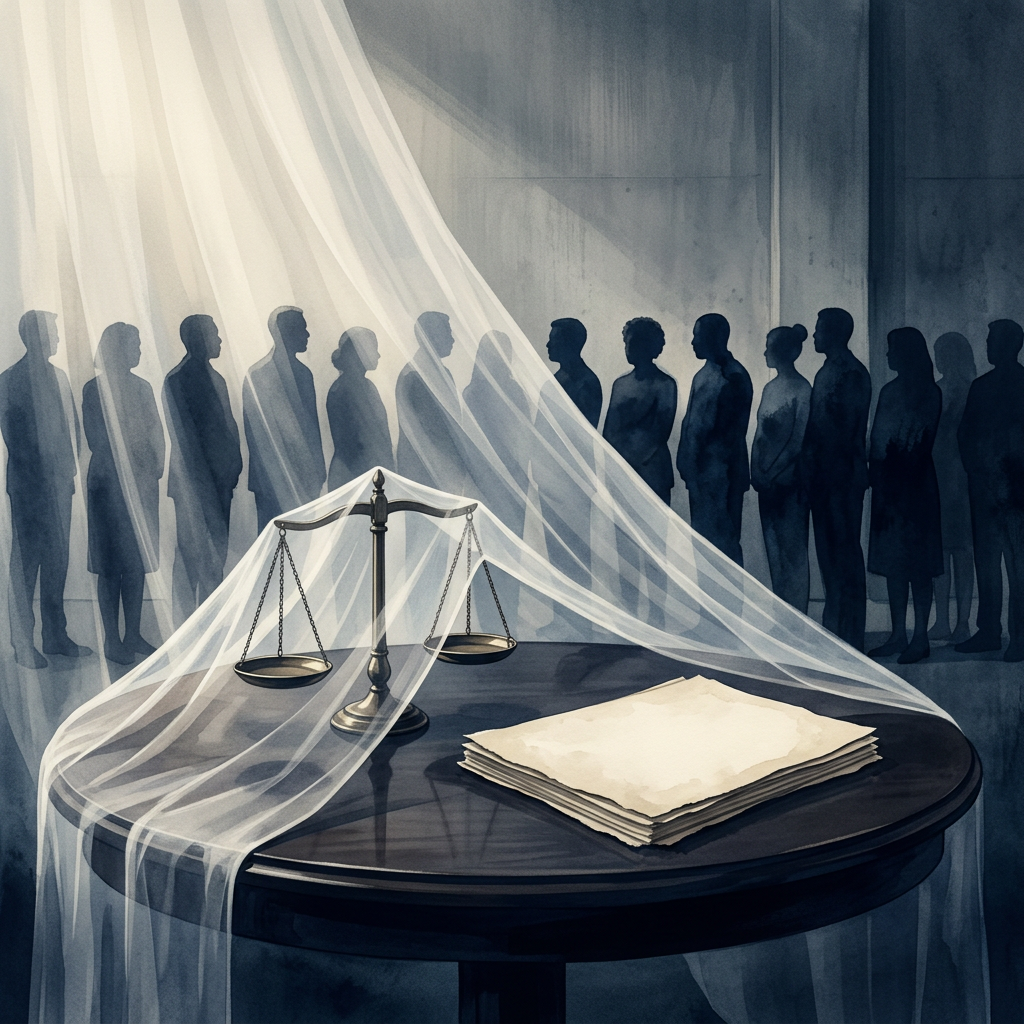
John Rawls called this the original position, and the constraint on knowledge the veil of ignorance. He developed the argument in A Theory of Justice in 1971, and it has occupied political philosophy ever since, largely because it does something no amount of moral exhortation can.
It makes fairness a matter of self-interest.
The mechanism
Every argument about justice runs into the same obstacle. People reason from where they stand. The landlord and the tenant do not disagree about eviction law because one of them fails to grasp the principle. They disagree because each knows exactly which side of the transaction he occupies.
Ask a roomful of people to divide a pie, and you get a negotiation. Ask them to divide it before anyone learns which slice he receives, and you get something closer to a rule.
Rawls understood the problem as one of contamination. Real bargaining reflects real leverage, and leverage traces back to accidents nobody earned. Nobody selects his parents, his genes, his native talents, or the decade of his birth.
Rawls treated all of it as morally arbitrary, luck rather than something deserved, and he saw no reason to let arbitrary facts write the rules everyone must live under.
Strip away the knowledge, and the bargaining advantage disappears with it. You cannot tilt the system toward the powerful without risking waking up powerless. You cannot design a police force accountable to no one if you might be the person it stops. Self-interest survives the veil intact. It simply loses its aim.
What comes out from the other side
Rawls argued that anyone reasoning honestly under those conditions would arrive at two principles, ranked in order.
The first secures an extensive scheme of equal basic liberties for everyone: speech, conscience, assembly, the vote, due process, freedom from arbitrary arrest. You protect these absolutely because you cannot rule out ending up in the minority whose views the majority despises.
The first principle takes priority. No amount of prosperity buys the right to trade away someone’s basic liberty, because that someone might be you.
The second principle governs inequality, and it does not abolish it.
Rawls accepted unequal outcomes on two conditions. Offices and positions must stand open to all under fair equality of opportunity, meaning genuine access rather than a formal absence of barriers. And any inequality must work to the greatest benefit of the least advantaged members of society.
Philosophers call this the difference principle. A surgeon may earn more than a clerk if the arrangement that creates the gap also raises the floor. Where the gap enriches the top and leaves the bottom untouched, the arrangement fails.
The logic underneath is a strategy gamblers know as maximin: maximize the minimum.
Facing a decision with unknowable odds and irreversible stakes, you protect against the worst outcome rather than chase the best. You do not bet your only life on a favorable draw.
The test in practice
The original position works best not as a blueprint but as a diagnostic, and it cuts fastest in the places I spent twenty years.
Take cash bail. Something I’ve written about in the past (https://joebroadmeadowblog.com/2026/02/26/in-rhode-island-justice-shouldnt-depend-on-your-wallet/)
A pretrial detention system keyed to available cash produces two justice systems, one for people with five hundred dollars and one for people without it. Design that rule behind the veil and you accept a coin flip on which system you enter. Almost nobody takes the bet.
Take public defense funding. A defendant’s odds should not depend on whether the state pays his lawyer by the hour or by the case. Yet, in most jurisdictions the disparity between prosecution and defense resources is a matter of budget rather than principle.
Nobody choosing blindly would fund one side of an adversarial contest and starve the other.
Take drug enforcement. I worked narcotics, and I watched a policy structure treat chemically similar substances with wildly different severity, with the harsher penalties falling on the poorer neighborhoods. Behind the veil, you write one schedule, because you do not know which neighborhood you get.
The test does not resolve every question. It exposes the questions whose answers depend entirely on who is asking.
The objections deserve a hearing
Robert Nozick attacked the whole framework in Anarchy, State, and Utopia, arguing justice concerns the history of holdings rather than their pattern.
If people acquire property justly and transfer it voluntarily, Nozick said, the resulting distribution is just no matter how lopsided it looks, and enforcing any pattern requires continuous interference with free exchange.
Communitarians, including Michael Sandel, challenged the picture of the chooser. A person scrubbed of religion, culture, family, and loyalty is not a neutral reasoner, Sandel argued. He is nobody at all, and the values he selects cannot claim authority over actual people embedded in actual traditions.
John Harsanyi accepted the veil but rejected the conclusion. Facing genuinely unknown odds, he argued, a rational person maximizes expected outcome rather than protecting the worst case, which points toward average utility instead of the difference principle.
Rawls argued that risk aversion is warranted when the stakes are your entire life, and you get only one attempt.
Susan Moller Okin noticed the family sits almost entirely outside the theory. However, it distributes advantages and burdens as ruthlessly as any public institution. Amartya Sen argued that the whole project of specifying perfectly just institutions distracts from the achievable work of comparing real arrangements and removing manifest injustice.
Each critique lands. None of them dissolves the intuition driving the thought experiment.
Why it endures
The original position survives because it converts a moral demand into a procedural one. It does not ask you to be generous, or empathetic, or better than you are. It asks you to reason carefully about your own interests under a specific constraint, and the constraint produces generosity as a byproduct.
Every unjust institution I encountered in twenty years as a police officer shared one feature. Someone designed it, or tolerated it, from a position of certainty about which end he occupied. The veil removes the certainty. What remains is the only honest question in political philosophy.
Would you accept the rules you are writing if you had to enter the world at the bottom of them?


Leave a Reply