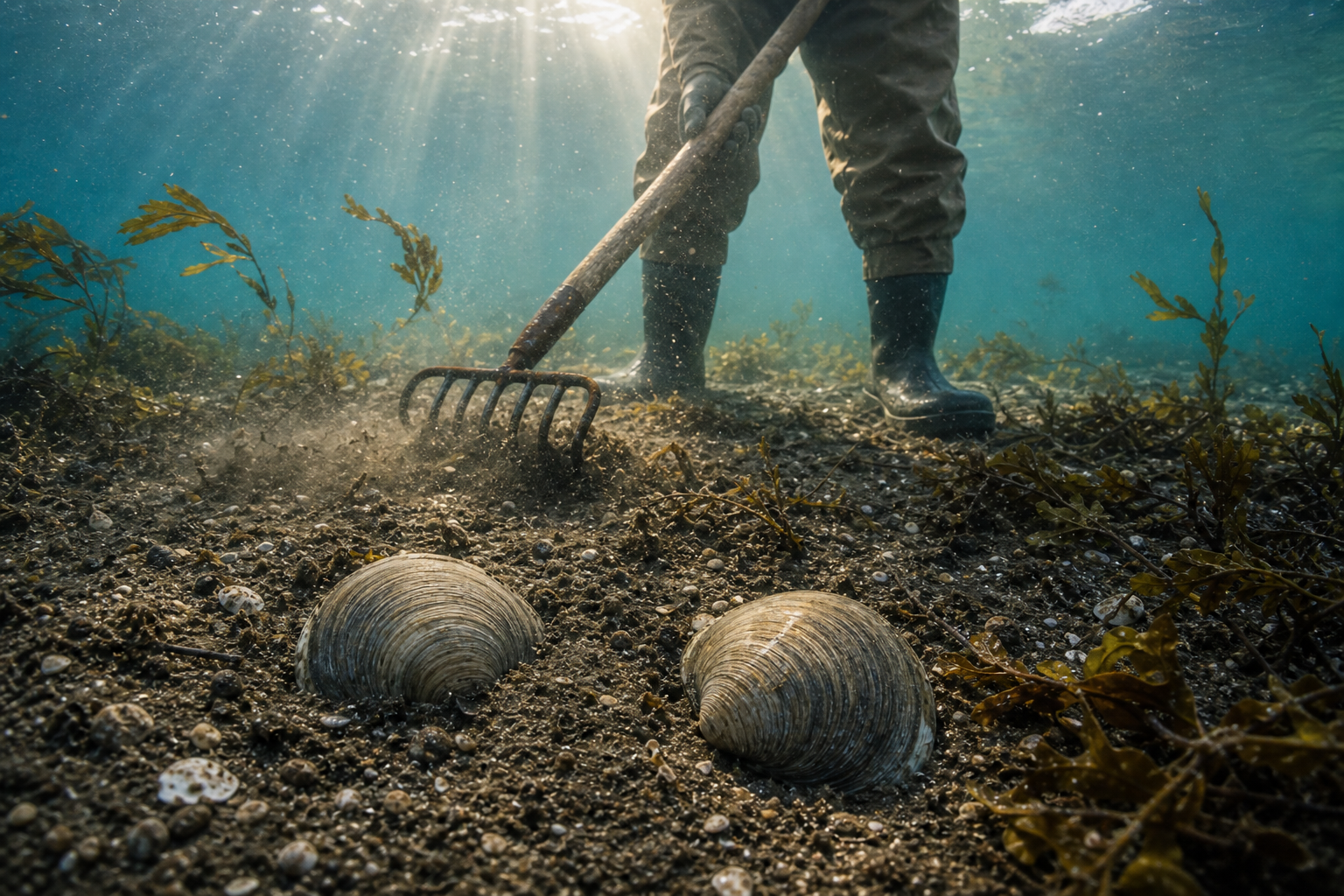
Cyril had lain in the same six inches of Narragansett Bay mud for eleven years, and he had opinions about it.
It was good mud. Silty on top, firm underneath, with a current that delivered plankton on a schedule you could set a watch by—if a quahog owned a watch, which Cyril did not, having neither wrists nor any interest in punctuality. He had a siphon, a foot, and a shell the color of a rained-on parking lot. That was the entire inventory. It had always been enough.
His neighbor Dolores lay four inches to the port side. They had been having the same conversation since 2015.
“You ever think about up there?” Dolores would ask.
“No,” Cyril would say.
The exchange took roughly nine months; quahogs converse at the stately pace of continental drift, and both parties considered it a lively debate.
Then, on a Tuesday in July—Cyril did not know it was Tuesday, or July, or anything—the sound arrived.
Scrape.
He felt it before he heard it, the way you feel a neighbor’s bass line through a wall. Something metal was combing the bottom about nine feet away and moving with intent.
Scrape. Scrape-scrape.
“Dolores,” Cyril said. “Do you hear that?”
Dolores, who was mid-sentence on a thought she had started in April, said, “Hm?”
The scraping came closer. Cyril ran through his available options, which, in the interest of accuracy, should be described as an option. A quahog’s tactical playbook contains exactly one play: dig. There is no second page. There is no audible.
He deployed his foot, that pale muscular tongue he had been dragging around for a decade, and burrowed with everything he had, which—and he wanted to be honest with himself here—was not much. At a full sprint, a quahog covers roughly the length of a business card per hour. The rake was covering that in a heartbeat.
Scrape.
He thought about legacy. Eleven years of filtering. Forty gallons a day, every day, no weekends, no thanks. He had personally cleaned enough water to fill a municipal pool and had never once received so much as a certificate.
Scrape. SCRAPE.
The tines came through the mud like the fingers of an enormous, unsentimental hand. One caught the rim of his shell, and Cyril, who had never known anything more dramatic in his life than a moderately cold February, shut himself up with a violence that Dolores felt and asked, four months later, if everything was all right.
Then the world tilted. Up. Light. Actual light, harsh and yellow and everywhere at once, and a rattling wire basket, and above the basket a man in bib waders with a sunburn shaped like a T-shirt.
“There’s one,” the man said.
Cyril was lifted. Cyril was inspected. Cyril, gripped between a thumb and forefinger that smelled of coffee and two-stroke fuel, was pressed into a metal ring—the culling gauge, the great arbiter, the bouncer at the door of the chowder pot.
He went through it like a quarter through a turnstile.
“Undersized,” the man said, with the particular disgust of a man whose entire morning had been undersized. He flicked his wrist.
Cyril flew. Cyril turned over twice in the sunlight, an experience he would spend the next six years describing to Dolores. Cyril hit the water, sank, and landed in mud that was not his mud but was, he conceded, comparable mud, and began at once to dig.
And there he was, happy as a clam.
Eleven feet away, the rake started up again.
“Delores,” he would ask, and go months with no answer. “How big are you?”

Leave a Reply