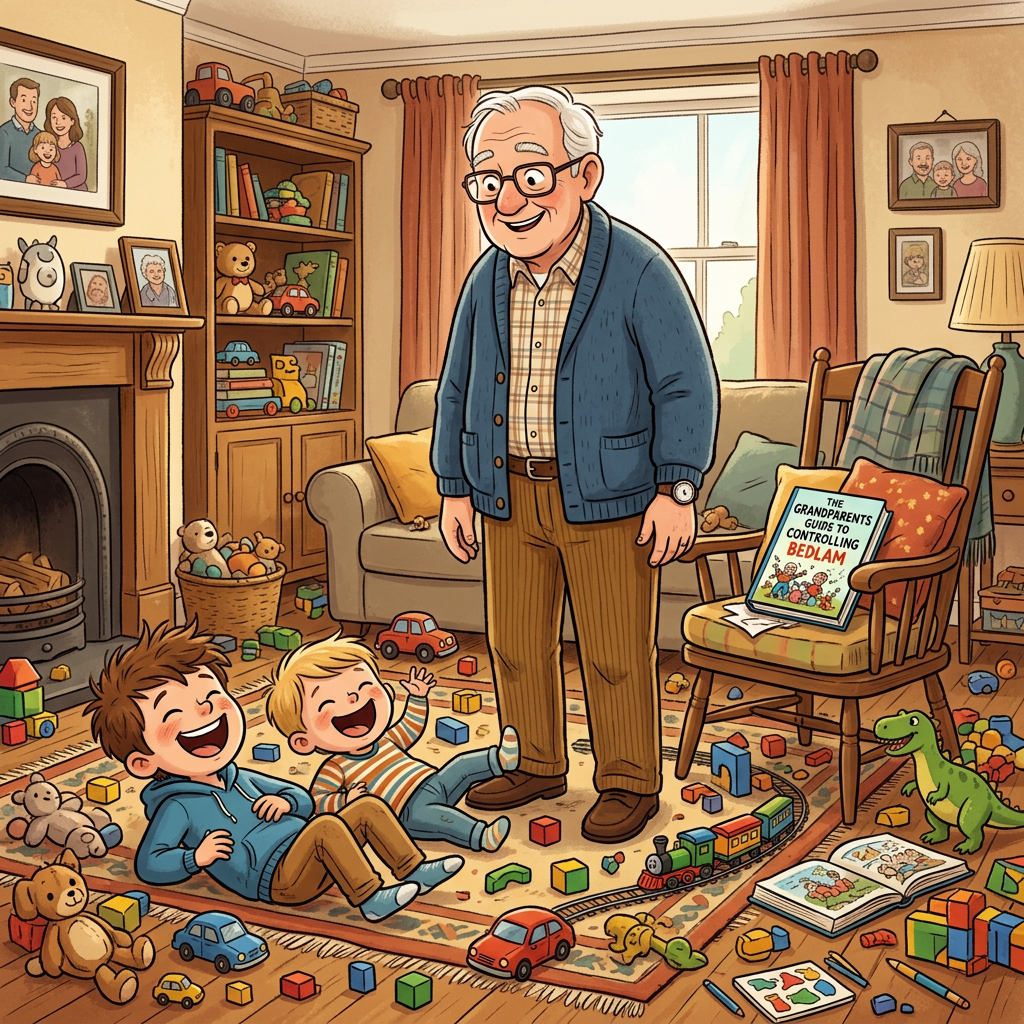
Field Operations Manual for the Grandparent on Duty
by Joe Broadmeadow
There is a moment, somewhere around hour two, when you realize the house has gone quiet.
Twenty years in law enforcement taught me that silence is not peace. Silence is planning. Silence is a small human standing on a kitchen counter with a jar of peanut butter and a plan he has not shared with the command staff.
Parents will tell you they want structure. Routines. Screen limits. A nap schedule laminated and posted like a fire evacuation plan. Nod when they say this. Nod slowly and with great sincerity, the way you nod when a suspect explains that the bag of cash in the trunk belongs to his cousin.
Then close the door behind them and begin operations.
Rule One: You Are Not in Command
Let us dispense with the fiction immediately. You do not run this house today. You are, at best, a hostage negotiator with snacks.
The children know this. They ran the numbers before you arrived. They know that Grandpa, who once talked a barricaded man out of a second-floor window, cannot say no to a four-year-old asking for a second popsicle at 9:40 in the morning. They know because it has never once worked, and they are patient people.
Accept it. The mission is not control. The mission is containment. Everyone comes back alive, the house is standing, and nothing structural is on fire. Anything beyond that is gravy.
Rule Two: The Fart Doctrine
Here is something no parenting book will tell you, because parenting books are written by people who have never successfully entertained a six-year-old for eleven straight hours.
The word “fart” is the single most reliable comedy instrument ever devised.
I have watched a room full of grown adults sit stone-faced through a professional comedian. I have also watched a child laugh so hard at the word “fart” that he had to lie down on the floor and hold his own ribs like a man who had been shot. That is not a small thing. That is power.
The Fart Doctrine has three principles:
Escalation. A fart joke is funny. A fart joke with a sound effect is funnier. A fart joke with a sound effect and a false accusation aimed at the dog is a masterpiece, and the dog, to his credit, has never once defended himself.
Attribution. Whoever smelt it dealt it remains the governing legal standard. It has never been overturned. I have looked.
Deniability. At some point one of them will actually fart, loudly, in a quiet room, and look directly at you with an expression of total innocence, and you will have to make a decision about the kind of man you are. Take the blame. This is what grandfathers are for. Your reputation is already gone. Spend it on the children.
Rule Three: Poop Is a Legitimate Topic of Conversation
I want to be clear that I did not choose this. I was drafted.
Somewhere between my career and my retirement, the entire conversational range of my life narrowed to one subject, and that subject is poop. Whether anyone has pooped. When they last pooped. Whether the pooping was, in their professional assessment, big. Whether the dog pooped. Whether a dinosaur, hypothetically, would have pooped in this exact spot in the living room, and how big that poop would have been, and would it have been bigger than the couch.
You may resist this. Do not resist this. Resistance simply means you will spend the entire day being asked about poop by someone who has not yet been informed that the topic is closed.
Lean in. Ask follow-up questions. Take a statement. Twenty years of interviewing people about things they did not want to discuss, and I now apply that entire skill set to establishing a reliable timeline of who pooped and when. My old lieutenant would be proud, or he would be concerned, and honestly at this stage I am not sure there is a difference.
And when the room takes on a certain quality, and someone announces “it’s stinky in here,” you do not deny it. You investigate. Loudly. With a flashlight if one is available. The stinky must be located. The stinky must be identified. The stinky, once found, must be discussed at length and then discussed again at dinner, because a stinky is not truly a stinky until it has been entered into the family record.
Rule Four: The Stooges Are Cultural Education
I will not be argued out of this position.
Somewhere along the way we decided that children need enriching content. Programs where a puppet explains feelings. Shows where nobody falls down and nothing gets hit with a ladder. This is how you raise a person with no comic timing whatsoever, and the world has quite enough of those already.
Moe, Larry, and Curly are not violence. They are physics. They are three men demonstrating, at considerable personal cost, what happens when momentum meets a doorframe. A child watching a Stooges short is learning cause and effect, consequence, the eternal folly of pride, and the specific sound a head makes when it meets a two-by-four, which is a sound they will spend the rest of the afternoon trying to reproduce with a wooden spoon and a cabinet door.
This is heritage. This is the transmission of culture from one generation to the next, the way it has always been done, which is badly and at high volume.
I would like the record to show that when their parents ask where they learned to do the eye-poke, the children do not give me up. Not one of them, not once. Under direct questioning from a hostile party. I have run investigations where grown men folded faster.
They are good kids.
Rule Five: The Sugar Gambit
Now we come to it.
Somewhere around the final hour of the shift, when the pickup is confirmed and the end is in sight, there arrives a window. A brief, beautiful, tactical window.
Cookies. Ice cream. A juice box of unknown provenance. Something from the back of the cabinet with a cartoon animal on it and a sugar content that would concern a physician.
Is this necessary? No. Is it defensible? Absolutely not. Do I do it every single time, with the calm deliberation of a man setting a timer on something? I do.
Understand the mechanism. Sugar administered sixty minutes before extraction does not peak on my watch. It peaks in the car. It peaks in the driveway of a house that is not my house. It peaks at bath time, at bedtime, at the exact moment two adults sit down and think the day is finally over.
I am not there for this. That is the entire point. That is the whole beautiful architecture of the thing.
My child did this to me for eighteen years. They did it without knowing they were doing it, which frankly makes it worse. This is not revenge, because revenge implies malice, and I do not feel malice. I feel a deep, warm, quiet satisfaction, the kind that settles into a man’s chest as he waves from the porch, watching the taillights go, listening to the sound of somebody else’s evening beginning.
Debrief
The house, when they leave, is destroyed. There is a fossilized apple slice under the couch. Someone has hidden the remote in a place I will discover in November. The dog will not make eye contact with me.
I sit down in the wreckage, and it is quiet, and this time the quiet is real.
Here is what nobody tells you about grandchildren. You get to be the fun one. You get the good hours. You get the fart jokes and the Stooges and the ridiculous conversations about dinosaur poop, and you hand back the discipline, the homework, the dentist, all of it, to people who love those kids as much as you do and who are, at this exact moment, discovering what a cookie can do.
Twenty years I spent walking into other people’s worst days. I have seen what people do to each other. I have delivered news no one should ever have to hear.
And now I spend my days getting outmaneuvered by a small person who thinks the funniest word in the English language is “stinky,” and I laugh until my chest hurts, and I mean it.
Controlled bedlam. Emphasis, most days, on the bedlam.
I would not trade a minute of it.

Leave a Reply