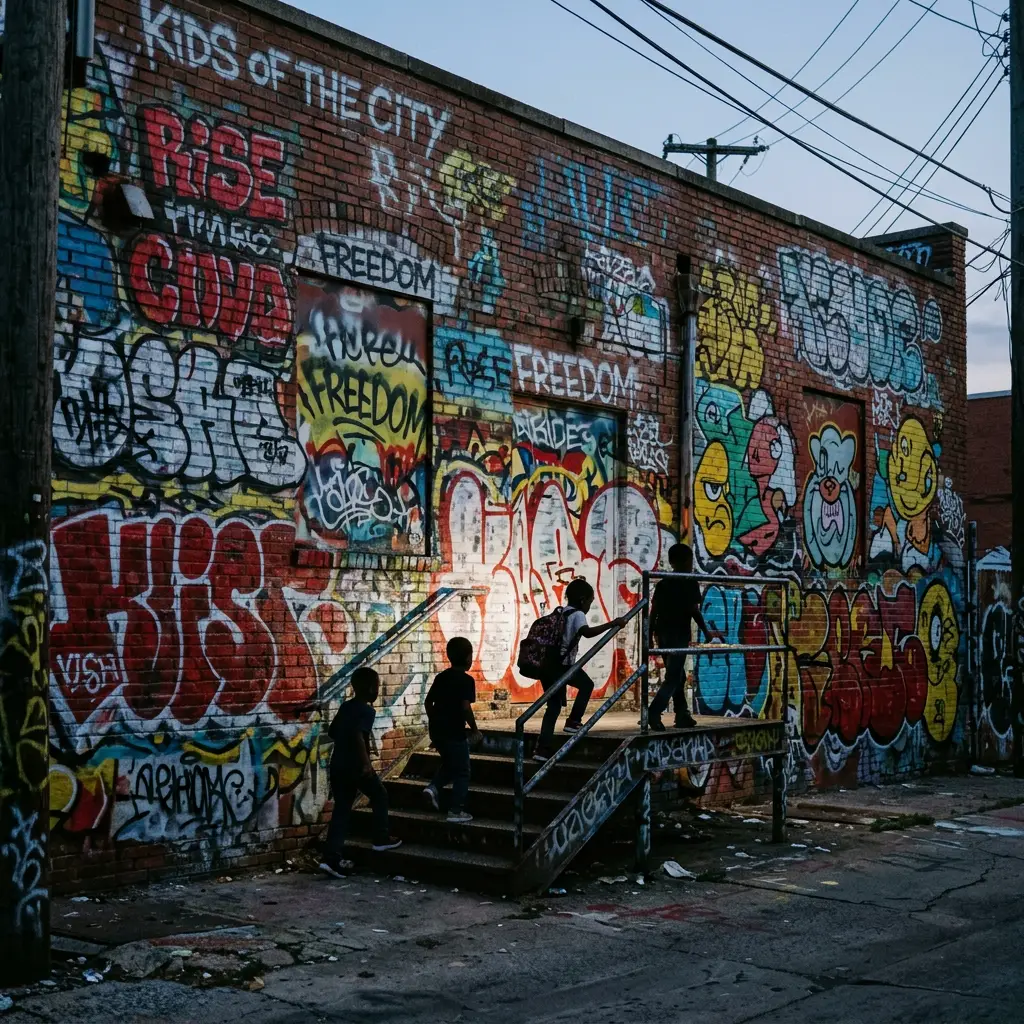
The first time I saw the boy, he was sitting on the back steps of a triple-decker, holding a blood-soaked towel to his cheek and staring at the empty lot across the street like it owed him an apology.
He couldn’t have been more than fourteen. Skinny, long arms, that loose, coiled way kids get when they haven’t decided whether they’re going to grow out of trouble or into it.
Blue lights painted the triple-decker in stuttering flashes. Radios hissed on shoulders. Someone in the crowd said, “He’s lucky, that’s all,” like luck was something that arrived on schedule if you filled out the right form.
I’d been retired six years by then. I was on the next street over, visiting an old partner who was dying loudly and stubbornly of something he refused to name. I heard the sirens, felt the old reflex twitch, and told myself—as I had been telling myself for years—that it wasn’t my problem anymore.
Then I looked out his window and saw the cluster of cruisers, the knot of people, the way the city tightens around a scene. Like a muscle around a wound.
“Go,” my partner said, lying propped up on pillows, oxygen cannula in his nose. His voice was sandpaper. “You’re not fooling anybody.”
“I’m retired,” I said.
“So is my liver,” he said. “Go.”
The boy’s towel was already pink through and dripping when I crossed the street. The patrol officers had backed the crowd off a few feet but left him where he was, like he was evidence they hadn’t figured out how to bag yet.
“EMS?” I asked the nearest uniform.
“En route,” she said. “Grazing wound, through and through on the cheek. He won the lottery.”
Her face said she’d seen the ones who didn’t.
“Any witnesses?” I said.
She nodded toward the boy. “He says he didn’t see anything.”
“Of course he didn’t,” I said.
She eyed me, taking in the gray hair, the way I still stood like I was on duty.
“You his father?” she asked.
“Not tonight,” I said. “Just a tourist.”
I walked over and crouched down in front of the boy. Up close, his eyes were brown and too old. Blood had run along his jaw and down his neck, drying in a dark collar.
“Let me see,” I said, nodding at the towel.
He hesitated, then lifted it. The bullet had carved a trench along his cheek, missing the eye by an indifference that could be called mercy if you were generous.
“You’re going to have one hell of a story,” I said.
He snorted, a small puff of defiance. “Ain’t nothing.”
“Sure it is,” I said. “It’s a line on your face. You don’t get many chances to pick what puts a mark on you.”
He looked away, back to the lot across the street. We both knew the story. Unknown car, unknown shooters, unknown disagreement that led to someone firing from a moving vehicle at a cluster of kids who hadn’t yet decided whether the world was something worth aiming back at.
“Tell me what you saw,” I said.
“I didn’t see nothing,” he said.
I nodded.
“That’s funny,” I said, “because the universe went to the trouble of sending a piece of metal past your eye at high speed. Seems rude to not at least notice.”
He glared.
“I ain’t no snitch,” he said.
There it was. The abiding theology of the neighborhood. The one commandment that didn’t need stone tablets.
“You got a name?” I asked.
He shrugged.
“Kid,” I said. “If I’m going to stand here getting blood on my shoes, I’d at least like to know who to haunt later when you make bad choices.”
A twitch at the corner of his mouth. Not a smile, but the rumor of one.
“Tony,” he said.
“Tony,” I repeated. “I’m Joe. Used to be a cop. Now I just bother people for free.”
He looked me over, deciding whether to believe me.
“I didn’t see nothing, Mister Joe,” he said. “I was just sitting there. I heard the shots. I hit the stairs. That’s it.”
“That’s your story,” I said.
“That’s what happened,” he said.
“No,” I said. “That’s your story. What happened is more complicated. That’s always true. But the story you pick is what sticks.”
He shifted, winced. The towel was red again.
“Ambulance is two minutes out,” the uniform called.
“Make it one,” I said, without looking back.
“Wish I could,” she said.
I sat on the step beside Tony. The crowd had that familiar murmur to it—half concern, half entertainment. Phones were out. Someone was recording. Someone would upload this, and it would become content: a bleeding boy on a stoop, sirens wailing, the city performing itself.
“You got family in there?” I nodded at the triple-decker.
“My Ma,” he said. “She at work. My little brother. He upstairs with my aunt. They fine.”
“You tell your mother everything that happened?” I asked.
He glanced at me.
“No,” he said.
“Why not?”
He stared at his sneakers.
“’Cause she’ll worry,” he said. “’Cause she’ll get mad. ’Cause she’ll move us again. I don’t know. ’Cause she already got enough.”
He said it like he’d been keeping inventory.
I thought of all the reports I’d written over the years. Witness statements, incident summaries, narratives boiled down to fit within the margins. You reduce chaos to paragraphs, check the boxes, move on. Lives turned into case numbers. Kids like Tony turned into subjects, complainants, victims, suspects. Sometimes all four, depending on the year.
“Here’s the problem, Tony,” I said. “Your story matters. To her. To you. To whoever did this. But if you tell the wrong story to the wrong people, it can get you killed.”
“I know,” he said, almost offended.
“Do you?” I asked.
He looked at me the way kids look at adults when they’re deciding if you’re part of the furniture or part of the fire.
“You used to be a cop?” he said.
“Yeah,” I said.
“You ever snitch?” he asked.
That one caught me.
“There’s a difference between telling the truth and handing someone a loaded gun,” I said. “Sometimes they look the same. Sometimes they don’t.”
“That ain’t an answer,” he said.
I liked him more for saying it.
“Come here,” I said.
He gave me a look like I was going to pull a rabbit out of his wound.
“Turn your head,” I said. “Other way. Toward me.”
He did. I took the corner of the towel and gently wiped away a streak of blood from just under his eye. The wound would scar. It would be visible from across a room.
“You know what a witness mark is?” I asked.
He shook his head.
“On old clocks,” I said, “watchmakers used to scratch tiny marks inside the case when they fixed something. Little lines, little initials. Barely visible unless you opened it up and knew where to look. It was their way of saying, ‘I was here. I did this. I changed something.’”
“And?” he said.
“And your face is going to have one of those,” I said. “Every time you look in the mirror, you’re going to see this mark and remember today. The question is what story you attach to it. You can make it ‘This is the day I almost died,’ or ‘This is the day I decided something.’”
“Decided what?” he asked.
“That you’re going to be the kind of person who leaves better marks than this,” I said.
He scoffed, but it was weak.
“That’s corny,” he said.
“Probably,” I said. “But it’s also true.”
The ambulance pulled up. EMTs swung out, moving with that brisk, practiced dance of people who are always five seconds behind disaster but keep trying anyway.
One of them, a woman with gray in her hair and deep, carved worry lines, knelt beside Tony.
“What do we got?” she asked.
“Grazing wound to the left cheek,” the uniform said. “Conscious, oriented, pretending it doesn’t scare him.”
“I ain’t scared,” Tony said.
“Good,” she said. “Be bored. Bored is better.”
She started working—gloves, gauze, a better towel than mine, questions about pain, dizziness, allergies.
“Who’s riding?” she asked.
“I’ll meet you there,” I said, before I could remind myself there was no ‘there’ I was supposed to be at.
Tony looked up at me, suspicious.
“You a cop or not?” he said.
“Not tonight,” I said again. “Tonight I’m just a guy who hates seeing kids bleed on stairs.”
They loaded him in. The doors slammed. The ambulance pulled away, siren dopplering off into the city’s endless hum.
I stood on the sidewalk until the blue lights dimmed, the crowd lost interest, and the triple-decker went back to being another tired building on another tired street.
My phone buzzed.
‘You fall in?’ my old partner had texted. Oxygen emoji. Skull.
On my way back, I thought about what I’d tell him. I’d leave out parts, because that’s what we do. We leave out pieces until the story fits the listener.
Weeks passed. My partner died, eventually, like we both knew he would. It was less dramatic than either of us imagined. Hospital room. Quiet machines. A nurse who looked like she’d seen the scene a thousand times and would see it a thousand more.
After the funeral, after the speeches where we turned his complicated life into something that could be said in ten minutes at a podium, I found myself driving past that triple-decker again.
Old habits. Old witness marks.
The lot across the street had a new mural. Someone had painted a pair of hands cupping a cityscape, buildings growing from the palms like stubborn weeds. At the bottom, in careful letters, someone had written:
WE WERE HERE
A few feet away, on the brick wall, someone else had sprayed, less carefully:
SNITCHES GET STITCHES
Contradictions, adjacent, as usual.
On the steps, kids were sitting. Not Tony. I’d know that scar by now.
I almost kept driving. I almost let it be somebody else’s problem. But the mark on my own life—decades of showing up to scenes you didn’t create but were obliged to sort through—itched.
I parked. Walked over. Up close, the mural was full of names, small ones, tucked into the lines of the hands, the windows of the buildings. The neighborhood had written itself into the art.
“Hey,” one of the kids on the steps said, eyeing me like I was there to hand out fines.
“Hey,” I said. “Any of you know a kid named Tony who lives here?”
They exchanged a quick glance that said yes more loudly than any word.
“Who’s asking?” one said.
“An old guy,” I said. “Who owes him a conversation.”
A window creaked open above us.
“What you want with my son?” a woman’s voice called down. Not hostile yet. Not friendly either.
“Just to see how his face healed,” I said.
There was a pause. Then footsteps. The door opened. She stood there, shoulders squared, eyes red from more than one kind of tired. Behind her, a younger boy peered around her hip, curious.
“He ain’t here,” she said. “He at some program.”
“Summer program?” I asked.
She hesitated, then shook her head.
“Juvenile thing,” she said. “Judge said it was either that or… you know.” She lifted a hand, palm up, indicating the rest of the world.
“He okay?” I asked.
She looked at me like she was weighing what that word meant.
“He alive,” she said. “He got that scar. People look at him like he did something. He didn’t do nothing. He just sat on them stairs and got shot.”
“I know,” I said.
“You do?” she asked.
“I was there,” I said. “Not officially. Just… there.”
Recognition flickered. Maybe she remembered my face from that night. Maybe she just recognized the way I stood, like I’d spent a lifetime trying to hold lines that kept moving.
“He talk about you,” she said, slowly. “Said some old guy told him his face was a… what you call it?”
“Witness mark,” I said.
“Yeah,” she said. “That.”
She looked past me at the mural.
“He been different since then,” she said. “Not all good. Not all bad. Just… thinking. I don’t need him thinking too much about the wrong things.”
“None of us are good at aiming our thoughts,” I said. “Mind wanders where it wants.”
She smiled, despite herself.
“You a cop?” she asked.
“I was,” I said. “Now I’m just someone who can’t stop seeing scenes even when nobody’s drawn a chalk line.”
“They don’t use chalk no more,” she said.
“I know,” I said. “Sometimes I miss it. At least you knew where not to step.”
We stood there, the city humming around us.
“You think that program gonna help him?” she asked.
It was the kind of question people had asked me my entire career. Will this help? Will this fix it? Will this make my kid come back better or worse? And my answer had always been a dance around uncertainty.
“I think,” I said, choosing each word like it might leave a scratch on something fragile, “that what happens to him there is only part of the story. The rest is what you tell him about who he is when he comes home. What story you let that scar tell.”
She nodded slowly.
“What if he don’t listen?” she asked.
“Then you keep telling it anyway,” I said. “Because once he’s heard it enough times, even if he’s pretending he doesn’t care, it’ll sit there in the back of his head waiting for a quiet moment to get loud.”
She laughed once, sharp.
“You talk like a preacher,” she said.
“I’ve been accused of worse,” I said.
She stepped back, hand on the door.
“If you see him,” she said, “you tell him his Ma says that scar means he lucky. And stupid. And that I’m tired of moving. We staying right here.”
She nodded at the mural.
“We were here,” she said. “He need to understand that don’t mean we stuck.”
“I’ll tell him,” I said.
Weeks later, I did see him. Community center gym, of all places. A basketball bounced, sneakers squeaked, a volunteer shouted about defense like it was a religion. Tony stood off to the side, watching more than playing, the new mark on his cheek now a thin, pale line like someone had drawn a quotation mark on his face and never finished the sentence.
He saw me. For a second, his expression was pure surprise. Then he covered it with something cooler, like a kid putting on a jacket that doesn’t quite fit yet.
“You still alive?” he said.
“Working on it,” I said.
He touched his cheek.
“You see this?” he said.
“Hard to miss,” I said.
He nodded, like he’d decided something.
“I been thinking,” he said.
“Dangerous habit,” I said.
“That night,” he said. “You said I could pick the story.”
“I did,” I said.
“I don’t know if I can,” he said. “Feels like people already picked it for me.”
I thought of data, of predictions, of systems that decided who you were going to be before you finished becoming it. I thought of all the times we’d looked at a kid’s file and said, “We know how this ends,” like fate was just paperwork.
“You know what a forecast is?” I asked.
“Like weather?” he said.
“Yeah,” I said. “People look at the sky, the wind, the data, and say, ‘It’s going to rain.’ Sometimes they’re right. Sometimes they’re wrong. But either way, you still decide if you’re going to carry an umbrella.”
He rolled his eyes.
“That’s corny, too,” he said.
“I’m on a streak,” I said. “Point is, everyone’s got a forecast for you. School. Cops. Judge. Your friends. Your enemies. Your Ma. Me. None of that changes that you’re the one who has to walk around inside your own head, living with whatever marks you leave.”
He was quiet for a moment.
“You ever feel like you could have gone the other way?” he asked. “Like… been the one in the car instead of on the stairs?”
“Every day,” I said.
“And?” he said.
“And I got lucky,” I said. “Lucky enough to see where the car ends up. Lucky enough to walk away. Lucky enough to know that luck isn’t the same thing as virtue.”
He looked at the court, where a kid had just made a shot and was pretending it was no big deal.
“I don’t want this to be the only thing people see when they look at me,” he said, touching his cheek again.
“Then don’t let it be,” I said. “Collect more marks. Good ones. Ones you choose. On other people. Fix something. Help someone. Leave your initials somewhere that doesn’t bleed.”
He glanced at me.
“You sound like my Ma,” he said.
“She sounds smart,” I said.
“She mad,” he said.
“She’s allowed,” I said.
He sighed, a sound too old for fourteen.
“You think I can change?” he asked. “Like, really change? Or you think I’m just gonna… you know.” He gestured at the door, the street, the invisible path everyone kept hinting at.
I thought of all the files I’d read that looked the same, all the paths that narrowed until the destination seemed inevitable. I thought of the rare ones who veered off at the last minute, surprising everyone.
“I think,” I said, “that change isn’t something that happens to you. It’s something you do, a thousand small times, when nobody’s watching. And I think it’s harder than staying the same. But I’ve seen people do hard things.”
He looked at me like he wanted to argue, then didn’t.
“You gonna keep checking on me?” he asked, half-challenging.
“If you want me to,” I said.
He shrugged.
“I don’t care,” he said.
“Good,” I said. “Me neither.”
As he walked back to the court, the overhead lights caught his scar. For a moment, it shone.
A witness mark. Not just of what had been done to him, but of the fact that he was still here to decide what to do next.
On the drive home, the city slid by in its usual blur of brick, graffiti, and exhaust. I thought about all the lines we draw—on faces, on maps, on reports, in courtrooms. How easy it is to believe those lines are borders you can’t cross.
But the truth is, every line is drawn by a hand. And hands can change.
Mine rested on the wheel, knuckles pale. Old scars on the fingers, from fights and falls and one particularly stupid attempt at changing a tire without proper tools. Each a witness mark.
I turned the corner toward home, thinking not about how the story ended, but about the quiet, stubborn work of earning a better line on the next page.

Leave a Reply