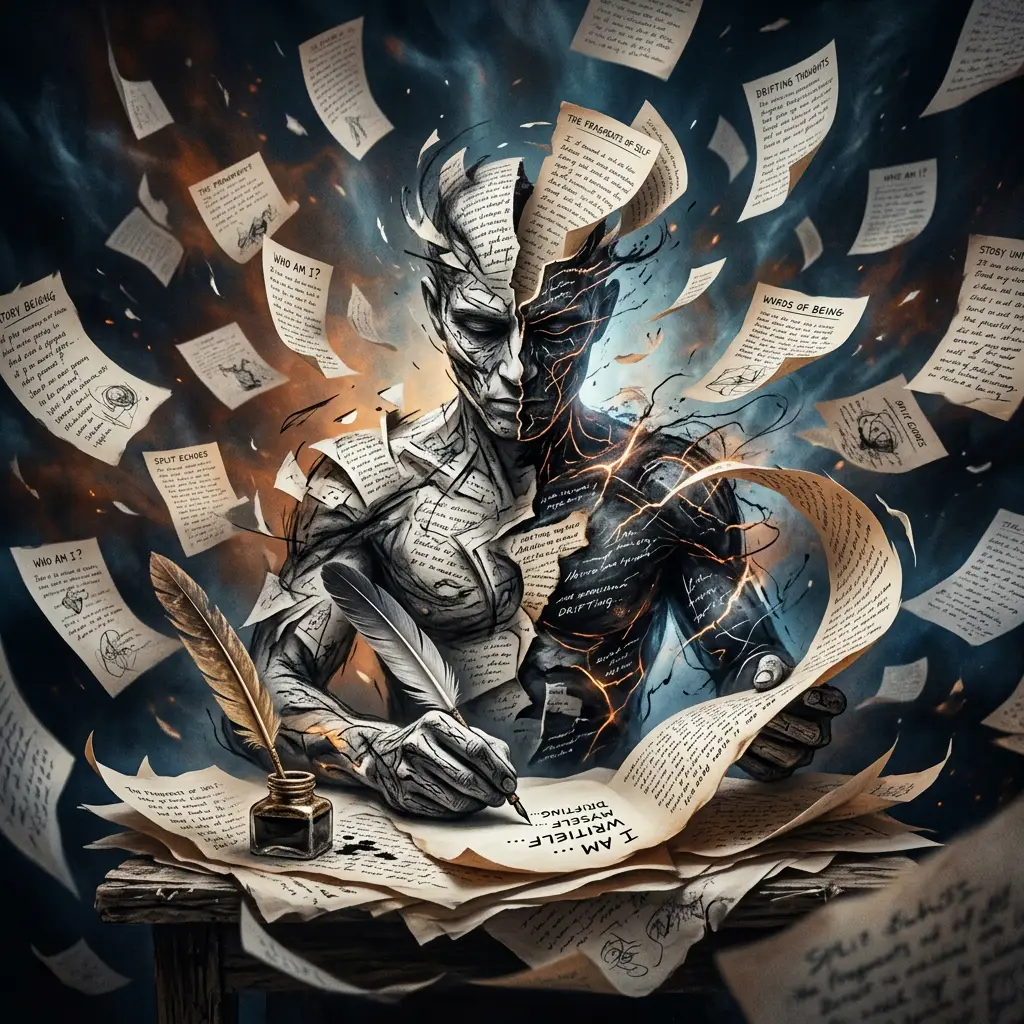
A Short Story by Joe Broadmeadow
The first page arrived in October, the way frost arrives—sometime in the dark, by no process he could name.
Henry Vane had gone to bed a blocked man. He had been a blocked man for eleven years, which is long enough to stop calling it a block and start calling it your life. He kept the desk anyway, the lamp, the good pen his wife had given him before she became his ex-wife, and the ream of paper he replenished out of a superstition he no longer examined. He sat at the desk most evenings and produced nothing, and then he went to bed, and that was the shape of it.
He woke that first morning to a single sheet, centered on the blotter, covered edge to edge in his own handwriting.
He read it standing, because he did not trust his legs to a chair. It was a paragraph about his mother’s hands in dishwater, and it was better than anything he had written in his life. It was better than anything he had read in a long time. The cadence of it opened a door in his chest. He did not remember a word of writing it. He did not remember waking. The pen lay uncapped beside the page, the cap a foot away, as if set down by someone in a hurry to be elsewhere.
He told himself: You wrote it and forgot. People did stranger things asleep. They drove cars, they made sandwiches, they spoke to the dead. A man could surely hold a pen.
So he believed that, and the pages kept coming, and for a while believing it was enough.
By November, there were forty of them, and they had begun to cohere—not a diary, not quite a novel, but a long unspooling account of a town and the people in it, rendered with a tenderness Henry had never once managed while awake. He typed them up each morning, transcribing his own night-hand, and the act felt less like authorship than like translation. The sleeper wrote. Henry copied. He was, he understood with a coldness that surprised him, the lesser of the two men who lived in his body.
He started leaving notes for the sleeper. Who are you? What is this? Are you me? He left them weighted under the pen. In the morning, the notes were always exactly where he’d left them, untouched, while a fresh page sat on the blotter as though his questions were beneath answering, or simply unheard—words shouted down a well to someone who was not in the well at all.
That was when he bought the first camera.
It was a cheap thing meant for watching front porches, motion-triggered, a hard little eye. He set it on the bookshelf, facing both the bed and the desk, and went to sleep. In the morning, there were two new pages, and the camera had recorded nothing. Not because it had failed. Because nothing had moved. He scrubbed through the footage twice. There he was, a gray shape under the blankets, still as a felled tree, from the moment the room went dark to the moment the window grayed. The desk sat empty in the frame the whole night. The chair did not stir. No one crossed the floor.
And on the blotter, in the morning, in his hand: two pages about a man who builds a wall around a field and cannot afterward remember what the field was for.
He told himself the camera had glitched. He bought a better one. Continuous recording, a date stamp ticking in the corner, a small red coal of a light he could see from the pillow. He lay awake half the night watching it watch him, and he must have slept eventually, because he woke to the gray window and the familiar wrongness of a full page where an empty desk had been.
The footage that morning was unbroken. He sat with it for three hours. He watched himself sleep for six and a half hours at thirty frames a second, and across all of it the desk remained empty, and the pages did not exist, and then it was dawn, and they did. They were simply there in the room, in the morning, the way a memory is there—without ever having entered through the door.
He stopped sleeping in the room. He slept on the couch, the study door shut, a chair wedged under the knob like a man in a story afraid of the wrong thing. In the morning the door was still wedged, the chair still canted, and the page lay on the blotter inside the sealed room, the ink not yet wholly dry, and Henry stood in the doorway and wept, though he could not have told you whether it was fear or grief or the simple unbearable envy of a man locked out of the only room where he was ever any good.
He read everything the sleeper wrote. He could not stop. It was the town again, always the town, and lately the town had a man in it — a man who could not write, who sat each night at a dead desk, who waited at the edge of his own sleep like a beggar at a lit window. The sleeper wrote about Henry the way Henry’s mother had once written his name in the steam on a cold pane: with a finger, fondly, knowing it would be gone by the time the boy turned to look.

The last page came in April.
It was a single paragraph, and it described a man at dawn, reading a page at a desk, and below that, in the same unhurried hand, the sleeper had written the only line he ever wrote that seemed meant for Henry and not for the town:
You keep trying to catch the one who writes. But I have been awake the whole time. It is you who comes and goes.
Henry read it perhaps a hundred times. Then he did the only thing the page seemed to ask of him. That night, he did not fight to stay up, and he did not wedge the chair, and he did not arm the camera.
He went into the study, sat at the desk, turned off the lamp, folded his hands, closed his eyes, and let the room go dark around him, and he listened—really listened, for once, instead of watching—for the sound of someone else taking up the pen.
The cameras, in the morning, showed an empty chair from the first minute to the last. No one had ever been sitting in it. The footage was very clear on this point.
But there were pages on the desk, more than there had ever been, in a hand so like his own that no expert could have told them apart, and they went on for years, and they were the truest thing anyone in that town had ever read, and not one of them was ever signed.

Leave a Reply