On a Universe That Needs No Maker
by Joe Broadmeadow
We remember Edgar Allen Poe for the tell-tale heart and the raven at the chamber door, not for cosmology.
Yet in 1848, a year before his death, he published a prose poem called Eureka in which he set out to explain nothing less than the beginning and the end of everything. It sold poorly. The counterintuitive nature and frequent clash with popular myths like religion do not lend science speculation to be embraced by the populace.
Even the scientists of his age ignored it, and the poets found it too much like a lecture. But buried in its strange, feverish pages is a sentence that reads today like a prophecy: “In the Original Unity of the First Thing lies the Secondary Cause of All Things, with the Germ of their Inevitable Annihilation.”
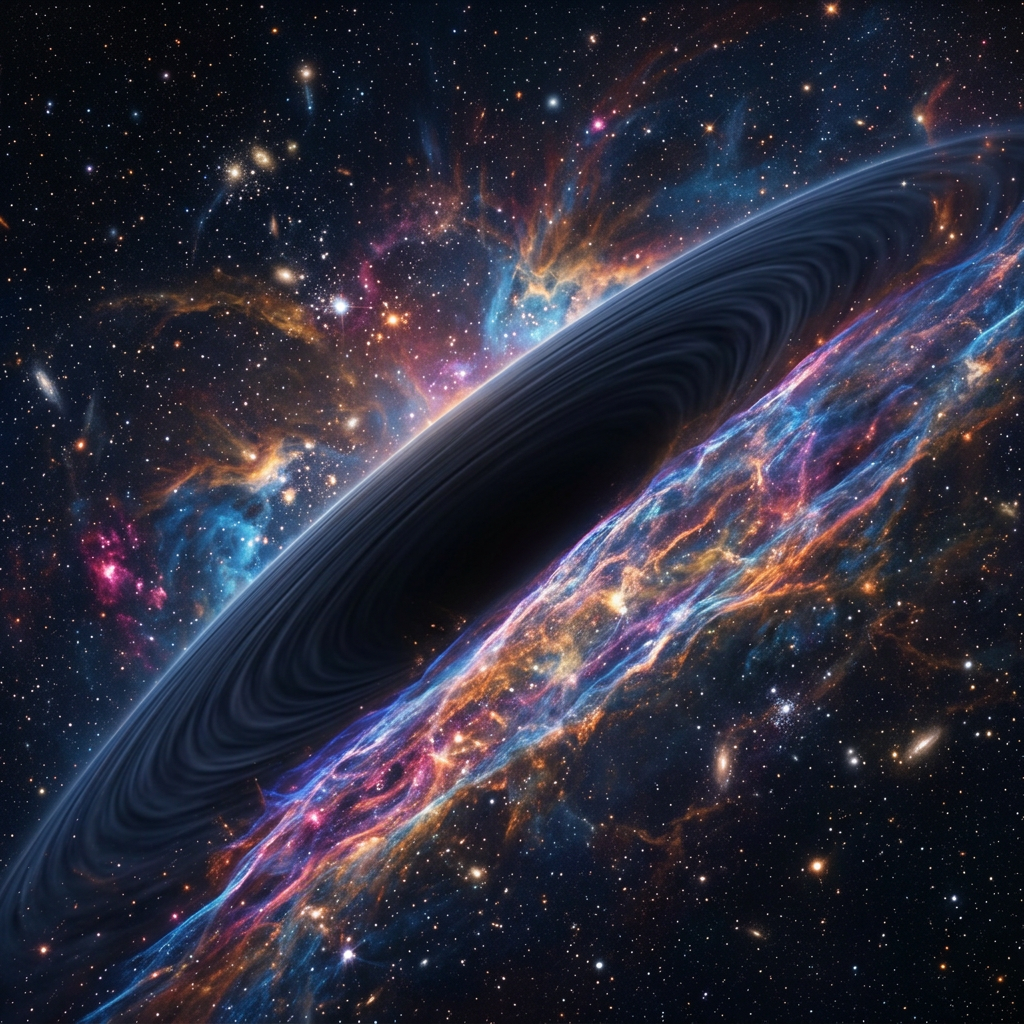
Poe had no telescope worth the name, no theory of relativity, no measurement of a receding galaxy. He reasoned by intuition and analogy toward a picture in which all matter began compressed into a single primordial particle, diffused outward, and the same gravity governing the diffusion would one day gather the scattered universe back into unity and dark.
He anticipated, by rough poetic instinct, both the Big Bang and the idea that a universe carries its ending inside its beginning. What took physics another century to formalize, Poe had already felt.
The sentence is worth pausing over, because it holds in compressed form the whole case for a self-sufficient cosmos. A universe that needs no God is not a universe emptied of wonder. It is a universe in which the wonder is internal, in which origin and destiny are written into the same fabric, and in which nothing outside the fabric is required to hold it together.
Begin with the harder question, the one theology has long claimed as its own: why is there something rather than nothing?
For most of history, the answer seemed obvious. Nothing does not make itself into something, so a maker must have lit the fuse. But that intuition rests on a picture of nothing borrowed from the kitchen and the countinghouse, an empty box waiting to be filled.
Physics has slowly dismantled the picture.
The nothing of the physicist is not a placid void. Quantum mechanics forbids perfect emptiness. Even a region scrubbed of every particle still seethes with fluctuation, with fields that cannot hold a value of exactly zero any more than a pendulum can hold perfectly still at the bottom of its arc.
Emptiness, it turns out, is unstable. It has structure, energy, and a tendency to give rise to things. In such a setting, the appearance of a universe is not a violation of natural order, but an expression of it.
There is a deeper move as well, and it belongs to the geometry of time.
In the no-boundary proposal advanced by James Hartle and Stephen Hawking, the question of what came before the beginning simply dissolves, because time itself is part of what begins.
To ask what preceded the first moment is like asking what lies south of the South Pole. The words form a grammatical sentence, but they point at nothing. A universe need not be started by an outside act if there is no before in which such an act could occur.
It can be finite in the past and yet have no edge; no first instant requires a cause.
None of this proves that no God exists. It shows something more modest and more useful: that existence does not require one. The laws themselves, the symmetries and the mathematics that describe a self-generating cosmos, do the work once assigned to a creator.
And those laws are not commandments issued by a lawgiver. They are the conditions under which anything can be consistent at all.
Return now to Poe’s germ of annihilation. If the origin needs no maker, the ending needs no destroyer. It is already implied.
The universe keeps books, and the ledger runs in one direction. Physicists call the quantity entropy, the measure of disorder, of energy spread thin and made unavailable for work. The second law of thermodynamics says that in a closed system entropy only rises.
This is the arrow of time, the reason a cup shatters but never reassembles, the reason we remember the past and not the future. And here is the quiet astonishment: the arrow points as it does only because the universe began in a state of extraordinarily low entropy, a condition of exquisite order and concentration. The very unity of the first thing, its smoothness and simplicity, is what lets everything afterward run downhill.
The ending was present at the beginning, not as a threat delivered from outside but as a consequence carried within. The universe expands, cools, and thins. Stars burn through their fuel and are not replaced. Galaxies drift beyond one another’s reach as the expansion accelerates. In the far future, the sky goes dark, matter itself may decay, and the cosmos settles toward a uniform, lukewarm stillness in which nothing further can happen.
Physicists call it heat death. It is not fire but the absence of any difference that could drive an event. Poe’s word for it was annihilation, and though the mechanism he imagined was collapse rather than dissipation, the poetry holds.
Unity gives rise to all things, and the character of that unity guarantees their undoing.
What, then, are we to make of a universe like this, one that lights itself and extinguishes itself and asks no permission from anything beyond?
The old fear is that such a universe must be cold, that meaning requires a mind behind the curtain, that without a maker our lives are accidents adrift in indifference. But fear confuses the source of meaning with its location.
Meaning is not something poured into the universe from outside. It is something that arises within it, late and local, in the brief interval when matter grows complex enough to know itself. We are the low-entropy order looking back at its own origin and forward to its own dissolution, and that we can do so at all is the most improbable thing the cosmos has produced.
Poe understood this too, in his way. Eureka ends not in despair but in a kind of ecstatic acceptance, a vision of the whole as a single beating process of expansion and return. He did not need a God to feel the sublime. He found it in the structure itself, in the terrible economy by which unity contains its own scattering and the scattering contains its own end.
A universe that requires no God for its existence loses nothing that was ever really there.
It keeps its beginning, its laws, its long unfolding, and its inevitable close. It keeps, above all, its capacity to be understood, which may be the only miracle it ever needed. In the original unity of the first thing lay the cause of all things and the germ of their annihilation.
Nothing else was necessary. Nothing else has ever been found.
Leave a Reply