The memory didn’t come back all at once. It came back the way ice breaks in March—a crack, then another, then the whole black river moving again.
Mara Doyle was thirty-one years old, standing in line at the Cumberland Farms on Route 114 in East Providence, holding a coffee and a scratch ticket she’d never bother to scratch, when she saw the back of a man’s neck and stopped breathing.
He was paying for gas. Heavyset, maybe sixty, wearing a Carhartt jacket the color of dried mustard. He had a tattoo at the base of his skull—a small anchor, faded blue-green, the kind merchant marines used to get in the eighties. He was saying something about his debit card not reading right, and the kid behind the counter was trying it again, and Mara’s vision went white at the edges.
She was six years old.
She was standing in the kitchen doorway in bare feet on a cold linoleum floor and her mother was at the sink and the man was behind her mother and then her mother wasn’t standing anymore.
That was all she’d ever had. That and the anchor.
Mara set the coffee down on a rack of beef jerky and walked out.
She sat in her car for eleven minutes. She knew it was eleven minutes because she watched the clock on her dash the same way she’d learned to watch everything—with the flat, cataloguing attention of someone who’d spent her whole life waiting to need the information. That was the job. She was a detective with the East Providence Police, Major Crimes. She was, by most accounts, very good at it.
She called her lieutenant, Frank Bellamy, on the drive back.
“I need you to run someone for me. Off-book for now. Anchor tattoo, base of skull. White male, late fifties to early sixties, heavyset. Was just at the Cumberland Farms on Newport Avenue, driving—she’d gotten the plate when she walked out, because that’s what she did, it was automatic, she couldn’t not—a 2018 Ram pickup, silver, RI plates, Yankee-Romeo-seven-four-four.”
“Mara,” Bellamy said.
“I know.”
“You okay?”
“Run the plate, Frank.”
He ran it. It took eight minutes.
Raymond Cull. Sixty-two years old. Address in Providence. Two priors—one for assault in 1987, charges dropped, and a receiving stolen property conviction in 1993, served nine months. No registered sex offenses. Currently employed, according to a quick pull on his business license, as the owner-operator of Cull Marine Services, a boat repair shop in Cranston.
Mara’s mother, Donna Polanski Doyle, had been found dead in their apartment in Warwick on November 9th, 1998. Blunt force trauma. The case had never been closed because it had never been solved. Mara had been taken by DCYF that same night and placed with her grandmother in Cumberland, and she’d grown up knowing only what she’d told the investigators at the time—which was nothing. She’d told them nothing because she’d had nothing. The sight of that kitchen, and the man’s back, and the anchor, and then she was standing outside the apartment building in the cold, and a neighbor was asking her what was wrong.
The therapists called it dissociative amnesia. Protective response. The mind choosing to go dark rather than hold something it couldn’t carry.
She called the Warwick Police Department and asked for the cold case unit. She knew the detective there, a guy named Serrano who’d pulled the Doyle file for her twice before, who understood what the case was and handled it with the particular quiet care that cops extend to other cops carrying something personal.
“I might have something,” she said. “Or I might have nothing. I need to look at the old file again. Physical evidence log.”
“I’ll pull it,” Serrano said. “Come by this afternoon.”
She drove to boatyard instead. She told herself she was just going to look.
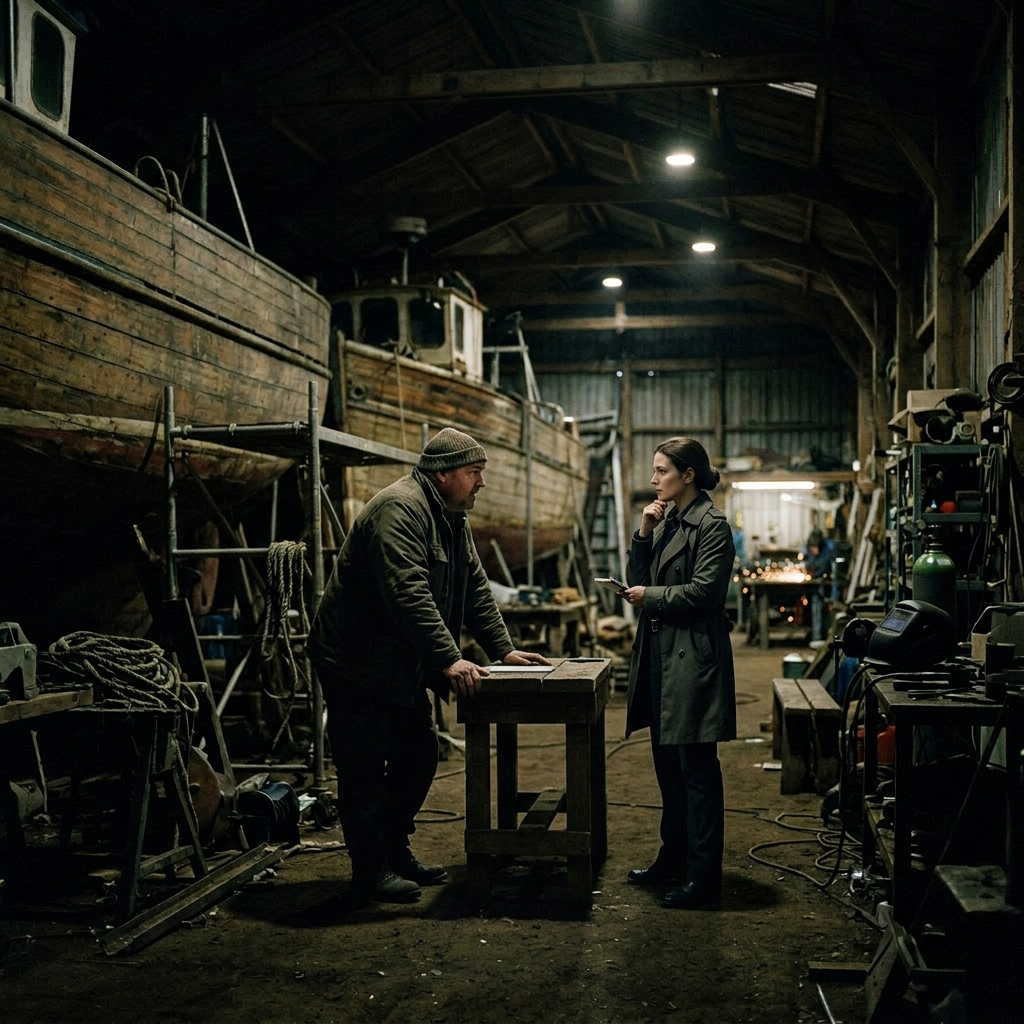
Cull Marine Services was a metal building at the end of a gravel lot, set back from the water, with two boats on trailers in the yard and the smell of fiberglass resin hanging in the cold air. Mara parked across the road and sat. The silver Ram was parked beside the building.
She thought about her mother. Donna Doyle had been twenty-eight years old when she died. Younger than Mara was now. She’d worked the lunch counter at a diner on Western Avenue and she’d had a laugh you could hear from the parking lot and she’d been, by the account of everyone who’d known her, a person who trusted too much and too fast and who needed that quality explained to her the hard way more than once.
The anchor.
Mara’s grandmother had told her once that Donna had dated a guy from the waterfront before she met Mara’s father. That was as much as she knew, or as much as she’d said.
She got out of the car.
She’d tell you later, if you asked her, that she was just going to ask questions. Get a name, get confirmation, bring it back to Serrano with something solid. She wasn’t going there as the daughter. She was going there as a detective.
She was lying to herself, and she knew it even then.
Cull was in the back of the shop running a grinder over a hull seam. He cut the tool when he saw her standing in the doorway. He was bigger than she’d registered at Cumberland Farms. Thick through the chest, gray-bristled, with red-rimmed eyes and a wide flat nose that had been broken at some point and set crooked.
“Help you?” he said.
She showed her badge. “Detective Doyle, East Providence Police. Mind if I ask you a few questions?”
Something moved behind his eyes. Most people, when they see a badge, their faces do a specific thing—a micro-flinch, a recalibration, the social performance of a citizen who has nothing to hide and wants to demonstrate it. Cull’s face did something different. It went still in a way that looked like practice.
“About what?” he said.
“Donna Doyle. Warwick, 1998.”
He set the grinder down on the hull. Slowly. Thinking. “I don’t know what you’re talking about.”
“That’s interesting,” Mara said. “Because I think you do.”
She kept her voice flat. She’d interviewed two hundred people in rooms, and she knew what she was doing. How to keep the temperature low, how to let silence do the work. But she was also standing in a metal building in Cranston with a man she was now certain had killed her mother, and she was doing the math on the evidence—the thirty-year-old case, the dropped assault charge, the absence of DNA evidence in the file because Serrano had mentioned the evidence kit had been lost in a storage facility flood in 2004—and she understood with cold, clear certainty that what she had right now was nothing. A tattoo. A memory from a six-year-old.
Cull looked at her for a long time. Then he said, “You’re the kid.”
It wasn’t a question.
“I’m a detective,” Mara said. “With the East Providence Police Department.”
“You’re the kid,” he said again. And the way he said it was not guilty, exactly—it was something more complicated than guilt. It was something that had been sitting in him for twenty-five years and had finally found the door.
She didn’t reach for her weapon. She didn’t need to. He wasn’t going to run, she could see that. Whatever he’d been doing for twenty-five years, it hadn’t been running.
“I need you to come with me,” she said.
“You don’t have anything,” he said. “Do you.”
“I have more than you think.” Which was technically true, because she now had him on record admitting he knew who she was.
He sat down on a work stool and put his big hands on his knees and looked at the floor of his shop for a long time.
“It wasn’t supposed to happen,” he said. It was the most predictable sentence she’d ever heard, and also the one she’d waited thirty-one years to hear. “We were fighting. She was going to—there was some money. It was stupid. It got stupid.”
“Stop,” Mara said. She pulled out her phone and hit record and identified herself and the date and the location. Her voice was steady. She was proud of that, later. “Now. You were saying.”
He said it again. He said more than that. He talked for twenty minutes, sitting on his stool in his boat shop in Cranston, the cold air moving through the open bay door, while Mara stood with her back against the wall and her hand near her hip and recorded every word. He talked like a man who had wanted to stop carrying something for a very long time and had finally been given permission.
She arrested him at the end of it. Walked him out to her car and put him in the back.
On the drive to Warwick PD, she didn’t think about her mother. She thought about the case—what the confession would and wouldn’t do, how to bring Serrano in immediately, and whether there were any physical evidence avenues left. She thought about chain of custody for the recording. She thought about the assistant AG she trusted most in the office.
She was very good at this.
She allowed herself, once, at a red light, to put her hand flat against her chest and feel her own heart beating.
Then the light changed, and she drove.

Leave a Reply