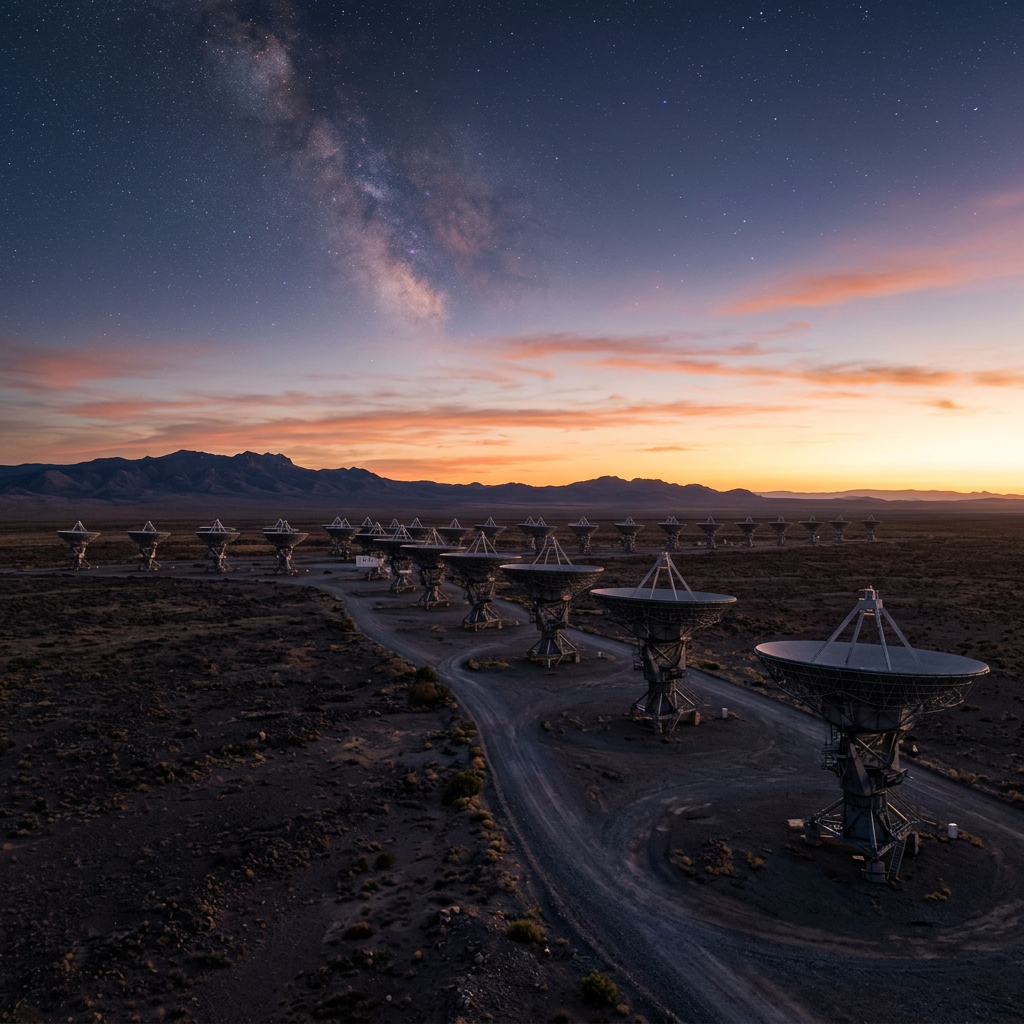
The signal arrived on a Tuesday, which seemed wrong in ways Mara Voss could not explain. Important things, she had always believed, should announce themselves with some gravitational ceremony—a Sunday, perhaps, or a storm. Not a Tuesday in February with a pot of burnt coffee going cold on the desk beside her.
She had been working the overnight shift at the Allen Telescope Array for eleven months. The work was largely maintenance: she monitored the 42-dish array’s automated pipelines, flagged interference from terrestrial sources—aircraft, satellites, the odd rogue microwave oven—and filed incident reports that nobody read. The array ran on automation, the way most things do now, which is to say it technically ran but without conviction. Mara was the conviction. She arrived at midnight and left at eight. In between, she watched the data streams the way a night watchman watches a dark parking lot: not expecting anything, but unable to stop looking.
The signal was in the 1,420-megahertz band—the hydrogen line, the frequency that physicists had long theorized any technologically sophisticated species would know to use, the way a universal address would work if the universe had a postal system. Every SETI researcher in the world knew this frequency the way a priest knows a particular passage of scripture: by heart, with a mixture of hope and exhaustion.
What caught her eye was not the frequency itself. It was the structure.
Natural hydrogen emission was broadband and diffuse, the universal cosmic static. What Mara saw in the pipeline output at 2:14 a.m. was a narrow-band transmission with a Doppler drift consistent with a source that was neither rotating with the Earth nor orbiting with a known satellite. She sat with this for a long time. The coffee went entirely cold. Outside, the California high desert was doing what it always did at 2 a.m. in February: nothing, slowly, under an extravagant number of stars.
She ran the interference checklist. She had written the interference checklist herself, adapted from the SETI Institute’s protocol documentation, and she knew it as well as she knew her own handwriting. An hour later, she had eliminated terrestrial sources, eliminated known orbiting hardware, and eliminated the three categories of natural astrophysical phenomena that could produce narrow-band emission in this range. She was left with a signal having no business existing, arriving from a point in Cassiopeia at a bearing she would later calculate corresponded to a star called HD 10307—a G-type main-sequence star 58 light-years distant, so similar to the Sun that astronomers sometimes called it the Sun’s twin.
She did not call anyone. This was not timidity. It was precision. She understood, in a way that most people who romanticize discovery do not, that the moment you speak a thing aloud, it becomes subject to other people’s needs. The department chair’s need to manage institutional exposure. The press office’s need for messaging. The funding committee’s need for a narrative that fits the grant cycle. She had watched a colleague spend three years trying to publish a result that threatened a senior researcher’s theoretical framework, and she had learned from it the way you learn from watching someone else touch a hot stove.
She recorded everything. She cross-correlated the signal against the array’s full antenna baseline to confirm it was not an artifact of a single dish. She calculated the signal-to-noise ratio—22 to 1, sharp enough to cut. She noted that the signal was not a simple carrier wave but contained what appeared to be internal modulation: not Morse, not binary pulses, not any encoding scheme she recognized, but a pattern with statistical properties inconsistent with noise. Something was varying the signal’s amplitude in a way that repeated approximately every 73 seconds, with internal variations she could not parse.
At 5 a.m., she opened a text message to Dr. Elliott Soane, her department director. She stared at it for twenty minutes before closing it. She thought about what she wanted to say, finding that the language had temporarily failed her—not the technical language, which was fine, precise, and available, but the human language. The language for what this was.
She stepped outside. The desert began its pale, slow surrender to morning. She could see the array’s dishes tilted against the lightening sky, 42 parabolic ears all pointed at the same patch of darkness, and she thought about the fact that photons currently activating the array’s receivers had left their source 58 years ago, in 1968. The year her mother was born. Some process—some mechanism she could not name, could not characterize—had sent something into the universe 58 years before Mara Voss existed. It had crossed the void between stars and arrived, specifically, in the frequency band humans identified as the universal frequency of hello, and had been captured by instruments that humans had built for exactly this purpose. She was the only one who knew.
At 34, Mara had a master’s degree in radio astronomy, a failed marriage, a cat named Kepler, and a mortgage she was mostly keeping up with. She had not, until this moment, thought of herself as a person to whom significant things happened.
She went back inside and sent the message to Soane.
He called her at 5:47 a.m., voice roughened by sleep, and she walked him through the data. She heard him grow quiet, the way scientists do when they run the checklist in their minds, eliminating alternatives. When she finished, he said, “You’ve held this for three hours.”
“I wanted to be sure.”
“Are you sure?”
She looked at the screen. The signal had continued uninterrupted for three hours and eleven minutes. “I’m sure the data is what the data is,” she said. “I’m not sure what the data is.”
He told her to document everything, change nothing, and tell no one. She had already done the first two. The third felt like something she could technically comply with while being completely unable to achieve it. She was already someone who knew. That fact had no protocol.
Soane arrived at seven-thirty with Dr. Patricia Muñoz from Berkeley, who had driven through the night. They crowded around her workstation and remained silent for a long time. Muñoz asked three questions—all technical, all sharp—and she answered them. Soane stared at the screen the way people stare at accidents. He was 61 years old. He had been working in SETI-adjacent research for 30 years. He looked, Mara thought, like a man who had just been told that everything he had spent his life believing might be true.
“We need to verify with a second instrument,” Muñoz said.
“Parkes is the obvious call.”
“Don’t do that yet. We need the briefing packet first.”
They went on like this for twenty minutes, two intelligent people managing their own fear by converting it into logistics. Mara sat in the corner watching them and understood that this was how the world actually worked: discovery happened in solitude, at 2 a.m., with cold coffee, and then immediately became an institutional problem.
The signal persisted for six hours and forty-two minutes before it stopped. It did not fade or degrade. It simply ceased, the way a held note ceases when the player finally breathes. In its absence, the frequency sounded through the audio converter Mara kept on, out of professional habit, like a long exhale.
By the afternoon, they had confirmations from Green Bank and Parkes. Things kicked into high gear. The briefing chain went up to NSF. There were calls made that didn’t include Mara. There were documents she was asked to sign. Soane told her, with genuine kindness, that the next several months would be difficult and that she should prepare herself, though he was unable to specify what he meant by ‘prepare’ or what exactly she was preparing for, because none of them knew.
She drove home in the late afternoon light. The desert was orange and very still. She thought about the 73-second cycle in the signal’s modulation—the thing she had not been able to characterize—and how it had not yet appeared in any of the briefing documents, because the briefing documents were concerned with the signal’s existence, its frequency, its source coordinates, its verifiability. No one had yet gotten to what it meant. It might have meant nothing in human terms. This was fine. This was completely fine, she told herself, and turned up the radio.
That night, she could not sleep. She lay in the dark and listened to Kepler purring at the foot of the bed and thought about a question she had not been able to frame properly yet, one that kept circling back to the same incomplete formulation: if something is trying to say something, and you can hear it, but you cannot understand it, which one of you is alone?
She did not know. She suspected no one did. She suspected this was the condition she would now live inside of, not for days or years but permanently, the way you live inside a language you are only beginning to learn—able to hear the difference between sounds but not yet what the sounds are reaching for, standing at the edge of something that has no floor you can see, that may have no floor at all.
The answer, if there was one, was 58 years away.
She closed her eyes. Kepler shifted. Outside, somewhere in the dark above the desert, 42 dishes turned slowly on their mounts, listening.

Leave a Reply